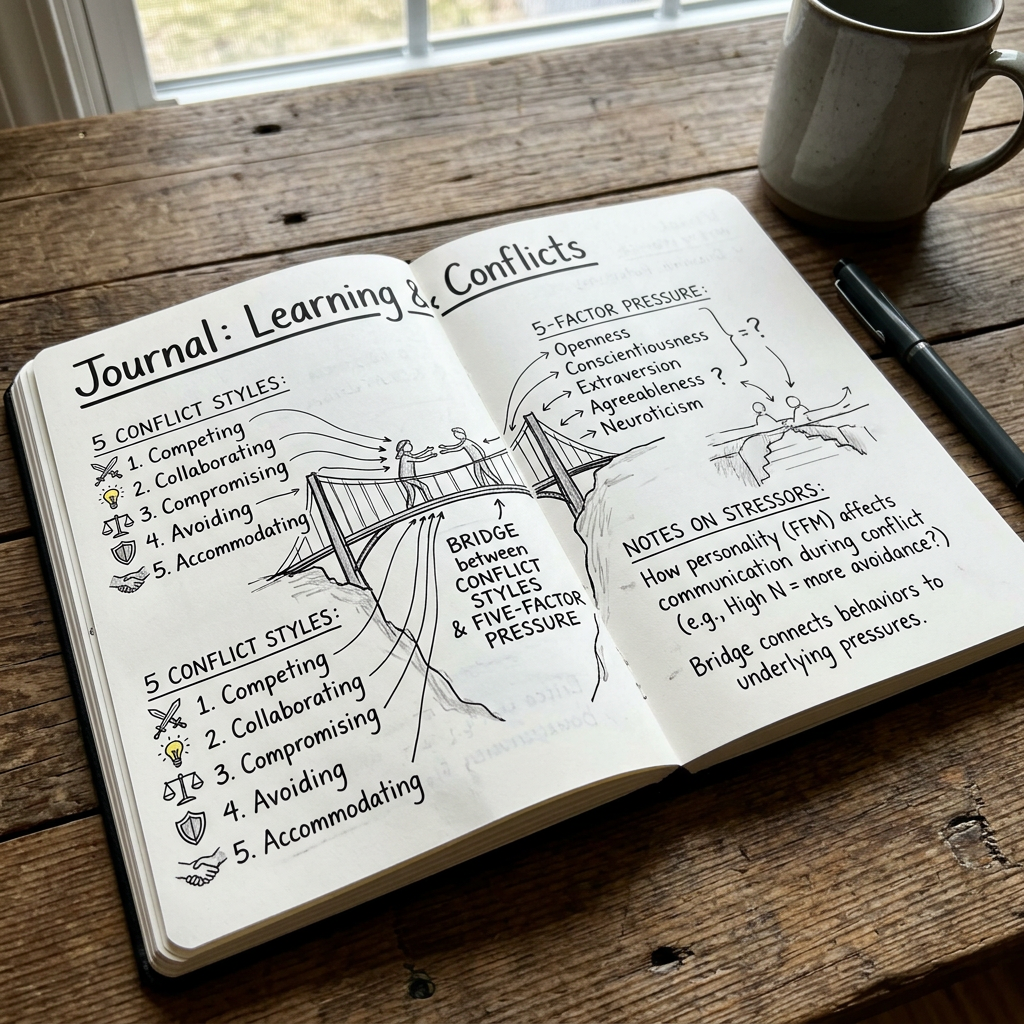

One of the useful things about moving from Communication and Conflict Management into Organizational Behaviour is that the two courses do not really sit in separate rooms.
They talk to each other.
Communication and Conflict Management asks what happens when people disagree, avoid, accommodate, compete, compromise, or collaborate. Organizational Behaviour asks how personality, motivation, perception, culture, team design, values, and systems shape what people do at work.
Put together, they raise a stronger question:
What happens when personality meets pressure?
That question matters for Standing on the Ledge because collapse is rarely caused by one bad conversation or one difficult personality. More often, collapse happens when people, roles, expectations, communication patterns, and systems begin to misalign.
By the time the visible conflict appears, the deeper pressure may have been building for a long time.
Conflict Style Is Not the Whole Person
In Communication and Conflict Management, conflict styles are often described through patterns such as avoiding, accommodating, competing, compromising, and collaborating.
These styles are useful because they give language to behaviour under pressure. Some people pull back. Some people push forward. Some try to preserve harmony. Some search for shared solutions. Some split the difference and move on.
But a conflict style is not the whole person.
A person who avoids a conversation may not be careless. They may be trying to regulate stress, gather information, prevent escalation, or survive an unsafe power dynamic.
A person who accommodates may not be weak. They may value peace, cooperation, loyalty, or stability. The problem begins when accommodation becomes the default response to unclear expectations or unfair responsibility.
A person who competes may not simply be aggressive. They may see a boundary, standard, or urgent risk that others are avoiding.
A person who compromises may be trying to keep movement alive when perfect agreement is not possible.
A person who collaborates may be looking for the deeper repair: not just “How do we end this argument?” but “How do we make the system workable again?”
That is where Organizational Behaviour adds another layer.
The Five-Factor Model Adds the Personality Lens
The Five-Factor Model of personality looks at five broad traits: openness to experience, conscientiousness, agreeableness, neuroticism or emotional stability, and extraversion.
These traits do not predict every behaviour perfectly, and they should not be treated like a box someone is trapped inside. Still, they can help explain why people respond differently to work, stress, uncertainty, leadership, change, and conflict.
Someone high in openness may be curious, imaginative, and adaptive. They may see patterns others miss. They may also become overloaded by too many possibilities.
Someone high in conscientiousness may be organized, dependable, and goal-focused. They may take obligations seriously. Under pressure, though, conscientiousness can become over-responsibility, especially when the person is held accountable without enough authority or support.
Someone high in agreeableness may be cooperative, compassionate, and team-oriented. That can improve trust and knowledge sharing. But if agreeableness becomes excessive accommodation, the person may carry too much for too long.
Someone high in neuroticism, or lower in emotional stability, may detect threats quickly and experience higher stress under uncertainty. This can create difficulty with change, but it can also make the person sensitive to early warning signs that others ignore.
Someone high in extraversion may be more comfortable speaking, influencing, leading, or asserting ideas in social settings. But extraversion is not the same as communication skill. A quieter person may still communicate powerfully when the conversation has purpose and structure.
Where the Two Models Meet
The conflict-style model looks at how people behave in disagreement.
The Five-Factor Model looks at broader personality tendencies.
Together, they suggest that conflict is not just about the conflict itself. It is also about the person’s habits, stress response, motivation, and work environment.
For example, a highly conscientious person may try to solve the problem by working harder. If the system is unclear, that effort may only hide the dysfunction for a while.
A highly agreeable person may preserve peace by not naming the problem directly. That can help in the short term but may allow resentment or confusion to grow.
A highly open person may keep analyzing the situation, searching for the larger pattern. That can produce insight, but it can also delay the clean ask.
A highly threat-sensitive person may notice danger early, but without structure, that signal can turn into rumination.
A selectively expressive person may not speak constantly, but when they do speak, they may need the conversation to matter.
This is where conflict management becomes more than technique.
It becomes self-management, role clarity, communication design, and system repair.
The Workplace Problem: Responsibility Without Authority
One of the recurring Standing on the Ledge themes is the trap of responsibility without authority.
This happens when a person is expected to produce outcomes but does not have the power, information, resources, or support needed to produce them.
Personality can make this trap worse.
A conscientious person may keep trying harder.
An agreeable person may avoid pushing back.
An open person may keep looking for a better explanation.
A threat-sensitive person may feel the danger before they can prove it.
A collaborative person may keep trying to repair the relationship even when the structure itself is broken.
That is how a workplace issue can become a personal burden.
The individual starts carrying what the system refuses to clarify.
Conflict Under Load
Under normal conditions, many people can communicate fairly well. The real test comes under load.
Pressure changes communication.
People become shorter, quieter, sharper, more defensive, more avoidant, or more controlling. Teams that seemed healthy can reveal hidden weaknesses. Roles that seemed clear can become muddy. Values that looked good on paper can disappear when money, deadlines, reputation, or power are involved.
This is why Standing on the Ledge keeps returning to communication under load.
The issue is not just whether people can talk.
The issue is whether the communication system still works when the stakes rise.
Can people ask clean questions?
Can they name unclear expectations?
Can they separate evidence from blame?
Can they identify who has authority?
Can they set boundaries before resentment builds?
Can they pause without disappearing?
Can they collaborate without over-carrying?
A Useful Bridge
The bridge between Communication and Conflict Management and Organizational Behaviour is this:
Conflict is not only interpersonal. It is also organizational.
Yes, people bring personality traits into the workplace. They bring habits, fears, strengths, weaknesses, communication patterns, and conflict styles.
But organizations also create conditions.
They create role clarity or role confusion.
They create healthy communication channels or silence.
They create fair responsibility or impossible accountability.
They create trust or suspicion.
They create recovery space or burnout.
They create values that are lived or values that are only printed.
So when conflict happens, the better question is not simply, “What is wrong with this person?”
The better question is:
What pattern is this behaviour responding to?
The Standing on the Ledge Takeaway
For Standing on the Ledge, this bridge matters because collapse recovery requires more than motivation.
It requires pattern recognition.
It requires knowing the difference between a personality issue, a communication issue, a role issue, and a system issue.
It requires knowing when to collaborate, when to compromise, when to pause, when to document, when to ask directly, and when to set a boundary.
Personality models can help, but they should not become excuses.
Conflict-style models can help, but they should not become labels.
The real value is practical:
Notice the pattern. Name the pressure. Clarify the role. Make the clean ask. Set the boundary. Take the next step.
That is the bridge.
From communication theory to organizational behaviour.
From personality to pressure.
From conflict to structure.
From reaction to agency.
Godspeed.
Discover more from Standing on the Ledge
Subscribe to get the latest posts sent to your email.

