
Effective Communication Is More Than Sending a Message
This week’s Organizational Behaviour reading focused on communication, and the more I worked through it, the more I realized that communication is not simply “person A sends a message and person B receives it.”
That is the simple version.
The real version is messier.
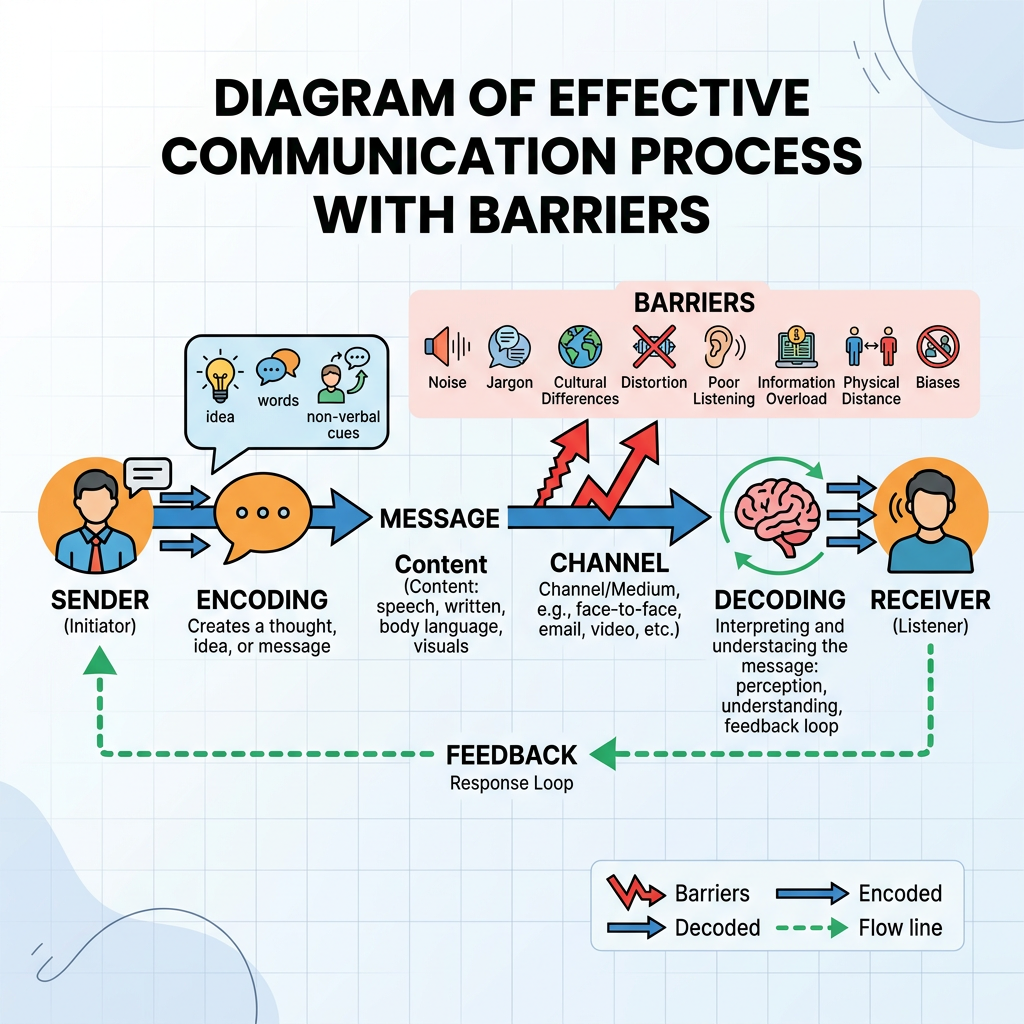
Effective communication happens when the receiver accurately deciphers the sender’s message. That sounds basic, but in practice it depends on several moving parts working at the same time. The sender has to encode the message clearly. The receiver has to decode it accurately. The communication channel has to fit the message. The context has to support understanding. Both people need enough motivation, ability, role clarity, and situational support to actually make the exchange work.
That connects directly to the MARS model: motivation, ability, role perceptions, and situational factors. Communication is not separate from these things. It runs through them.
A person may have the ability to communicate but not the motivation. A person may be motivated but not understand their role. A person may understand the message but lack the situational support to act on it. This is where communication becomes more than a soft skill. It becomes part of the operating system of the organization.
Organizations are groups of people who work interdependently toward some purpose. They come into being when people are able to communicate with each other. That means communication is not just something that happens inside an organization. Communication is one of the things that makes an organization possible in the first place.
Communication is vital for decision-making. It helps change behaviour. It coordinates work. It supports employee well-being. A workplace cannot make good decisions if people are not receiving, understanding, and acting on the same information.
One point that stood out to me is that communication is not a free-flowing conduit. Meaning does not simply travel cleanly from one person to another. The transmission of meaning from person A to person B can be interrupted by noise. That noise can be psychological, sociological, structural, emotional, cultural, generational, or language-based. These barriers can distort or obscure the sender’s intended message.
When part of the message is distorted or broken, the sender and receiver may not actually share the same understanding. They may think they are talking about the same thing while holding two very different versions of the message in their minds.
That is where conflict often starts.
Not always because someone is evil. Not always because someone is lazy. Not always because someone is trying to cause a problem.
Sometimes the message failed.
Sometimes the channel failed.
Sometimes the timing failed.
Sometimes the relationship failed before the words even arrived.
Encoding, Decoding, and Shared Meaning
According to the communication process model, effective communication depends on both the sender’s and receiver’s ability, motivation, role clarity, and situational support. The sender has to encode the message, and the receiver has to decode it. But that process depends on more than vocabulary.
Four things stood out to me.
First, the sender and receiver need similar “code books.” They need some shared understanding of symbols, words, gestures, tone, expectations, and context. If two people attach different meanings to the same words or signals, misunderstanding becomes more likely.
Second, frequency and practice matter. Over time, a sender may become more proficient because they learn which words, examples, symbols, formats, or gestures work best to transmit their message. Communication improves with repetition and feedback. It is a skill, not magic.
Third, skill and motivation matter. Encoding and decoding work better when both people are proficient with the communication channel and motivated to use it properly. However, even when people have the skill, communication can still fail if the motivation is missing. The topic, a person’s mood, stress level, fatigue, personal history, or attitude toward the other person can all affect whether the message is received accurately.
Fourth, shared mental models help communication. Two people who have worked in similar environments may be able to discuss a problem more efficiently than someone who has never experienced that setting. They can picture the situation more easily because they have some experiential knowledge of what the other person means.
This matters in real workplaces.
A supervisor who has never done the front-line work may not understand what an employee means when they describe a “small problem” that actually signals a larger breakdown. A worker who has never seen the budgeting side may not understand why management is focused on timing, costs, or liability. Neither side necessarily has the full picture.
That is why effective communication requires more than speaking clearly. It requires building enough shared context that the message has somewhere to land.
Generational Communication Challenges
This week also brought up communication challenges across generations.
To me, this is a no-brainer. This is always a problem, and it is not really anything new. Each generation develops different communication styles because of changing life circumstances, current technology, and preferences shaped by that evolution.
The true challenge is finding common ground: a communication system that works well enough for everyone involved.
That does not mean every person will prefer the same channel or style. They will not. Some people prefer face-to-face conversations. Some prefer email because it creates a written record. Some prefer text or instant messaging because it is fast and informal. Some want a phone call. Some hate phone calls. Some see emojis as helpful emotional context. Others see them as unprofessional or unclear.
The challenge for organizations is not to force everyone into one communication style. The challenge is to create enough shared expectations that communication does not become a guessing game.
Generational communication differences are often blamed on age, but I think that is too simple. Age matters, yes. But technology, work history, industry, education, class background, role expectations, and personal experience also matter.
A person who grew up with handwritten memos may process written communication differently than someone who grew up with instant messaging. A person who spent years in high-pressure operational work may prefer direct communication. A person who has worked in a conflict-heavy environment may read neutral messages as threats because that is what experience has trained them to watch for.
This is where organizational behaviour becomes useful. It helps us avoid reducing communication breakdowns to personality flaws. Instead, we can ask better questions.
- Are people using the same code book?
- Are they using the right channel?
- Are they motivated to understand each other?
- Do they share enough context?
- Does the organization support clear communication, or does it create noise?
Channels of Communication
A central feature of the communication process model is the medium through which information is transmitted. Communication channels can generally be divided into two types: verbal and nonverbal.
Verbal communication uses words, whether spoken or written. Spoken communication, especially face-to-face communication, tends to be stronger than written communication for transmitting emotions and persuading the receiver. One reason is that spoken communication carries nonverbal components such as tone, gestures, cadence, facial expression, and real-time adjustment.
In face-to-face communication, the sender can not only convey the message, but also watch how the receiver responds and adjust accordingly. If the other person looks confused, hurt, defensive, or disengaged, the sender can slow down, rephrase, soften, clarify, or ask a question.
That is much harder to do in memos or emails.
Written communication has strengths. It creates a record. It allows people time to think. It can reduce emotional escalation if handled carefully. It can provide consistency when the same message needs to reach many people.
But written communication also strips away tone, facial expression, body language, and immediate feedback. That makes it easier for people to misread intent.
Text chats and instant messaging sit somewhere in between. They are written, but they move quickly. Emojis, punctuation, GIFs, short replies, and reaction buttons can create emotional signals that old workplace memos never had. But this only works if both parties share the same understanding of those signals.
That brings me to emojis.
Emojis and the Question of Nonverbal Communication
The nonverbal channel includes communication that does not rely on words. This can include facial expression, tone of voice, personal distance, body language, gestures, posture, images, diagrams, and other wordless documents.
But where do emojis fit?
That is an interesting point to ponder.
Emojis do not use spoken or written words in the traditional sense. At the same time, many emojis now carry a fairly standardized emotional meaning. They can soften a message, show humour, signal frustration, indicate support, or reduce the harshness of short written replies.
In many ways, emojis have evolved into something close to a language of their own.
But this may also be part of the generational challenge in communication. One group may see emojis as normal emotional context in a message. Another group may see them as informal, unclear, childish, passive-aggressive, or unprofessional. The symbol may be the same, but the meaning may not be shared.
That connects directly back to similar code books and shared mental models. Communication works better when people understand not only what is being said, but also the symbols, tone, assumptions, and context behind the message.
If the code book is not shared, even a smiley face can become noise.
Communication Styles and Workplace Relationships
The Forbes articles connected well with this section because they point to something practical: people do not all communicate the same way, and mismatched communication styles can damage working relationships.
Mark Murphy’s work on communication styles identifies four broad styles: analytical, intuitive, functional, and personal. None of these styles is automatically better than the others, but they can clash when people do not recognize what the other person needs from a message. A Forbes summary of Murphy’s work notes that boss-employee communication style mismatches can reduce engagement.
That makes sense.
An analytical communicator may want facts, data, and precision. An intuitive communicator may want the point quickly without too much detail. A functional communicator may want process, sequence, and steps. A personal communicator may want relational context, emotional tone, and connection.
If those people are forced to communicate without awareness, the problems write themselves.
The analytical person may see the personal communicator as vague.
The personal communicator may see the analytical person as cold.
The intuitive communicator may get impatient with the functional communicator’s details.
The functional communicator may see the intuitive communicator as careless or reckless.
Again, the problem is not always that someone is bad at communication. Sometimes the problem is that people are communicating from different assumptions about what a good message should look like.
This also connects to the article on millennial communication preferences. Millennials grew up alongside texting, instant messaging, email, and digital communication, so it makes sense that written and fast-moving communication channels would shape workplace preferences. But this should not be treated as a lazy stereotype. It is better understood as part of the larger issue: people’s communication preferences are shaped by the tools, norms, and environments they were trained in.
The organizational challenge is not to mock one group or romanticize another. The challenge is to build a communication system flexible enough to handle difference.
The Johari Window and Disclosure
Another concept that fits this week is the Johari Window.
The Johari Window focuses on self-awareness and mutual understanding by comparing what is known to the self with what is known to others. It is often used to improve communication, feedback, and trust within groups.
This matters because many workplace communication problems come from hidden assumptions and blind spots.
There are things I know about myself that others may not know.
There are things others see in me that I may not recognize.
There are things everyone knows.
And there are things nobody fully understands yet.
In a team, the Johari Window encourages disclosure and feedback. That does not mean everyone has to share everything. Workplace communication still needs boundaries and privacy. But it does mean that teams work better when people are not operating under a cloud of unknown beliefs, hidden fears, unspoken expectations, or invisible values.
For example, if a supervisor values directness but never says so, employees may experience their tone as harsh. If an employee values detailed written instructions but never asks for them, the supervisor may assume verbal direction is enough. If a team has unresolved conflict but nobody names it, every message may be filtered through suspicion.
The Johari Window helps explain why feedback matters. Feedback can shrink blind spots. Appropriate disclosure can reduce hidden areas. Both can increase the open area where trust and shared understanding live.
That connects back to effective communication: the goal is not merely to send information. The goal is to create shared meaning.
Mass Communication and Privacy
There are times when communication can be shared with a stakeholder group through a mass distribution method. This can be efficient, especially when everyone needs to receive the same message at the same time.
A memo, email, announcement, policy update, or digital post can make sure that everyone technically “hears” the same thing.
However, the likelihood that everyone reads, receives, processes, accepts, and interprets that message in exactly the way intended by the sender is slim to none.
This matters because mass communication can create the illusion of consensus.
Just because a message was sent does not mean it was understood.
Just because it was received does not mean it was accepted.
Just because it was opened does not mean it changed behaviour.
This connects back to noise. A message may be sent once, but it is received through many different filters: experience, mood, role, status, workload, generation, culture, personal history, and trust.
There is also a growing emphasis on privacy in the workplace. This can run counter to mass communication methods used in email, social media-style workplace platforms, and other digital media. Organizations want efficiency, but employees also expect boundaries, confidentiality, and appropriate handling of personal information.
That creates tension.
A message sent to everyone may be efficient, but not personal.
A private conversation may be respectful, but not scalable.
An open announcement may build transparency, but if handled poorly, it can create fear.
This is why leaders need judgment. Communication is not only about choosing a channel. It is about understanding what the message does to the people receiving it.
Communication and the Human Senses
Another idea that stood out to me is that communication involves more than words. The five senses of the human body all feed into communication in order to create a fuller understanding.
This does not mean that all communication can literally be smelled or tasted. But organizational behaviour can be better understood when we remember that people process communication through their bodies as well as their minds.
People notice tone.
They notice volume.
They notice facial expression.
They notice posture.
They notice physical distance.
They notice the room.
They notice whether the conversation feels rushed, safe, tense, dismissive, or respectful.
A message said calmly in a private room may land differently than the same message delivered sharply in a hallway. A difficult announcement made face-to-face may carry more care than the same message sent in a cold email. A diagram may clarify what paragraphs cannot. A quiet tone may reduce defensiveness. A harsh tone may turn even a reasonable message into a threat.
This sensory approach combines with awareness of individual beliefs, self-worth, scope of control, and the ability of an individual to separate personal beliefs from the core beliefs of the organization.
That separation is important.
Employees are not machines. They bring their own values, beliefs, histories, triggers, loyalties, fears, and hopes into the workplace. At the same time, organizations have their own stated values, goals, and expectations.
Effective communication has to recognize where those overlap, where they conflict, and where people need clarity.
Understanding People Is Not Automatic
Understanding your people is something leaders and organizational supervisors often say they value.
Unfortunately, many seem to believe that understanding comes naturally with position, title, or the moral authority attached to leadership roles.
That is not necessarily true.
A person can hold a leadership title and still misunderstand the people they lead.
A person can have authority and still fail to listen.
A person can deliver a message with confidence and still completely miss the emotional or situational reality of the team receiving it.
To effectively apply communication, the communicator has to understand the situation. That means understanding the nuances, challenges, emotions, pressures, and timing present at that specific moment.
Effective communication styles place focus on all of these facets. Messaging needs to be shaped in a way that appeals to the personalities and communication styles of the recipients. It also has to be receivable given the current dynamics of the team.
Communication styles cannot be static. Situational factors, team dynamics, and individual environmental experiences can change quickly. What worked yesterday may not work today. What works for one employee may not work for another. What works during a calm week may fail during a crisis.
Understanding the audience is key to applying communication strategies that actually build organizational behaviour.
Leadership Sets the Communication Climate
Leadership does not mean taking on a position for title and salary. Leadership means embracing the opportunities and challenges that come with enhancing, guiding, and developing the workforce.
Leaders set the tone for communication. They influence what is considered acceptable, professional, safe, risky, honest, disrespectful, transparent, or avoidant.
Leadership communication affects key aspects of workplace life, including:
- Respect
- Honesty
- Integrity
- Transparency
- Directness versus indirectness
- Inclusivity versus divisiveness
- Inspiration
- Temperance
- Caring
- Realism
- Objectiveness
Any number of these variables being present, or absent, can make the difference between effective and ineffective messaging.
Directness without caring can become bluntness or aggression.
Caring without honesty can become avoidance.
Inspiration without realism can become empty motivation.
Transparency without temperance can create panic.
Objectiveness without respect can feel cold or dismissive.
The communication style of leadership matters because it becomes part of the organization’s culture. Employees learn what is safe to say, what must be hidden, what will be punished, and what kind of communication is rewarded.
That is why communication and organizational effectiveness are connected. Performance is not just about individual effort. It depends on whether the organization’s systems, leadership, people, and stakeholders are working coherently together.
Without a focus on building healthy organizational behaviour, a company may thrive in the short term. But over time, employee turnover, weak productivity, poor morale, and cycles of conflict can undermine the ability of the organization to gel and perform as a unit.
Consistency Between Leaders and Workers
There should be no division in an organization when it comes to applying values to workers and leaders. Perceptions and interpretations of what is acceptable must be consistent across the whole organization.
Employees do not expect to have a higher standard imposed on them than the people who lead them. In fact, the opposite is usually true.
Leaders are expected to model the standard first.
If employees are expected to be respectful, leaders must be respectful.
If employees are expected to communicate honestly, leaders must communicate honestly.
If employees are expected to take responsibility for tone, timing, and clarity, leaders must do the same.
If employees are expected to accept feedback, leaders must also accept feedback.
If employees are expected to adapt their communication styles, leaders must also adapt theirs.
The leader helps determine which communication norms, styles, and applications will support the organization and how those norms will be delivered. That is an important component of developing organizational behaviour.
This is also where motivation and well-being connect back to communication. People are more likely to engage when they understand what is expected, why it matters, and how their work fits into the larger purpose. They are also more likely to disengage when communication is inconsistent, disrespectful, vague, manipulative, or one-sided.
Communication can build trust.
Communication can also destroy trust.
And once trust is damaged, even accurate messages become harder to receive.
Emotional Contagion and Communication Climate
Another concept that fits into Week 2 is emotional contagion. Emotional contagion is the automatic process of catching and mimicking another person’s emotions. In workplace communication, this matters because people do not only receive words. They also absorb emotional signals from the people around them.
A tense leader can spread tension. A calm leader can help regulate a room. A frustrated employee can change the emotional tone of a team. A confident message can create stability, while a panicked message can increase uncertainty.
This does not mean everyone experiences emotional contagion in exactly the same way. People vary. Medical, psychological, neurological, sociological, and cultural factors may all influence how strongly someone reads, mirrors, or responds to another person’s emotional state.
This is important because organizations often assume emotional signals are obvious to everyone. They are not. Some people may read tone, facial expression, and social atmosphere very quickly. Others may miss those cues, interpret them differently, or rely more heavily on direct verbal information.
That creates another communication challenge. If one person assumes the emotional message is obvious and the other person does not receive it, both may leave the exchange believing the other person failed. In reality, they may simply be processing emotional information differently.
This connects back to the larger communication process. Noise is not only technical. Noise can also be emotional. A message delivered in anger may be decoded as threat. A message delivered with calmness may be easier to receive. A message delivered without visible emotion may be seen as professional by one person and cold by another.
Choosing the Best Communication Channel
Choosing the best channel for communication is another major part of effective organizational behaviour. There are many factors to consider, but four important ones are synchronicity, social presence, social acceptance, and media richness.
Synchronicity refers to whether communication happens at the same time or at different times. A face-to-face conversation, phone call, or live video meeting is synchronous because people respond in real time. Email, memos, and many workplace messages are asynchronous because the sender and receiver do not have to participate at the same moment.
The right choice depends on the urgency of the response, the complexity of the topic, and whether the recipient needs time to reflect before responding. If the issue is urgent, a synchronous channel may be better. If the topic is complex or emotionally loaded, the receiver may benefit from time to think before replying.
Social presence refers to the degree of psychological closeness created by the communication channel. A face-to-face conversation usually has stronger social presence than an email because the receiver can hear tone, see body language, and feel the presence of the other person. This matters when empathy, trust, influence, or emotional clarity are needed.
Social acceptance refers to whether a channel is approved, supported, and understood by the people using it. This depends on organizational norms, team culture, each party’s preference and skill with the channel, and the symbolic meaning attached to the channel.
For example, a text message from a supervisor may feel normal in one workplace and inappropriate in another. A formal memo may feel respectful in one organization and cold or bureaucratic in another. The channel itself carries meaning before the message is even decoded.
Media richness refers to the data-carrying capacity of a communication channel. In other words, how much volume and variety of information can be transmitted in a specific amount of time? Richer channels can carry words, tone, facial expression, gestures, immediate feedback, and emotional cues. Leaner channels carry less information.
The need for media richness depends on the situation. Routine issues may not need a rich channel. A simple schedule update can often be handled by email or message. Non-routine, ambiguous, emotional, or conflict-heavy issues usually need richer communication because the risk of misunderstanding is higher.
Exceptions to Media Richness Theory
There are also exceptions to traditional media richness theory. Digital media may have more richness than the theory originally proposed. This can happen for at least three reasons: the ability to multicommunicate, communication proficiency, and social presence effects.
Multicommunicating means people can communicate through more than one channel or with more than one person at the same time. For example, a person may be on a video call, reading a shared document, and responding to a chat thread at once. This can increase the amount of information available, but it can also increase distraction and overload.
Communication proficiency also matters. A person who is highly skilled with digital tools may be able to communicate warmth, clarity, urgency, humour, or empathy through text, emojis, formatting, voice notes, or video. Another person using the same tools may communicate poorly because they lack skill with the channel.
Social presence effects also complicate the theory. Some digital channels can create stronger feelings of connection than expected. Video calls, voice notes, emojis, reaction buttons, shared documents, and fast back-and-forth messaging can all increase the sense that another real person is present.
This connects back to the earlier discussion of emojis and generational communication. Digital tools are not automatically cold or shallow. Their effectiveness depends on shared code books, skill, norms, trust, and whether the channel fits the message.
The practical lesson is that communication channels should not be chosen by habit alone. Leaders and employees need to ask: How urgent is this? How complex is this? How much emotional context is needed? Does the person need time to reflect? Is this channel accepted by the team? Does this channel create enough social presence for the message to land properly?
The best channel is not always the fastest one. It is the one most likely to create shared meaning with the least distortion.
Communication Channels and Persuasion
Persuasion uses facts, logical arguments, and emotional appeals to change another person’s beliefs and attitudes, usually for the purpose of changing behaviour. This connects directly to communication channels because the same message can have a different effect depending on how it is delivered.
Spoken communication tends to have a stronger persuasive effect for three main reasons.
First, spoken communication carries nonverbal communication along with the words. Tone, facial expression, emotion, cadence, pauses, posture, and eye contact all help the receiver interpret the message. Spoken communication can combine logic with emotional presence in a way that written communication often cannot.
Second, spoken communication provides immediate feedback. The sender can see whether the receiver understands, resists, agrees, disagrees, or needs clarification. This allows the sender to adjust the message in real time instead of assuming the message landed as intended.
Third, people are often more persuaded under conditions of high social presence. Face-to-face communication creates psychological closeness. Low-social-presence channels, such as websites, text messages, and email, can be less persuasive because they create more anonymity and psychological distance.
This does not mean written communication cannot persuade. Written messages have their own strengths. They can provide technical details, step-by-step explanations, written records, precise wording, and time for reflection. A spoken message may be more emotionally persuasive, but a written message may be stronger when accuracy, detail, or documentation matters.
The practical lesson is that the channel should fit the purpose. If the goal is emotional buy-in, trust-building, or conflict repair, spoken communication may be stronger. If the goal is technical clarity, complex detail, or a stable record, written communication may be the better support.
Communication Barriers, Noise, and the Illusion of Understanding
Despite our best intentions to communicate effectively, several barriers can inhibit the process. Some of these barriers are referred to as noise. Noise can distort the message before it reaches the receiver, or it can distort the receiver’s interpretation after the message arrives.
William H. Whyte, the sociologist and author, captured this problem in his 1950 Fortune article “Is Anybody Listening?” with the line: “The great enemy of communication, we find, is the illusion of it.” The broader point of the passage is that people often talk enough but fail to listen deeply enough to understand the complexity and distance between themselves and the people they are trying to reach.
That line fits this week’s reading well because communication can feel successful even when it has not actually occurred. A sender may assume that because the message was spoken, sent, posted, emailed, or announced, the communication process is complete. But sending is not the same as understanding. Delivery is not the same as agreement. Hearing is not the same as shared meaning.
Perception as a Communication Barrier
One major barrier is perception. Both the sender and receiver have imperfect receptors. We assume that the intended message is transmitted, received, and mutually understood, but perception can alter what is noticed, ignored, emphasized, or remembered.
A simple example would be a conversation about the goodness of oranges. The sender may strictly refer to oranges throughout the entire conversation, but the receiver may leave believing the conversation was about tangerines. The words may have been clear from the sender’s point of view, but the receiver’s perception, associations, assumptions, or prior experience changed what the message became in their mind.
This is why checking for understanding matters. It is not enough to ask whether the other person heard the message. The better question is whether both people are leaving with the same meaning. If the sender leaves thinking “oranges” and the receiver leaves thinking “tangerines,” communication has failed even if both people believe a conversation took place.
This brings the Week 2 material back to the larger theme: effective communication is not just about transmission. It is about shared meaning, feedback, channel selection, perception, and the willingness to test whether understanding actually happened.
Language as a Source of Noise
Another major source of communication noise is language. Sender and receiver seldom have identical code books. Even when people are using the same language, they may not attach the same meaning to the same words, phrases, tone, or sentence structure.
This becomes even more complicated when people are communicating in a language that neither person has fully mastered, or when they come from different cultures that assign different meanings to specific words or phrases.
A simple example is the phrase, “Can you close the door?” On the surface, it sounds obvious. But it may carry several possible meanings. It could mean, “Are you permitted to close the door?” It could mean, “Are you physically capable of closing the door?” It could mean, “Is the door designed to be closable?” It may not really be a question at all. It may be a directive: close the door.
That example shows how language can create noise even when the words are ordinary. The sender may believe the meaning is obvious, while the receiver may process a completely different layer of meaning.
Language ambiguity is not always accidental noise. Sometimes ambiguity may be intentional. Leaders may use vague or softened language to avoid unwanted emotional responses, or to create a desired interpretation of their chosen words.
For example, organizations may use terms such as “right-sizing” or “restructuring” to obscure the more direct meaning that people may be laid off, terminated, or fired. These words can make a difficult action sound technical, strategic, or neutral.
Ambiguous language can also shift focus or allow incorrect assumptions to form. If the outcome is later challenged, the sender may still have deniability because the original wording was never fully clear. In that sense, ambiguity can become a strategy rather than merely a communication failure.
Jargon, Lingo, and Group Code Books
Jargon or lingo also plays an important role in communication. These are specialized words, phrases, shortcuts, and meanings that usually develop within a group, workplace, trade, profession, or subculture.
Jargon can improve communication inside the group because it allows people to move quickly. If everyone shares the same code book, a short phrase can carry a large amount of meaning.
However, jargon becomes noise when it is used outside the group. A phrase that is clear to insiders may be confusing, intimidating, or misleading to outsiders. This is another example of how the same communication tool can either improve understanding or destroy it, depending on context and audience.
This connects back to shared mental models. Communication works better when people know the work, the language, the assumptions, and the environment behind the words. Without that shared background, lingo can become a wall instead of a bridge.
Information Overload
Information overload is another communication barrier. It happens when the amount of information received exceeds the recipient’s capacity to absorb, process, and interpret it.
People have processing limits. Those limits vary from person to person and from situation to situation. Stress, fatigue, unfamiliar material, emotional pressure, poor formatting, unclear priorities, and lack of time can all reduce the amount of information a person can handle effectively.
When information exceeds that capacity, noise increases. Important details may be overlooked. Instructions may be misunderstood. People may miss opportunities, make poor decisions, or experience higher stress and burnout.
Information overload can be reduced by increasing capacity, reducing the load, improving the quality of delivery, or increasing the expected time available to absorb and interpret the information.
One point that stands out to me is that information overload is not only a recipient problem. The textbook discussion seems to lean toward the receiver’s capacity, but it is also possible that the sender is creating the overload. Sometimes the issue is not that the receiver failed to keep up. Sometimes the sender’s expectations are too extreme, the message is poorly organized, or too much is being pushed through the wrong channel at the wrong time.
That matters because organizations can easily blame the receiver for being overwhelmed while ignoring the fact that the communication system itself is producing the overload.
Filtering and Cherry-Picked Communication
Filtering is another communication barrier. It refers to the tendency to screen, delay, delete, soften, or cherry-pick information before passing it along.
Filtering may happen accidentally. A person may summarize poorly, forget a detail, misunderstand what matters, or leave out information because they assume it is not important.
But filtering can also be deliberate. People may filter messages to protect themselves, protect their image, avoid conflict, avoid accountability, or frame the situation in a way that benefits them.
This is especially dangerous when negative information is delayed, diluted, or removed from the message. If decision-makers are not receiving accurate information, they cannot make accurate decisions. The organization may appear stable on paper while the real situation is deteriorating underneath.
Filtering connects back to the larger Week 2 theme because communication is not just transmission. It is interpretation, selection, framing, and sometimes distortion. What is left out of a message can be just as important as what is included.
Cross-Cultural and Gender Communication
This part of the reading grouped cross-cultural communication and male-female communication together. My first reaction is that I do not like those two things being treated as if they naturally belong in the same category. Gender should not automatically equal culture. When we lump those together too easily, it can separate or divide humanity in a way that may create more assumptions than understanding.
Interestingly, at least at this point in the reading, the section does not get into gender right away. It begins with culture, language, and the way meaning can shift between groups. That connects directly to the earlier point that language can be a significant source of noise.
Voice Intonation Across Cultures
Voice intonation is another communication barrier across cultures. How loudly, quickly, softly, deeply, or directly people speak can vary across different cultures and social settings. These voice intonations send secondary messages, and those secondary messages may have different meanings in different societies.
For example, the textbook gives an example of a UK firm having to explain to its German counterpart that the word “interesting,” when used as a response to a suggestion, may not actually be complimentary. In some contexts, “interesting” may mean the person is curious or impressed. In other contexts, it may be a polite way of saying they are skeptical, unconvinced, or not ready to agree.
This is where communication gets complicated. The word itself may be understood, but the tone, cultural habit, and implied meaning may not be.
Nonverbal Differences Across Cultures
Nonverbal communication also changes across cultures. Some unconscious or involuntary cues, such as smiling, may carry similar emotional meaning across much of the world. But deliberate gestures often have different interpretations depending on culture, region, and context.
For example, shaking the head side to side is commonly understood in Canada as meaning “no.” But a variation of a head movement in India may indicate understanding or acknowledgment. The textbook also notes that for some Filipinos, raising the eyebrows can indicate an affirmative answer, while in some Arabic contexts, eyebrow movement combined with clicking the tongue may be interpreted as a negative response.
Eye contact is another example. Many Canadians maintain eye contact with a speaker to show interest and respect. However, in some Indigenous communities, people may be taught from an early age to show respect by looking down when speaking with an elder or more senior person. If those differences are not understood, the same behaviour can be misread. One person may think they are showing respect, while another person may interpret the behaviour as avoidance, disrespect, dishonesty, or disengagement.
This connects back to the idea of shared code books. The gesture may be visible to everyone, but the meaning attached to that gesture may not be shared.
Male-Female Communication Differences
The text also raises male-female communication differences. I think this part has to be handled carefully. These should be understood as broad communication patterns or tendencies discussed in the textbook, not fixed rules about every man or every woman.
The textbook describes men as tending to use more “report talk,” which focuses on information, advice, asserting power, giving direct advice, and sometimes dominating the conversation style. It also describes men as apologizing less often and being less sensitive to nonverbal cues.
Women are described as tending to use more “rapport talk,” which focuses on relationship building, indirect advice, flexible conversation, more frequent apologies, and greater sensitivity to nonverbal cues.
Again, I do not think these patterns should be treated as boxes that people are forced into. There are men who communicate relationally and women who communicate directly. There are also cultural, professional, personal, and situational factors that affect how anyone communicates.
The useful point is not to stereotype people. The useful point is to recognize that different communication patterns may exist, and those patterns can create misunderstanding if people assume their own style is the only normal or correct one.
This brings the journal back to the central Week 2 theme: effective communication is not just sending a message. It is creating shared meaning across differences. Those differences may involve language, culture, tone, status, gender expectations, workplace norms, or personal experience. The more differences involved, the more intentional communication has to become.
Improving Interpersonal Communication
This section continues the Week 2 learning journal by focusing on improving interpersonal communication. Effective communication depends on both sides of the exchange: the sender’s ability to get the message across and the receiver’s performance as an active listener.
Getting the message across requires more than simply speaking clearly. The sender has to empathize with the receiver by being sensitive to words, phrases, tone, and cues that may trigger an incorrect or unwanted emotional response. This does not mean avoiding difficult information. It means communicating difficult information in a way that keeps the receiver able to hear it.
One way to improve the message is to adjust and rephrase key points as needed. If the receiver looks confused, defensive, overwhelmed, or disconnected, the sender may need to slow down, clarify, or choose different wording. This connects back to the earlier discussion of feedback and social presence: the sender learns from the receiver’s response and adjusts the message accordingly.
Timing and channel also matter. Choosing the best time and method of communication can remove competing messages and reduce noise. A serious issue may not be best handled in a rushed hallway conversation. A complicated issue may not be best handled through a short text message. The communication channel should fit the urgency, complexity, sensitivity, and emotional weight of the message.
Another important point is to focus on the topic, not the person, when negative information must be relayed. People often stop listening when the message feels like an attack on their self-concept. If a message becomes “you are the problem,” the receiver may become defensive and protect their identity instead of hearing the information.
A better approach is to name the issue clearly, explain the impact, and carefully suggest what the listener can do to improve. This shifts communication away from blame and toward behaviour, repair, and practical next steps.
Active Listening
Active listening is just as important as talking. Listening is not simply hearing the other person speak. It is the active process of interpreting the sender’s words and actions, including what we see, and trying to do so accurately.
The old maxim often attributed to Epictetus says that nature gave us one tongue and two ears so that we may listen more than we speak. The attribution is debated, and some versions are linked to Zeno, but the principle is still useful for organizational behaviour: communication improves when people listen with discipline rather than simply waiting for their turn to talk.
There are three major components of active listening: sensing, evaluating, and responding.
Sensing
Sensing is the process of receiving signals from the sender and paying attention to them. This includes not only the words being spoken, but also tone, facial expression, body language, pace, and emotional cues.
Sensing can be improved in three ways. First, postpone evaluation. This means not forming an immediate opinion before the speaker is finished. Second, avoid interruption. Interrupting may satisfy the listener’s urge to respond, but it can break the sender’s flow and damage trust. Third, remain motivated to listen. Listening takes effort, especially when the topic is uncomfortable or when the listener disagrees.
Evaluating
Evaluating involves understanding the message, assessing it, and remembering it. This is where the listener works to make sense of what has been said rather than merely reacting to it.
Evaluating improves when the listener empathizes with the speaker. This means trying to understand and be sensitive to the speaker’s feelings, thoughts, and situation. It also improves when the listener organizes the speaker’s ideas during the communication episode. A listener may mentally sort the message into key points, concerns, evidence, and requested action.
Responding
Responding is the third component of active listening. It involves giving feedback to the sender in a way that motivates the sender to continue and confirms that the message is being received.
This can be done by maintaining appropriate eye contact, using back-channel signals, and clarifying the message. Back-channel signals may be verbal, such as “I see,” “go on,” or “that makes sense,” or nonverbal, such as nodding, facial expression, or posture.
Responding also includes rephrasing or clarifying the speaker’s ideas at appropriate breaks. This helps confirm whether the listener understood the message correctly. It also gives the speaker a chance to correct misunderstandings before they become larger communication failures.
This connects back to the larger Week 2 theme: communication is not complete when a message is sent. Communication becomes effective when meaning is shared, checked, clarified, and acted on.
Workspace Design and Communication
Workspace design is another part of organizational communication. The way a workspace is designed can influence who communicates, how often they communicate, and what kinds of conversations happen in the first place.
Many organizations have shifted away from cubicles and toward open spaces in the hope that increased line of sight to coworkers will increase collaboration and the sharing of information.
There is logic behind that idea. If people can see each other, they may be more likely to ask quick questions, notice problems, share updates, or build informal relationships. But open space can also have the opposite effect.
The loss of privacy, increased distraction, and higher noise levels can reduce productivity and increase employee dissatisfaction. In other words, a workspace designed to improve communication may create new forms of communication noise.
This connects directly to the Week 2 theme. Communication does not happen in a vacuum. It happens in physical and social environments. A noisy, exposed, or constantly interrupted workplace can make even simple communication harder.
Team Spaces and Collaboration
Another strategy is to create team spaces for collaboration. This does not mean the entire office has to become an open workspace. Employees may still retain personal work areas while the organization also provides shared spaces for teamwork, such as boardrooms, meeting rooms, project rooms, or informal collaboration areas.
This seems more balanced to me. Collaboration matters, but privacy matters too. People need places to work together, but they also need places to concentrate, think, recover, and handle sensitive conversations.
Good workspace design should support communication without forcing constant exposure. The goal should not be noise disguised as teamwork. The goal should be the right space for the right kind of communication.
Digital-Based Organizational Communication
For decades, employees received company news through letters, newsletters, or company magazines. Some organizations still use these methods today. However, much of this communication has been replaced by internal websites, emails, PDFs, and other digital tools.
Digital communication is fast and efficient, but employees are increasingly skeptical of management-driven or management-produced news. If employees believe the message is polished, filtered, or one-sided, they may not trust it even if the information is technically accurate.
As an adaptation, some companies now use internal social media channels or enterprise platforms. These may include task-focused message boards, blogs, shared notices, comment sections, and news-oriented spaces where employees can respond or provide feedback.
This adds a feedback loop that older one-way communication systems often lacked. However, it also requires trust. If employees believe their comments will be ignored, punished, or used against them, the platform may exist in name only.
Executive Communication, Town Halls, and Roundtables
Effective organizational communication involves regular interaction between senior executives and employees. One common method is the town hall meeting, where executives gather staff and brief them on the company’s current strategy, results, challenges, or direction.
Town halls can still be one-way communication if leaders only speak and employees do not have a meaningful opportunity to respond. But they may be more personal and credible than a video, memo, or mass email because employees can at least see and hear leadership directly.
Town halls may also allow employees and lower management to meet senior leaders they otherwise would not encounter. Smaller roundtable meetings can support this even more because they create space for more direct conversation before, after, or alongside larger town hall communication.
This connects back to social presence. A message from leadership may carry more weight when employees can see the person, hear the tone, observe the body language, and ask questions.
Management by Wandering Around
A less formal approach is management by wandering around. The textbook attributes this phrase to Hewlett-Packard and the practice of senior managers leaving their offices and regularly chatting with employees.
The value of this approach is that communication becomes less trapped inside formal reporting systems. Leaders may learn things they would never see in a dashboard, report, or scheduled meeting. Employees may also experience leadership as more accessible and human.
However, this only works if the wandering is genuine. If leaders walk around merely to perform visibility, monitor people, or create pressure, the practice may backfire. Employees can usually tell the difference between curiosity and surveillance.
Communicating Through the Grapevine
The grapevine is an unstructured and informal communication network based on social relationships rather than organizational charts, job descriptions, or official reporting lines.
Most employees use the grapevine, but few prefer it as their main source of information. The reason is obvious: people may hear things through informal channels, but they may not fully trust what they hear. The textbook notes that only about a third of employees believe grapevine information is true, yet people may still turn to it when official communication is absent, slow, unclear, or not trusted.
The grapevine works through informal social networks. It may originate with only a few individuals. It may be more active among employees with similar backgrounds, shared concerns, or close working relationships. It often contains some kernel of truth, possibly because it is transmitted through media-rich channels where people can use tone, facial expression, emphasis, and context.
Benefits and Limitations of the Grapevine
Whether the grapevine should be encouraged is not an easy question.
One benefit is that the grapevine may carry information that is not available through regular channels. It may also be one of the main ways organizational stories, symbols, and cultural meanings are communicated. In addition, it may relieve tension and anxiety because employees can talk through uncertainty together.
But the limitations are serious. Grapevine information can become distorted. It can create tension. It can spread fear. It can also create negative reactions when management is slow to respond or slow to correct false information.
The most important point for me is that management should listen to the grapevine rather than simply dismiss it. Informal communication tells leaders what employees are wondering about, afraid of, confused by, or no longer trusting.
If the grapevine is full of false information, that may be a sign that official communication is weak. If employees are relying on rumours, it may be because formal channels are not giving them enough clarity, credibility, or speed.
That closes the Week 2 material for now. The journal keeps coming back to the same point: communication is not just about sending a message. It is about whether the message can survive the channel, the noise, the environment, the culture, the relationship, and the trust level of the people receiving it.
Final Reflection
This week’s reading made me think about how often workplace conflict is treated as a personality problem when it may actually be a communication-system problem.
People may be blamed for not listening, not caring, not following instructions, or not being team players, when the deeper issue may be that the message was distorted by noise, unclear roles, weak trust, poor timing, mismatched communication styles, generational assumptions, lack of shared context, inconsistent leadership, language ambiguity, jargon, information overload, perception gaps, or filtering.
From an organizational behaviour perspective, effective communication requires more than good intentions. It requires structure. It requires shared meaning. It requires feedback. It requires leaders who understand that sending a message is not the same thing as creating understanding.
That is the real point I am taking from Week 2.
Communication is not just the sending of information.
Communication is the creation of shared meaning.
And shared meaning requires more than words. It requires awareness, feedback, trust, consistency, plain language, responsible channel selection, active listening, cultural awareness, workspace design, credible leadership, and communication systems that support the people expected to use them.
Additional Week 2 textbook concepts referenced: emotional contagion, channel selection, synchronicity, social presence, social acceptance, media richness, persuasion, noise, perception, language ambiguity, jargon, information overload, filtering, cross-cultural communication, gender communication patterns, interpersonal communication, active listening, workspace design, digital communication, town halls, roundtables, management by wandering around, and the grapevine.
Sources Referenced
Forbes article supplied by the student: Mark Murphy, “My Boss and I Have Different Communication Styles and It’s Destroying Our Relationship.”
Forbes article supplied by the student: Larry Alton, “How Do Millennials Prefer to Communicate?”
Johari Window concept referenced for disclosure, feedback, and self-awareness in group communication.
William H. Whyte quotation checked against Quote Investigator and Today in Science History.
Active listening and “one tongue/two ears” maxim checked against attribution research noting that Epictetus attribution is common but disputed, with variants associated with Zeno.
Workspace design, digital communication, town halls, management by wandering around, and grapevine concepts referenced from Week 2 Organizational Behaviour textbook material.
Discover more from Standing on the Ledge
Subscribe to get the latest posts sent to your email.

