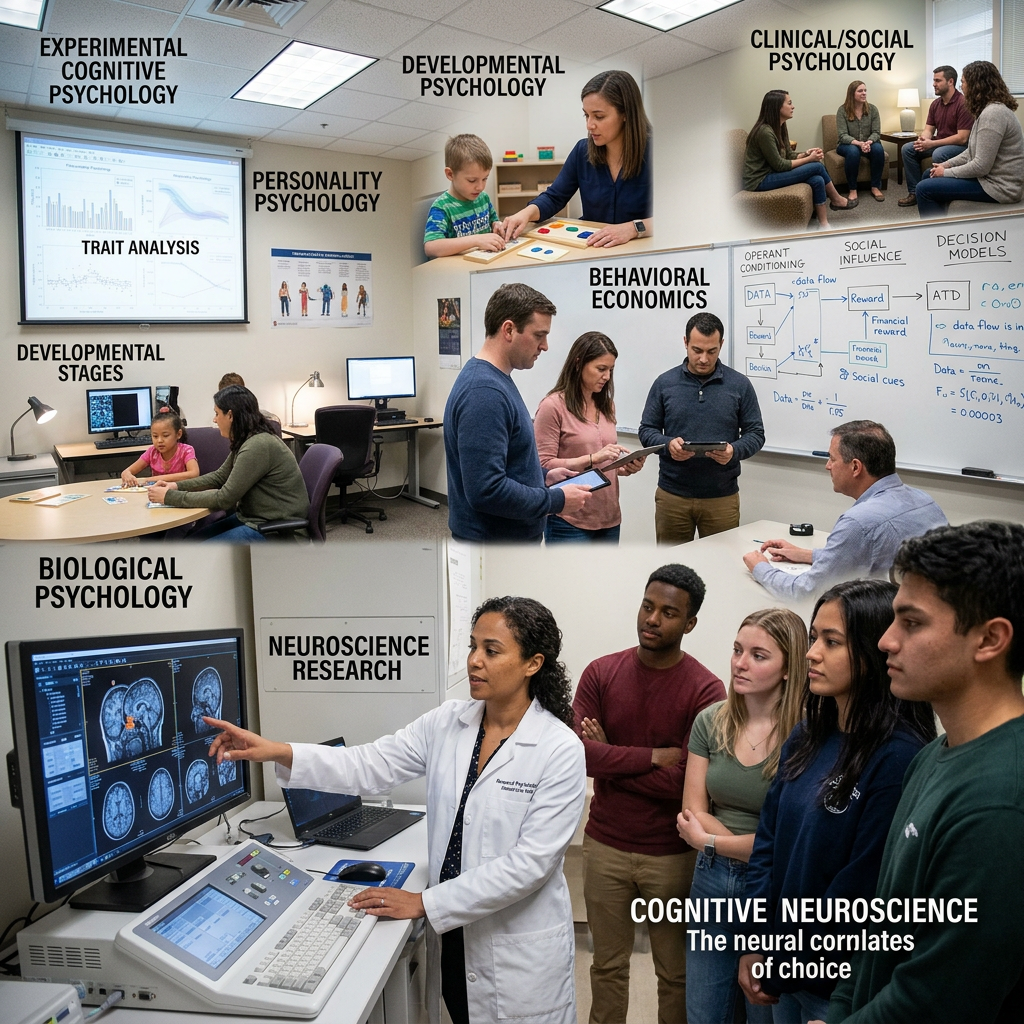

A reflection on The World of Psychology, Ninth Canadian Edition, by Samuel E. Wood, Ellen Green Wood, Denise Boyd, Eileen Wood, and Serge Desmarais
Introduction
The World of Psychology provides a broad introduction to the scientific study of human thought, emotion, and behaviour. The book examines how biological processes, personal experiences, relationships, learning, culture, and social environments interact to shape the way people understand and respond to the world.
Before studying psychology, it is easy to assume that behaviour is mostly a matter of personality or personal choice. Someone succeeds because they are motivated. Someone struggles because they lack discipline. Someone becomes angry because they have a bad attitude. Someone remains in a harmful situation because they are unwilling to change.
Psychology complicates these explanations. It shows that human behaviour rarely has a single cause. What a person does may be influenced by biology, past learning, emotional state, perception, memory, stress, social pressure, environmental conditions, and the resources available at that moment.
Behaviour becomes easier to understand when we stop asking only what a person did and begin asking what influenced their ability to respond.
This principle connects closely with organizational behaviour and Standing on the Ledge. Both examine people under pressure, but psychology provides a deeper understanding of the internal processes involved. It helps explain how people interpret events, learn patterns, form habits, experience stress, make decisions, and recover after disruption.
Psychology as a Science
One of the most important lessons from the book is that psychology is a science rather than a collection of opinions about human nature.
People frequently rely on personal experience when explaining behaviour. Experience is valuable, but it can also be misleading. We tend to notice information that confirms what we already believe. We remember unusual events more easily than ordinary ones. We may confuse correlation with causation or assume that a result applying to one person must apply to everyone.
Scientific psychology attempts to reduce these errors through observation, measurement, controlled research, replication, and critical analysis.
This does not mean psychological research is perfect. Human beings are complex, and psychological studies are influenced by research methods, participant selection, cultural context, measurement limitations, and ethical restrictions. However, the scientific method provides a stronger foundation than intuition alone.
This has a practical application in organizational behaviour. Workplace decisions are often based on assumptions:
- Employees are not working hard enough.
- Low morale is caused by negative attitudes.
- A conflict exists because two people dislike each other.
- Training will correct a performance problem.
- A financial incentive will automatically increase motivation.
These assumptions may be correct, but they should not be accepted without evidence. Before deciding on a solution, an organization should examine what is actually happening, what information supports the conclusion, and what alternative explanations may exist.
The scientific perspective teaches me to separate what I know from what I believe. This is especially important when examining emotionally charged experiences. A strong feeling may be valid without providing a complete explanation of the event.
The Biological Foundations of Behaviour
The book’s examination of the brain, nervous system, hormones, genetics, and other biological processes demonstrates that the mind is not separate from the body.
Thoughts, emotions, attention, memory, sleep, motivation, and stress all involve physical processes. Changes in health, sleep, medication, nutrition, pain, hormones, or neurological functioning can influence behaviour.
This matters because people are often morally judged for behaviour that may be partly connected to physical or psychological conditions. Fatigue may be described as laziness. Difficulty concentrating may be treated as carelessness. Emotional overload may be viewed as unprofessionalism.
Recognizing biological influences does not eliminate personal responsibility. It does mean that responsibility should be evaluated within the person’s actual capacity and circumstances.
In organizational behaviour, the biological perspective reminds us that employees are not machines. Long hours, rotating shifts, inadequate sleep, physical pain, illness, and chronic stress affect attention, memory, emotional regulation, and decision making.
An organization cannot continually demand more from the body without eventually affecting the mind.
Human performance is limited by human biology, regardless of what a schedule, policy, or production target requires.
Sensation, Perception, and Interpretation
Sensation refers to the process through which sensory receptors detect information. Perception is the process through which the brain organizes and interprets that information.
The distinction is important because people do not experience events as neutral recordings. We interpret what happens through expectations, previous experiences, emotional states, beliefs, and mental frameworks.
Two people can witness the same conversation and leave with different understandings of what occurred. One person may interpret direct communication as honesty. Another may experience it as hostility. One may view silence as agreement, while another understands it as fear or withdrawal.
This has significant implications for communication and conflict management. Conflict is not always caused by what was said. It may arise from how the message was perceived.
Perception is also influenced by attention. People cannot process every detail in their environment, so they select certain information and ignore the rest. During stressful situations, attention can narrow. A person may focus on a threat while missing information that would normally influence the decision.
This is relevant to Standing on the Ledge because people experiencing collapse may interpret the world through a heightened sense of danger. A delayed response, ambiguous message, or minor setback may feel more threatening when the nervous system is already overwhelmed.
Recovery therefore requires more than solving the external problem. It may also require creating enough stability for the person to interpret new events without viewing everything as another immediate threat.
Consciousness, Sleep, and Awareness
The study of consciousness includes waking awareness, sleep, dreams, attention, altered states, and the effects of substances. This section of psychology reinforces the importance of sleep and mental recovery.
Sleep is often treated as time that could be used more productively. In many workplaces, exhaustion is even presented as proof of commitment. People boast about long hours, minimal rest, and the ability to continue functioning while tired.
Psychology shows why this attitude is dangerous. Sleep affects attention, learning, memory, mood, reaction time, judgment, and emotional control. A person may remain physically present while their ability to perform safely and accurately declines.
This connects with organizational behaviour because many performance problems may be partly caused by fatigue rather than motivation. Employees working long or irregular hours may become less attentive, more emotionally reactive, and more likely to make mistakes.
The lesson for Standing on the Ledge is equally important. During crisis, people may sacrifice sleep while trying to solve every problem immediately. This can create a cycle in which exhaustion weakens judgment, poor judgment creates additional problems, and the new problems create further stress.
Rest is not avoidance. Under some circumstances, it is a necessary part of regaining the ability to think.
Learning and Conditioning
Psychology defines learning as a relatively lasting change in behaviour or knowledge resulting from experience.
Classical conditioning shows how people can learn associations between events. Operant conditioning demonstrates how behaviour is strengthened or weakened by its consequences. Observational learning explains how people learn by watching the behaviour of others.
These principles are visible throughout organizational life. Employees learn what an organization truly values by observing what is rewarded, ignored, or punished.
An organization may publicly encourage honesty while punishing employees who identify problems. It may promote cooperation while rewarding only individual results. It may claim that safety is the highest priority while praising people who take risks to meet production targets.
In each case, employees learn from consequences rather than slogans.
Culture is taught through repeated consequences.
Conditioning can also help explain behaviour during and after harmful experiences. If a person repeatedly experiences criticism whenever they speak, they may learn to remain silent. If asking for assistance consistently leads to rejection, they may stop asking. If effort is repeatedly followed by disappointment, motivation may decline.
This does not necessarily represent weakness. It may be a learned response to previous consequences.
Standing on the Ledge must therefore consider what a person has learned from the collapse. They may have learned that workplaces are unsafe, authority cannot be trusted, or effort has no value. Rebuilding requires examining these lessons and determining which remain useful and which now prevent recovery.
Memory and the Reconstruction of Experience
Memory is not a perfect recording of the past. Information must first be encoded, stored, and later retrieved. Each stage can be influenced by attention, emotion, time, expectations, and new information.
People can honestly remember the same event differently. Memories may lose detail, become reorganized, or be influenced by later conversations. Confidence in a memory does not guarantee that every part of it is accurate.
This has direct implications for workplace conflict and legal disputes. People often assume that disagreement means someone is lying. Sometimes dishonesty is involved, but disagreement may also reflect the reconstructive nature of memory.
Documentation becomes important because written records, emails, schedules, photographs, and contemporaneous notes can help preserve details that memory may later lose.
However, documents also require interpretation. An email may show what was written without fully explaining the tone, surrounding conversation, or circumstances.
For Standing on the Ledge, this reinforces the importance of recording events while memories are recent. It also requires humility. The purpose of documentation should be to improve accuracy rather than to prove that one person’s memory is automatically complete.
Thinking, Language, and Intelligence
Human thinking involves concepts, problem solving, decision making, language, creativity, and judgment. These abilities allow people to adapt, but they are also vulnerable to errors and bias.
People commonly use mental shortcuts when making decisions. These shortcuts can be efficient, but they may lead to incorrect conclusions. We may give too much weight to recent information, judge a situation based on a familiar example, or seek evidence that supports an existing belief.
Language also shapes understanding. The words used to describe a situation influence how others interpret it.
An employee may be described as resistant rather than cautious, emotional rather than concerned, or unmotivated rather than exhausted. Once the label is accepted, future behaviour may be interpreted through it.
This is important in organizational behaviour because those with authority often have greater power to define the problem. A manager’s description may become the official explanation even when the employee has a different understanding.
The study of intelligence also challenges the idea that ability is a single quality. People may demonstrate different strengths in reasoning, communication, practical problem solving, creativity, emotional understanding, or adaptation.
Workplaces sometimes define intelligence too narrowly. An employee who performs poorly on written tests may possess strong practical knowledge. Someone who speaks confidently may be viewed as more capable than someone whose strengths are less visible.
A fair organization should assess the abilities required for the actual work rather than relying only on status, presentation, or one method of measurement.
Human Development Across the Lifespan
Developmental psychology examines physical, cognitive, emotional, and social change throughout life.
People continue to develop beyond childhood. Identity, relationships, priorities, and abilities may change as individuals move through adulthood and later life. Development is influenced by both biological processes and social experience.
This perspective challenges the assumption that adults are finished products. A person is not permanently defined by one mistake, one period of illness, one failed relationship, or one career disruption.
Human beings can learn, adapt, and reorganize their lives. However, development does not always occur in a smooth or predictable sequence. Progress may include periods of stability, disruption, loss, and rebuilding.
This closely reflects the Standing on the Ledge framework. Collapse can be viewed not only as an ending but also as a developmental transition. The person may be forced to reconsider identity, values, relationships, goals, and assumptions about the future.
This does not make the loss desirable. It means that growth can emerge from the process of responding to it.
Motivation and Emotion
Motivation concerns the forces that initiate, direct, and sustain behaviour. Emotion includes physical arousal, thoughts, subjective feelings, and outward expression.
People are motivated by more than rewards and punishment. Biological needs, belonging, achievement, autonomy, competence, values, identity, and expectations can all influence effort.
This is especially relevant to organizational behaviour. Employers often assume that money is the primary solution to motivation problems. Compensation matters, but it cannot fully replace fairness, recognition, purpose, autonomy, or trust.
A person may be well paid and still become disengaged if the work conflicts with their values or if they feel powerless and disrespected.
Expectations are also important. People are more likely to invest effort when they believe effort can lead to competent performance and that performance will lead to a meaningful outcome.
When effort repeatedly produces no improvement, motivation may decline. This can resemble laziness from the outside, but internally it may reflect the belief that further effort will not matter.
Emotion influences attention, memory, communication, and judgment. Anger may focus attention on perceived injustice. Fear may encourage escape or avoidance. Sadness may slow behaviour and lead to withdrawal. Positive emotions can support creativity, connection, and persistence.
Emotions should not be treated as the enemy of rational thought. They provide information about needs, threats, values, and relationships. The challenge is to interpret that information without allowing the emotion to control every decision.
Personality and Individual Differences
Personality refers to relatively consistent patterns of thought, feeling, and behaviour. Different theories explain personality through traits, unconscious processes, learning, cognition, humanistic development, or biological influences.
Trait approaches can help describe tendencies, but they should not become permanent labels. A person may generally be conscientious, reserved, agreeable, or emotionally reactive while still behaving differently under pressure or in different environments.
This matters in workplaces because personality is sometimes used to explain problems created by the system. An employee may be labelled difficult when the actual problem involves poor communication, contradictory expectations, or unfair treatment.
Personality assessments can support reflection, but they should not be treated as absolute measures of a person’s value or potential. A test result is a description based on a particular method and moment. It is not the entire person.
The humanistic perspective is especially relevant to Standing on the Ledge because it emphasizes growth, meaning, choice, and the development of human potential.
Recovery is not simply returning someone to their previous level of productivity. It may involve creating a life that is more consistent with their values and needs.
Stress, Health, and Coping
The study of stress was one of the most personally significant parts of the book.
Stress occurs when people perceive that demands exceed their ability or resources to respond. The stress response can be useful during immediate danger. It prepares the body to act. However, when stress becomes chronic, the same systems that support short term survival can contribute to physical and psychological harm.
Not all stress is caused by dramatic events. Ongoing uncertainty, lack of control, conflict, financial pressure, excessive workload, role ambiguity, and repeated minor frustrations can accumulate.
This is important in organizational behaviour because workplaces often examine each demand separately. One additional task may appear manageable. One missed break may appear unimportant. One difficult interaction may seem minor.
The individual, however, experiences the combined load.
Collapse is often caused not by one unbearable demand, but by the accumulation of demands without enough recovery.
Coping strategies can focus on changing the problem, regulating emotional responses, seeking support, changing interpretations, or temporarily distancing oneself from the stressor.
No single coping strategy is appropriate in every situation. Problem focused coping may be useful when the situation can be changed. Emotion focused coping may be necessary when the person has little immediate control. Social support may provide practical assistance, perspective, and a sense of belonging.
A major lesson is that coping should not be confused with silently enduring harmful conditions. Personal resilience cannot permanently compensate for an unhealthy environment.
Psychological Disorders and Mental Health
The study of psychological disorders examines disturbances in thought, emotion, and behaviour that cause significant distress or interfere with functioning.
Understanding mental health requires caution. Ordinary sadness is not automatically depression. Worry is not automatically an anxiety disorder. Distraction does not automatically indicate an attention disorder. Diagnosis requires careful assessment of symptoms, duration, context, impairment, and alternative explanations.
At the same time, fear of labels should not prevent people from seeking help. Psychological difficulties are not evidence of moral failure. They emerge through complex interactions among biological vulnerability, experience, stress, cognition, relationships, and environment.
The biopsychosocial approach is valuable because it avoids reducing mental health to a single cause. Biology matters, but so do thoughts, relationships, working conditions, financial stability, trauma, discrimination, and social support.
This connects directly with Standing on the Ledge. Collapse may contain psychological symptoms without being explained entirely by an internal disorder. A person may be reacting to genuine loss, prolonged stress, betrayal, uncertainty, or isolation.
The correct response should address both the individual and the conditions affecting the individual.
Therapy and Psychological Treatment
Psychological treatment includes a range of approaches. Different therapies may focus on unconscious conflict, learned behaviour, distorted thinking, emotional acceptance, relationships, meaning, or practical problem solving.
Medication may also be used for some conditions, often alongside psychological or social interventions.
The existence of multiple approaches reinforces the idea that people and problems are not identical. A method that helps one person may not be effective for another. Treatment should be based on evidence, individual needs, safety, accessibility, and the nature of the problem.
One lesson I take from therapy models is the value of examining the relationship between thoughts, emotions, and behaviour.
A thought such as “nothing I do matters” may contribute to withdrawal. Withdrawal may reduce opportunities for positive experiences. The lack of positive experiences may then appear to confirm the original belief.
Changing this cycle may require small actions before motivation fully returns. It may also require questioning whether the belief is universally true or whether it developed from a particular period of experience.
However, psychological treatment should not be used to teach people to tolerate preventable injustice. Helping someone manage stress does not remove an organization’s responsibility to correct harmful conditions.
Social Psychology and Group Influence
Social psychology examines how people think about, influence, and relate to one another.
Behaviour changes in groups. People may conform to group expectations, obey authority, adopt social roles, favour members of their own group, or reduce personal effort when responsibility is shared.
People also form rapid judgments about others. Stereotypes, prejudice, attribution errors, and group loyalties can shape how behaviour is interpreted.
The fundamental attribution error is particularly relevant to organizational behaviour. It describes the tendency to overemphasize personal characteristics while underestimating situational influences when explaining another person’s behaviour.
A manager may conclude that an employee missed a deadline because they are irresponsible while overlooking workload, unclear instructions, missing resources, or competing demands.
When explaining our own behaviour, we are often more aware of these circumstances. This difference can create conflict because each party believes their explanation is obvious.
Groupthink is another important concept. Groups seeking agreement may suppress criticism, ignore warning signs, and create an illusion that everyone supports the decision.
Healthy teams need psychological safety. Members must be able to raise concerns without being humiliated or punished. Agreement achieved through silence is not genuine agreement.
Connections to Organizational Behaviour
The World of Psychology strengthens my understanding of organizational behaviour by showing the individual processes beneath workplace behaviour.
Organizational behaviour examines motivation, perception, communication, decision making, leadership, stress, teams, and conflict. Psychology provides much of the foundation for understanding these subjects.
The most important connections include:
- Perception influences how employees interpret messages and workplace events.
- Learning principles explain how rewards and consequences shape behaviour.
- Memory limitations affect reports, investigations, and conflict narratives.
- Cognitive bias influences decisions and performance evaluations.
- Personality affects tendencies but does not fully determine behaviour.
- Motivation depends on meaning, expectations, fairness, and needs as well as money.
- Stress affects health, attention, emotional regulation, and performance.
- Group pressure can silence disagreement and produce poor decisions.
- Social labels can influence how employees are treated and evaluated.
Psychology also demonstrates why organizational problems should not be reduced to individual weakness. Behaviour emerges from the interaction between the person and the environment.
A strong employee can perform poorly in a chaotic system. A capable manager can make flawed decisions under stress. A normally cooperative team can become divided when resources are scarce and authority is unclear.
Improving behaviour therefore requires attention to both personal skills and organizational conditions.
Connections to Standing on the Ledge
Psychology adds an important internal dimension to the Standing on the Ledge framework.
Sociology examines the systems surrounding collapse. Organizational behaviour examines the workplace structures and relationships involved. Psychology helps explain what happens within the individual as the event is perceived, remembered, and emotionally processed.
During the impact and triage stages, psychology helps explain:
- Why attention narrows during crisis.
- Why sleep and memory may become disrupted.
- Why motivation may disappear after repeated failure or loss.
- Why ordinary events may be interpreted as threats.
- Why people withdraw when they expect rejection.
- Why identity can become unstable after the loss of a major role.
During rebuilding, psychology helps identify practical needs:
- Restoring sleep and physical stability.
- Creating manageable routines.
- Challenging beliefs formed during crisis.
- Replacing avoidance with gradual action.
- Rebuilding social connection.
- Developing a sense of competence and control.
- Separating a painful event from permanent identity.
This reinforces the idea that rebuilding cannot be measured only by employment or outward productivity. A person may return to work while remaining psychologically trapped in the original collapse.
Recovery involves regaining the ability to interpret the present without continually reliving the past.
Critical Evaluation of the Text
The primary strength of The World of Psychology is its broad and practical introduction to the field. It connects psychological concepts with everyday experiences, allowing readers to recognize how research applies to learning, relationships, health, work, and decision making.
The Canadian edition is also valuable because it places psychological discussion within a Canadian educational and social context rather than relying entirely on examples from another country.
The breadth of the book is also a limitation. Introductory psychology covers an enormous field. Complex debates about biology, culture, diagnosis, intelligence, personality, therapy, and research methods must be summarized.
This can make some theories appear more certain or universal than they are. Psychological findings may change as research methods improve and more diverse populations are studied.
The book should therefore be treated as a foundation rather than a final authority. It introduces the major concepts and provides the vocabulary needed for deeper study.
Personal Application
The most important change in my thinking is that I will be more cautious when assigning simple explanations to behaviour.
Instead of immediately describing a person as lazy, difficult, irrational, or unmotivated, I will consider what else may be influencing the behaviour.
I will ask:
- What is the person perceiving?
- What have they learned from previous experiences?
- What consequences are shaping their actions?
- What physical or emotional stress are they carrying?
- What expectations do they have about the outcome?
- What environmental conditions are supporting or obstructing them?
I will apply the same approach to myself. Self reflection should include responsibility, but it should not become automatic self blame.
When my behaviour does not match my intentions, I need to examine the full pattern. This includes sleep, stress, health, environment, habits, emotions, expectations, relationships, and the perceived value of the outcome.
Understanding the cause does not excuse inaction. It makes useful action more likely.
Conclusion
The World of Psychology demonstrates that human behaviour is the product of interacting biological, psychological, and social influences.
People are neither completely controlled by their circumstances nor completely independent of them. They act within bodies, relationships, environments, histories, and systems that influence what they notice, believe, feel, remember, and choose.
The book strengthens organizational behaviour by explaining the psychological foundations of motivation, perception, learning, stress, communication, decision making, and group influence.
It also strengthens Standing on the Ledge by explaining why collapse can affect far more than employment or income. Collapse can disrupt attention, sleep, identity, confidence, motivation, memory, relationships, and the ability to imagine a different future.
Recovery must therefore address the whole person rather than simply restoring visible productivity.
To understand why someone is standing on the ledge, we must examine not only what happened to them, but how the experience changed what they perceive, expect, remember, and believe is still possible.
Reference
Wood, S. E., Wood, E. G., Boyd, D., Wood, E., and Desmarais, S. (2020). The World of Psychology (9th Canadian ed.). Pearson Canada.
Discover more from Standing on the Ledge
Subscribe to get the latest posts sent to your email.

