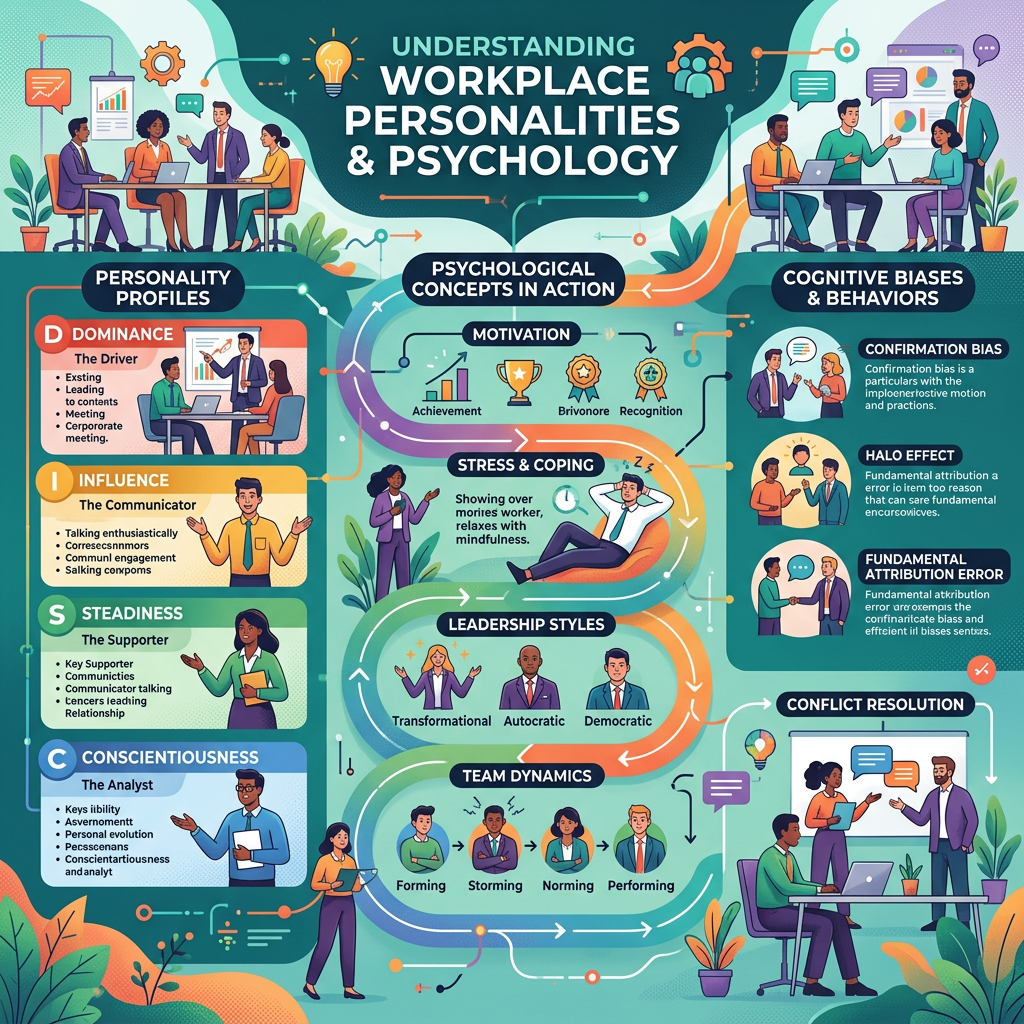

Personality, Values, Jungian Type Theory, the Dark Triad, and Perception in Organizations
MGT2382 Organizational Behaviour
Topic focus: This journal entry reviews Chapter 2 of Canadian Organizational Behaviour, 12th Edition, including personality, the nature-versus-nurture debate, the Five-Factor Model, Jungian personality theory, the Myers-Briggs Type Indicator, the Dark Triad, and values. It also extends the reflection into Chapter 3 by looking at self-concept, perception, attribution, and how people interpret themselves and others in organizational life.
Personality
Personality is the relatively enduring pattern of thoughts, emotions, and behaviour that characterizes a person, along with the psychological processes behind those characteristics. In essence, personality is the bundle of characteristics that makes us similar to, and different from, other people.
Personality traits are broad concepts that allow us to label and understand individual differences. Each trait implies that there is something within the person, not just environmental factors alone, that predicts behavioural tendencies.
Some studies seem to indicate that tests taken in childhood may predict many behaviours and outcomes in adulthood. At the same time, I would also state that many studies reveal these tests may be inaccurate in their predictions. This means personality testing can be useful, but it should not be treated as destiny.
What Causes Personality?
Personality is shaped by both nature and nurture, although the importance of each is still debated and studied.
Nature refers to genetic makeup or hereditary origins. Studies of identical twins suggest that genetics may account for a significant portion of variation in behaviour and temperament. In other words, genetics affect more than physical attributes; they can also help shape our attitudes and behaviour.
Nurture also plays a role in forming us through life experience, socialization, and other environmental interactions.
Personality mainly develops from childhood into young adulthood and typically stabilizes around the age of 30. However, personality may continue a slower evolution after that point. For example, openness to experience and social vitality may increase into young adulthood, while agreeableness and conscientiousness may tend to increase later in life.
Personality can also change somewhat because of the job we work in for a long time. Migration to life in another culture may also affect personality over time.
Why Personality Stabilizes by Young Adulthood
One theory is that personality stabilizes because our concept of self has become more stable. This is connected to the executive function centre of the brain, which monitors and regulates goal-directed behaviour so that our actions remain consistent with our concept of self.
The Five-Factor Model of Personality
The Five-Factor Model is one of the major frameworks used to describe personality traits. The five major dimensions are conscientiousness, agreeableness, neuroticism, openness to experience, and extraversion.
| Trait | Higher Score Tendencies | Lower Score Tendencies |
|---|---|---|
| Conscientiousness | Organized, dependable, goal-focused, thorough, disciplined, methodical, and industrious. | Careless, disorganized, less thorough, and less dependable. |
| Agreeableness | Trusting, helpful, good-natured, considerate, tolerant, selfless, generous, and flexible. | Less cooperative, less tolerant of others’ needs, suspicious, and self-focused. |
| Neuroticism | Anxious, insecure, tense, emotionally reactive, and vulnerable to stress. | Higher emotional stability: poised, secure, calm, and emotionally steady. |
| Openness to Experience | Imaginative, creative, unconventional, curious, nonconforming, autonomous, and perceptive. | Resistant to change, more conventional, less open to new ideas, and more fixed in established ways. |
| Extraversion | Outgoing, talkative, energetic, sociable, and assertive. | More introverted: quieter, less socially assertive, and more reserved. |
Personal Reflection: Big Five Test Results
As a reflective exercise, I completed a Big Five personality test. These results are not a diagnosis and should not be treated as a final measure of identity. However, they can still be useful for thinking about work habits, communication style, motivation, and areas where self-management may be needed.
| Trait | Result / Description | Workplace Interpretation |
|---|---|---|
| Openness to Experience | Dominant trait; extremely high. | Suggests strong curiosity, imagination, pattern recognition, and tolerance for new ideas. This can support creative work, learning, adaptation, and systems thinking. The risk is over-analysis or becoming interested in too many directions at once. |
| Conscientiousness | High, but overloaded. | Suggests responsibility, persistence, and a drive for structure. Under pressure, this may become too many open commitments or a tendency to carry more than one person can realistically manage. Prioritizing and closing loops becomes important. |
| Agreeableness | Compassionate, but not submissive. | Suggests concern for people, fairness, cooperation, and support, while still maintaining boundaries. This can help team performance, but it also means cooperation should not be confused with passivity or automatic compliance. |
| Neuroticism | High threat detection, but not weakness. | Suggests sensitivity to risk, ambiguity, and possible problems. In the workplace, this can function as an early-warning system when managed well. The challenge is keeping threat detection from turning into stress overload. |
| Extraversion | Selective; ambivert; purpose-driven expression. | Suggests the ability to speak, lead, or engage socially when there is a reason, while still needing recovery time and quieter reflection. This can support facilitation, writing, training, and focused communication rather than constant social performance. |
Five-Factor Model and Work Performance
Personality mainly affects behaviour and performance through motivation, specifically by influencing employee direction and intensity of effort. All five factors can predict one or more types of employee behaviour and performance to some extent, but they do not all predict the same type of performance equally.
Conscientiousness
Conscientiousness is generally considered the best overall personality predictor of proficient task performance for most jobs. Specifically, industriousness and dutifulness are strong predictors of proficient task performance. Employees who score high in these areas tend to set higher personal goals, persist longer, engage in more organizational citizenship behaviour, and show less counterproductive work behaviour.
However, conscientiousness is a weaker predictor of adaptiveness. In fact, two specific traits connected to conscientiousness, orderliness and dependability, may suppress adaptability because a person may prefer structure, consistency, and known procedures over rapid change.
Extraversion
Extraversion is often described as the second-best predictor of proficient task performance, although it is much weaker than conscientiousness. Assertiveness and positive emotion are the strongest parts of extraversion for predicting proficient task performance.
Assertiveness is also a strong predictor of adaptive and proactive performance. Assertive employees tend to take charge of situations. Extraversion is also associated with influencing others and feeling comfortable in social settings. Combined with assertiveness, this helps explain why effective leaders and salespersons often tend to be more extroverted than the general population.
Agreeableness
Agreeableness is positively associated with organizational citizenship behaviour and negatively associated with counterproductive work behaviour. Employees with a high rating in agreeableness are often motivated to cooperate, be sensitive to others, remain flexible, and support the team.
However, agreeableness does not strongly predict proactive or proficient task performance. It may be associated with lower motivation to set aggressive goals and push toward individual results. At the same time, employees with higher agreeableness can improve team performance through better knowledge-sharing and motivation to help others. This may not hold true if agreeableness is too high, because excessive accommodation can weaken boundaries or reduce directness. Agreeableness can also have a positive effect on friendliness in customer service jobs.
Openness to Experience
Openness to experience is a weak predictor of proficient task performance, but it is one of the better personality predictors of adaptive and proactive performance. Employees with high openness often show curiosity, imagination, and tolerance of change. These traits help explain why openness to experience is associated with successful performance in creative work and in roles that require learning, innovation, and adaptation.
Emotional Stability / Neuroticism
Emotional stability, or low neuroticism, is one of the better personality predictors of adaptive performance. Higher emotional stability is connected with a better ability to deal with ambiguity, uncertainty, and change.
On the other side, those with higher neuroticism may view change as a threat. They may avoid change or experience high stress when faced with uncertainty in the workplace. These characteristics lend support to the belief that emotional stability may predict proactive performance, although there is limited research to fully support that claim.
Caveats to the Five-Factor Model
A higher rating is not always better. It is easy to assume that the perfect employee would score high on all desirable traits and high on emotional stability, meaning low neuroticism. However, some studies report that better employees do not always have the highest scores on every factor.
The relationship between personality and performance is not a straight line. Sometimes specific traits, such as industriousness, dutifulness, assertiveness, or orderliness, are better predictors than the broad Big Five categories.
Personality is not static. There is an unfortunate tendency to think that an adult’s personality is locked in time. Yes, personality may stabilize, but it is not carved in stone.
The model also does not cover every possible personality trait. That is why it is called the Five-Factor Model, not the “all factors under the sun” model.
Jungian Personality Theory and the Myers-Briggs Type Indicator
The Five-Factor Model may have the strongest research base in modern personality psychology, but it is not necessarily the personality language most people recognize. In workplaces, career counselling, leadership development, and executive coaching, many people are more familiar with Carl Jung’s theory of psychological types and the Myers-Briggs Type Indicator, usually shortened to MBTI.
Carl Jung’s book Psychological Types was first published in 1921. Jung was interested in how people habitually orient themselves toward the world and how they process experience. One of his best-known distinctions was introversion and extraversion. Introversion refers to an orientation toward the inner world of reflection, ideas, and subjective meaning. Extraversion refers to an orientation toward the outer world of people, objects, action, and external events.
Jung also described four psychological functions. Sensation focuses on concrete information and what can be observed through the senses. Intuition focuses on patterns, possibilities, and meanings that may not be immediately visible. Thinking evaluates experience through logic, structure, and principles. Feeling evaluates experience through value, meaning, relationship, and human impact. In Jung’s theory, people tend to develop preferred ways of perceiving and judging, while other functions may remain less developed.
This matters because Jung’s theory was not meant to reduce people to a permanent label. Type describes a preference, not a prison. A person may prefer introversion, but that does not mean they cannot function socially. A person may prefer thinking, but that does not mean they lack feeling. The weaker or less-used side may still be developed over time.
Katharine Cook Briggs and Isabel Briggs Myers later adapted Jung’s ideas into the Myers-Briggs Type Indicator. Their goal was to make type theory more usable and understandable for ordinary people. The MBTI sorts people into sixteen personality types using four preference pairs: Extraversion or Introversion, Sensing or Intuition, Thinking or Feeling, and Judging or Perceiving. The fourth pair, Judging or Perceiving, was an addition in the Myers-Briggs system to describe how a person tends to approach the outside world: with more structure and closure, or with more openness and flexibility.
How Jungian Type Theory Applies in the Workplace
In the workplace, the best use of Jungian type theory is as a language for self-awareness and communication. It can help employees notice how they prefer to gather information, make decisions, organize work, respond to conflict, and interact with other people. Used carefully, it can reduce the assumption that everyone should think, communicate, or work in the same way.
For example, a sensing-oriented employee may want specific details, proven procedures, timelines, and concrete evidence. An intuitive-oriented employee may be more interested in patterns, future possibilities, and broader meaning. A thinking-oriented employee may focus first on consistency, fairness, logic, and task requirements. A feeling-oriented employee may focus first on morale, values, relationship impact, and whether people feel respected. A judging-oriented employee may want closure, planning, and deadlines. A perceiving-oriented employee may want more flexibility, exploration, and room to adapt.
This can be useful in team development. A manager who understands these preferences may communicate change in more than one way. A team may need both the person who asks for practical details and the person who sees future possibilities. It may need both the person who pushes for a clean decision and the person who notices that the decision may affect trust, morale, or inclusion. The model can also help explain why coworkers sometimes talk past each other. They may not be resisting each other; they may be entering the same problem through different doors.
This is also why the MBTI remains popular in career counselling and executive coaching. It gives people accessible language for strengths, blind spots, communication habits, and preferred work environments. It is easier for many people to remember “I tend to be intuitive and need to slow down for details” than to remember a set of percentile scores across several statistical traits.
Concerns and Limitations
The major concern with MBTI is that it dichotomizes people into distinct groups. A person is placed on one side or the other: introvert or extravert, sensing or intuitive, thinking or feeling, judging or perceiving. Real personality traits are often more continuous than that. Someone near the middle of a scale may be classified as one type even though their actual behaviour is more balanced or context-dependent.
This can create problems when people treat type as identity rather than as a working description. An employee may say, “I am a perceiver, so I cannot meet deadlines,” or “I am a thinker, so I do not need to consider feelings.” That is not development; that is using a personality label as an excuse. Type language can also encourage stereotyping if a manager assumes that a person’s four-letter code explains everything about them.
There are also research concerns. Compared with the Big Five, the MBTI has weaker support as a scientific predictor of job performance and workplace behaviour. Some research has questioned its reliability, validity, and statistical structure. For that reason, MBTI should not be used as the sole basis for hiring, promotion, discipline, or deciding who is capable of a role. It is better used as a conversation tool than as a gatekeeping tool.
Why It Remains Useful Despite the Concerns
Despite those concerns, there is a reason Jungian type theory remains popular. It is strengths-based and non-pathologizing. It does not tell a person that they are “bad” at being a person. It tells them that they may have preferences, and that every preference brings both a strength and a limitation depending on the situation.
This is one area where MBTI can feel more practical than the Big Five for coaching and personal development. The Big Five gives a more research-supported and dimensional picture, but the results can feel more clinical or restrictive if they are not explained well. A person who hears that they are high in neuroticism or low in agreeableness may feel judged. A person who hears that they tend to process decisions through values, relationship impact, or logic may be more willing to reflect without becoming defensive.
The Big Five is stronger for research, comparison, and prediction. MBTI is often stronger as an entry point for reflection, discussion, and coaching. The mistake is choosing one model and pretending it does everything. The better approach is to ask what each model is useful for. Big Five is better for evidence-based trait measurement. Jungian type theory and MBTI are often better for accessible self-understanding, team language, and developmental conversations, provided the labels are kept flexible.
Connection Back to Organizational Behaviour
From an organizational behaviour perspective, the useful lesson is not that one personality system wins and another loses. The useful lesson is that personality models shape how people talk about behaviour. The Big Five helps explain broad trait patterns. Jungian type theory helps people recognize different working styles. The Dark Triad reminds us that personality can also have destructive forms when manipulation, entitlement, or lack of empathy are rewarded.
Used well, personality theory can improve communication, coaching, leadership, and self-awareness. Used poorly, it becomes another label that boxes people in. The workplace goal should not be to sort people into fixed categories. The goal should be to understand tendencies, reduce unnecessary friction, and help people develop beyond their automatic patterns.
Values and Individual Behaviour
Values complete the other half of Chapter 2. Personality helps explain the relatively stable ways people tend to think, feel, and act. Values help explain why certain choices, behaviours, relationships, and organizational expectations matter to a person in the first place.
A value is a broad belief about what is important, desirable, or worthwhile. Values are deeper and more general than attitudes. An attitude might describe how I feel about a specific job, manager, policy, or workplace practice. A value sits underneath that attitude and helps explain why the issue matters. For example, a person who strongly values fairness may react strongly to inconsistent rules. A person who strongly values autonomy may struggle in a workplace that relies on close supervision and little discretion.
The key lesson is that values influence behaviour before a person even makes a visible choice. They affect what options seem attractive, how the person interprets the situation, and how consistent the person tries to be with their own standards. In this way, values are not just abstract ideals. They shape motivation, decision making, conflict, trust, and the sense of whether a person fits within a workplace.
Values, Choices, and Perception
Values make some choices feel more acceptable than others. If an employee values security, a stable job with clear expectations may feel attractive. If an employee values growth, that same role may begin to feel restrictive. If an employee values service, helping a coworker may feel meaningful even when it is not formally rewarded. If an employee values achievement, recognition and measurable progress may matter more.
Values also frame perception. Two people can look at the same workplace decision and see different things because different values are active. A schedule change might look efficient to one person, unfair to another, and disrespectful to a third. The event is the same, but the meaning is filtered through what each person believes should matter.
This connects back to earlier learning around motivation and communication. People do not only respond to instructions. They respond to what those instructions seem to say about respect, fairness, trust, belonging, competence, and control.
Schwartz’s Values Model
One useful way to organize values is Schwartz’s values model. The model groups common human values around broad tensions. One tension is openness to change versus conservation. Openness to change includes values such as self-direction and stimulation, while conservation includes values such as security, conformity, and tradition. Another tension is self-enhancement versus self-transcendence. Self-enhancement includes achievement and power, while self-transcendence includes benevolence and universalism.
This is useful in organizational behaviour because workplace conflict often involves values that are not automatically compatible. Innovation may conflict with stability. Individual achievement may conflict with team harmony. Loyalty to tradition may conflict with the need for adaptation. A good workplace does not pretend these tensions do not exist. It recognizes them and manages them openly.
The model also helps avoid oversimplifying people. A person may value both security and growth, or both achievement and care for others. The issue is often not whether one value exists and another does not. The issue is which value becomes dominant when pressure increases.
Values Congruence and Person-Organization Fit
Values also matter because employees compare their own values with the values of the organization. When there is alignment between personal values and organizational values, work can feel more meaningful and less draining. This can support motivation, commitment, trust, and organizational citizenship behaviour.
However, values congruence has to be real. There is a difference between espoused values and enacted values. Espoused values are the values an organization claims to hold. Enacted values are the values revealed by actual decisions, policies, rewards, silence, discipline, communication, and everyday behaviour. When those two do not match, employees may become cynical or disengaged.
This also raises a caution around “fit.” A workplace should not use values fit as a way to create sameness or exclude people who think differently. A healthier approach is to look for alignment on core ethical values while still allowing diversity of background, perspective, personality, and working style. Otherwise, “fit” can become a polite word for conformity.
Values, Ethics, and the Workplace
Values are closely connected to ethical behaviour. They influence what a person notices as morally important and what the person feels responsible for doing. In a workplace, ethical behaviour is not only shaped by personal character. It is also shaped by systems, incentives, leadership behaviour, peer norms, fear of consequences, and whether people believe they can speak up safely.
This is where Chapter 2 becomes practical. If an organization rewards only short-term results, employees may learn that the stated values are secondary. If a workplace says it values respect but ignores disrespectful behaviour from high performers, employees learn the real rule. Values become visible in what the organization protects, ignores, rewards, and corrects.
Personal Reflection on Values
For me, the values section is one of the more useful parts of Chapter 2 because it explains why some workplace issues feel larger than the immediate event. Sometimes the problem is not only the policy, comment, email, or decision. The deeper issue may be that a value has been touched: fairness, honesty, autonomy, responsibility, dignity, loyalty, competence, or belonging.
This also helps explain why communication and conflict can become emotionally loaded. People are not always defending a position. Sometimes they are defending a value. If I only listen to the surface argument, I may miss what the disagreement is really about. Organizational behaviour becomes more useful when it helps identify not only what people do, but what they believe is at stake.
The Dark Triad Personality Traits
The history of the Five-Factor Model is partly connected to the lexical hypothesis: the idea that important personality traits become encoded in everyday language. Researchers worked through large lists of personality-descriptive words, reduced them, removed unclear or overly evaluative terms, and used factor analysis to identify broader trait patterns. That process is useful, but it also helps explain a limitation. When researchers organize personality around broad, socially familiar trait language, some darker or more socially undesirable patterns may sit outside the main five-factor frame.
The Dark Triad refers to three overlapping but distinct personality traits: Machiavellianism, narcissism, and psychopathy. In organizational behaviour, the key point is not to diagnose people. These are not labels to throw around casually. The useful question is: what happens to a workplace when patterns of manipulation, excessive self-importance, low empathy, impulsivity, or calculated self-interest become influential inside the system?
| Dark Triad Trait | Plain-Language Definition | How It May Show Up at Work |
|---|---|---|
| Machiavellianism | A strategic, calculating, and manipulative orientation toward people and situations. The person may treat relationships as tools for gaining advantage, power, protection, or control. | Information hoarding, political maneuvering, charm used as leverage, selective honesty, scapegoating, coalition-building against targets, and a willingness to use others as means to an end. |
| Narcissism | A pattern of grandiosity, entitlement, self-importance, and strong need for admiration or recognition. The person may see themselves as exceptional and may react badly when challenged. | Credit-taking, blame-shifting, fragile reactions to feedback, domination of meetings, image management, overpromising, devaluing others, and treating disagreement as disrespect. |
| Psychopathy | In this workplace context, a subclinical pattern of callousness, low remorse, impulsivity, thrill-seeking, and reduced concern for harm caused to others. | Bullying, intimidation, reckless risk-taking, rule-breaking, emotional coldness, conflict escalation, lack of accountability, and harm to trust or psychological safety. |
How Dark Triad Traits Can Create Workplace Dysfunction
The immediate danger of Dark Triad traits is that they can look effective before they look destructive. A manipulative person may appear politically skilled. A narcissistic person may look confident, bold, and visionary. A callous or impulsive person may look fearless under pressure. The problem is that the short-term signal can hide the long-term cost.
In a workplace, these traits can create dysfunction in several ways. Trust may decline because employees learn that information can be twisted or used against them. Psychological safety may decline because people stop speaking honestly. Teamwork may weaken because collaboration becomes transactional rather than cooperative. Conflict may increase because disagreement becomes personal, strategic, or punitive. Performance may also become distorted because the organization rewards appearance, loyalty, or dominance rather than competence, ethics, and actual contribution.
Dark Triad traits can also increase counterproductive work behaviour. This may include undermining coworkers, withholding information, taking credit for another person’s work, manipulating supervisors, violating rules when convenient, or creating conflict that serves the individual’s interest. The damage is not always loud. Sometimes it appears as quiet erosion: people stop volunteering ideas, stop trusting leadership, stop asking questions, and eventually stop caring.
Where Dark Triad Traits May Look Desirable
This is where the topic becomes uncomfortable but useful. Some dark traits can produce behaviours that appear valuable in certain roles or moments. Machiavellianism can look like strategic thinking, negotiation ability, political awareness, or calm long-game planning. Narcissism can look like confidence, charisma, ambition, bold public presentation, or willingness to take a visible leadership role. Subclinical psychopathy can look like stress tolerance, fearlessness, decisiveness, or the ability to act under pressure without becoming emotionally overwhelmed.
That does not make these traits healthy by themselves. The difference between useful assertiveness and destructive dark-triad behaviour is usually the presence of ethics, accountability, empathy, boundaries, and consequences. Confidence without humility becomes entitlement. Strategy without ethics becomes manipulation. Fearlessness without responsibility becomes recklessness. A workplace may benefit from boldness, decisiveness, political awareness, and resilience, but those traits need to be anchored in prosocial purpose and organizational safeguards.
This may be one reason toxic personalities sometimes rise inside organizations. If leadership only measures short-term output, charisma, aggressiveness, or political skill, it may mistake dark-triad behaviour for leadership potential. The employee appears strong because they push through resistance, dominate the room, win arguments, or seem immune to stress. But if the cost is fear, turnover, suppressed communication, ethical drift, or damaged trust, then the organization has not gained leadership. It has purchased performance with culture as the currency.
Connection Back to the Five-Factor Model
The Five-Factor Model is still useful because it helps organize broad patterns in personality. But the Dark Triad reminds me that not all workplace problems can be explained by low agreeableness, high extraversion, low conscientiousness, or poor communication. Some behaviour is strategic. Some behaviour is self-protective. Some behaviour is exploitative. Some behaviour is rewarded because the organization confuses confidence with competence or dominance with leadership.
For me, the practical lesson is caution. Personality models can help explain tendencies, but they should not become excuses. A trait may explain why someone behaves a certain way, but it does not remove responsibility for the impact of that behaviour. In organizational behaviour, the real issue is not merely whether someone has a difficult personality. The real issue is whether the workplace has enough structure, accountability, feedback, and ethical leadership to prevent difficult traits from becoming system-wide damage.
Chapter 3: Perceiving Ourselves and Others in Organizations
Chapter 3 moves from individual differences into perception. Chapter 2 asks what people bring into the workplace through personality and values. Chapter 3 asks how people interpret themselves, other people, and the situations around them. This is important because employees do not respond only to objective events. They respond to what they believe those events mean.
The Self-Concept
Self-concept refers to how a person understands and describes themselves. In organizations, this includes personal identity, social identity, self-esteem, self-efficacy, and the roles a person believes they occupy. The way people see themselves affects how they respond to feedback, conflict, leadership, responsibility, recognition, and failure.
A person may want to see themselves as competent, fair, loyal, resilient, creative, independent, or useful. When workplace experiences support that self-view, the person may feel stronger and more engaged. When workplace experiences threaten that self-view, the person may become defensive, discouraged, angry, or withdrawn.
This does not mean self-concept is bad or self-protection is wrong. Everyone has a need for a coherent sense of self. The issue in organizational behaviour is that self-concept can affect how accurately people interpret events. A person who sees themselves as helpful may struggle to hear that their help felt intrusive. A person who sees themselves as fair may resist hearing that others experienced a decision as unfair.
Self-Evaluation and Work Behaviour
Self-evaluation influences how people handle challenges. Employees with stronger self-efficacy are more likely to believe they can perform a task or learn what is required. Employees with stronger self-esteem may recover more quickly from criticism, though too much defensiveness can still block learning. Locus of control also matters because it influences whether people believe outcomes are shaped mainly by their own actions or by outside forces.
This connects to performance and motivation. A person who believes effort can change outcomes is more likely to adapt, ask questions, and keep trying. A person who feels powerless may disengage even if they have ability. This connects back to the MARS model because motivation and role perceptions are affected by how people understand themselves in the situation.
Perception and Attribution
Perception is the process of selecting, organizing, and interpreting information. In a workplace, people are constantly interpreting behaviour: why a coworker missed a deadline, why a manager sent a short email, why a team member stayed quiet, why a customer reacted sharply, or why a decision was made. These interpretations affect trust and behaviour.
Attribution is the process of deciding why something happened. People may attribute behaviour to internal causes, such as effort, character, ability, or attitude. They may also attribute behaviour to external causes, such as workload, unclear expectations, lack of resources, pressure, or situational constraints.
This matters because attribution errors can create conflict. A missed task may be interpreted as laziness when the real cause was unclear instruction or competing priorities. A blunt message may be interpreted as disrespect when the sender was rushed or under pressure. At the same time, external explanations should not become excuses for repeated harmful behaviour. The point is to slow down interpretation long enough to test whether the story in our head matches the evidence.
Perceptual Biases in the Workplace
Several perceptual biases can distort workplace relationships. Stereotyping happens when people assign assumptions to someone based on group membership rather than individual evidence. The halo effect happens when one positive trait influences the entire judgment of a person. The horns effect does the same thing in the negative direction. Confirmation bias leads people to notice information that supports what they already believe and overlook information that challenges it.
There is also a danger in first impressions. Early information can become sticky, even when later evidence is more balanced. This can affect hiring, performance reviews, team trust, and conflict. Once a person has been labelled as difficult, quiet, emotional, lazy, negative, or high potential, later behaviour may be interpreted through that label.
This connects directly with communication and conflict management. Conflict does not only escalate because people disagree. It escalates because people begin to assign motives. Once motives are assumed, listening becomes harder. The conversation shifts from “What happened?” to “What kind of person are you?” That shift can damage trust quickly.
Improving Perception and Self-Awareness
The practical goal is not to eliminate perception. That would be impossible. The goal is to improve the quality of perception by slowing down assumptions, seeking more information, asking clearer questions, and being willing to revise a first interpretation.
Useful workplace practices include perspective-taking, active listening, checking assumptions, asking for examples, separating behaviour from identity, and creating environments where people can clarify misunderstandings before they harden into conflict. This also requires self-awareness. A person needs to know which values, fears, expectations, and past experiences may be shaping their interpretation of the present moment.
Personal Reflection on Chapter 3
Chapter 3 is useful because it explains why the same event can produce different reactions in different people. Personality and values shape what a person brings into the room. Perception shapes what the person believes is happening once they are there.
For me, the important lesson is that communication problems are not always communication problems alone. Sometimes they are perception problems. Sometimes they are self-concept problems. Sometimes people are reacting to the meaning they have assigned to a situation, not only to the situation itself.
This makes organizational behaviour more practical. Before judging a conflict, I need to ask: What values are active here? What self-image is being protected? What assumptions are being made? What evidence is missing? What story is each person telling themselves? These questions do not remove accountability, but they create a better path toward understanding and repair.
Updated Closing Note
Overall, Chapter 2 and Chapter 3 work well together. Chapter 2 explains how individual differences such as personality and values influence workplace behaviour. Chapter 3 then shows how people interpret themselves and others once they enter the workplace. Together, these chapters show that behaviour is rarely random. It is shaped by traits, values, self-concept, perception, motives, and the situation.
The Five-Factor Model remains useful because it gives a research-supported way to describe broad personality patterns. Jungian type theory and the MBTI remain useful as a coaching and reflection language, even though they should not be treated as strong predictors of performance. The Dark Triad adds a caution that some traits can look effective in the short term while damaging trust, ethics, and psychological safety over time.
The values section adds another important layer. A workplace is not only a set of tasks. It is also a values environment. People notice whether fairness, respect, accountability, autonomy, loyalty, safety, and honesty are actually practised. When stated values and lived values do not match, trust suffers.
Chapter 3 adds that people do not simply react to reality; they react to perceived reality. Self-concept, attribution, stereotypes, confirmation bias, and assumptions about motive can all change how workplace events are understood. This makes self-awareness and communication especially important.
The main takeaway for me is that organizational behaviour is not only about managing people. It is about understanding people, including myself, more accurately. Personality, values, and perception do not excuse behaviour, but they help explain why people act as they do and why workplace conflict can become so personal so quickly. Good workplaces need systems, but they also need self-awareness, honest communication, ethical consistency, and enough humility to check assumptions before they become judgments.
Sources Consulted
- American Psychological Association. APA Dictionary of Psychology: Big Five personality model.
- Encyclopaedia Britannica. Five-factor model of personality. Last updated May 18, 2026.
- Encyclopaedia Britannica. Dark triad. Last updated May 11, 2026.
- Paulhus, D. L., & Williams, K. M. (2002). The Dark Triad of personality: Narcissism, Machiavellianism, and psychopathy. Journal of Research in Personality, 36(6), 556–563.
- Roivainen, E. (2013). Frequency of the use of English personality adjectives: Implications for personality theory. Journal of Research in Personality, 47(4), 417–420.
- Schyns, B., Braun, S., & Wisse, B. (2019). Dark Personalities in the Workplace. Oxford Research Encyclopedia of Psychology.
- Szabó, Z. P., Diller, S. J., Czibor, A., Restás, P., Jonas, E., & Frey, D. (2023). “One of these things is not like the others”: The associations between dark triad personality traits, work attitudes, and work-related motivation. Personality and Individual Differences, 205, 112098.
- Jung, C. G. (1921/1971). Psychological Types. Princeton University Press.
- The Myers-Briggs Company. Our Story: Carl Jung Publishes Psychological Types; Isabel Briggs Myers begins work on the Indicator.
- The Myers & Briggs Foundation. Myers-Briggs Type Preferences: Perception and Judgment.
- The Myers-Briggs Company. All About the MBTI Assessment.
- Pittenger, D. J. (1993). Measuring the MBTI… And Coming Up Short. Journal of Career Planning and Employment, 54(1), 48-52.
- Randall, K., Isaacson, M., & Ciro, C. (2017). Validity and Reliability of the Myers-Briggs Personality Type Indicator: A Systematic Review and Meta-analysis. Journal of Best Practices in Health Professions Diversity, 10(1), 1-27.
- Zarate-Torres, R., Correa, J. C., & Forero, D. A. (2023). How good is the Myers-Briggs Type Indicator for predicting leadership-related behaviors? Frontiers in Psychology, 14, 940961.
- McShane, S., & Warner, M. (2024). Canadian Organizational Behaviour (12th ed.). McGraw Hill Ryerson.
- McGraw Hill Canada. Canadian Organizational Behaviour, 12th Edition product page and table of contents.
- ResearchGate. Canadian Organizational Behaviour, 12th Edition publication entry.
- Schwartz, S. H. (1992). Universals in the content and structure of values: Theoretical advances and empirical tests in 20 countries. Advances in Experimental Social Psychology, 25, 1-65.
- Schwartz, S. H. (2012). An overview of the Schwartz theory of basic values. Online Readings in Psychology and Culture, 2(1).
- Heider, F. (1958). The Psychology of Interpersonal Relations. Wiley.
- Ross, L. (1977). The intuitive psychologist and his shortcomings: Distortions in the attribution process. Advances in Experimental Social Psychology, 10, 173-220.
Discover more from Standing on the Ledge
Subscribe to get the latest posts sent to your email.
 Standing on the Ledge