
Reader’s Moment
After a hard hit, memory becomes a crowded room.
You remember the email, but not the exact date.
You remember the tone, but not the wording.
You remember the meeting, but not who was present.
You remember the pressure, but not the sequence.
Then the mind starts filling gaps. Sometimes it fills them with fear. Sometimes with shame. Sometimes with anger. Sometimes with a story that may be emotionally true but practically hard to use.
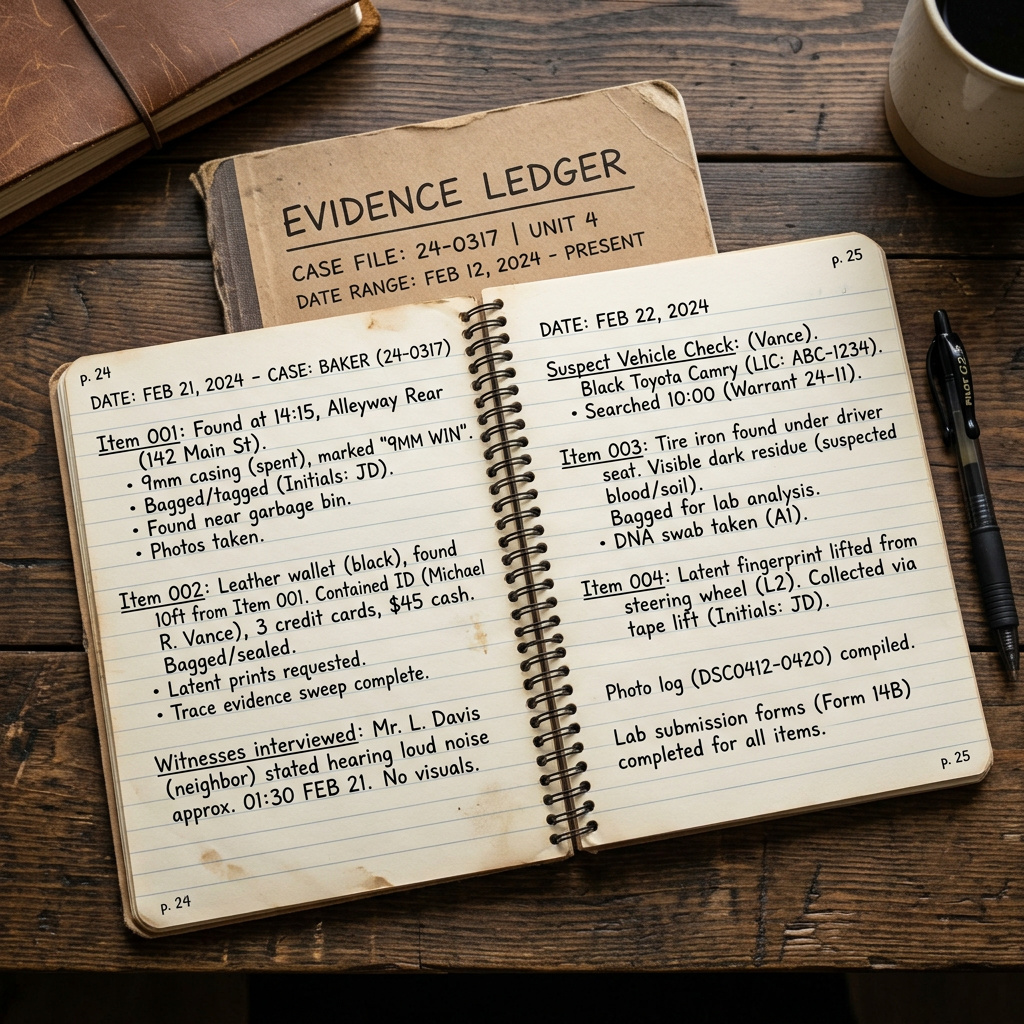
That is why the Evidence Ledger exists.
It is not a diary.
It is not a rant file.
It is not a revenge notebook.
It is not a courtroom performance.
It is a record.
Why a diary is not enough
A diary can be useful. A journal can help you process emotion, notice patterns, and hear yourself honestly. Standing on the Ledge itself began with that kind of pressure needing somewhere to go.
But when the issue involves work, money, agreements, conflict, legal exposure, institutional pressure, responsibility, authority, or a pattern of events, a journal is not always enough.
A journal often says, “Here is how this felt.”
An Evidence Ledger asks, “What happened, when, who was involved, what changed, and what supports this record?”
Both have a place. They are not the same tool.
The problem begins when a person tries to use emotional memory as if it were documentation. Under pressure, emotional memory may be sincere and still incomplete. It may point toward the truth without preserving the details needed to act on that truth.
The Evidence Ledger gives the facts somewhere to stand.
What the Evidence Ledger records
An Evidence Ledger entry should be boring enough to be useful.
That is not a joke. Under stress, boring is a strength.
Each entry should answer:
- Date and time: when did this happen?
- People involved: who was present or included?
- Event: what happened in plain language?
- Source: what email, text, contract, photo, invoice, notice, or note supports it?
- Change: what changed because of this event?
- Impact: what practical effect did it have?
- Next step: what needs to be done, saved, asked, or clarified?
Notice what is missing.
No character assassination.
No mind reading.
No theatrical argument.
No turning every entry into a verdict.
If the facts are strong, they do not need to be decorated.
Example of the difference
A diary entry might say:
“They completely blindsided me again. I am tired of being treated like I am the problem when they keep changing things and expecting me to absorb it.”
That may be emotionally honest. It may even be accurate. But it is hard to use.
An Evidence Ledger entry would say:
“May 6, 2:15 p.m. – Received email from X stating that the expected staffing level would be reduced from A to B effective May 10. Previous instruction on April 21 stated A was required. Saved email in Contract/Staffing folder. Practical impact: schedule and billing assumptions changed. Next step: ask for written clarification on expected baseline hours.”
That is useful.
It does not require the reader to believe your emotional state. It preserves the pattern.
Evidence protects you from two traps
The first trap is self-blame.
When pressure hits, the mind often says, “I failed.” Evidence asks, “What changed? What was asked? What was promised? What authority did I have? What resources were available? What was outside my control?”
The second trap is overstatement.
Pain wants language as large as the injury. But exaggerated language can weaken your own position. Evidence asks you to stay with what you can support.
That does not make the pain smaller. It makes the record stronger.
The Evidence Ledger and legal silence
If there is a live legal, workplace, contractual, or sensitive personal matter, the Evidence Ledger becomes even more important.
The public page is not the place to litigate.
The private ledger is where you preserve the sequence.
This distinction matters. You can write publicly about patterns, tools, lessons, pressure, shame, communication, and recovery without turning the internet into your evidence file.
That is discipline, not silence.
The next-step line
The most important line in the Evidence Ledger may be the last one: next step.
Without a next step, documentation can become another loop.
You keep collecting, replaying, saving, sorting, and rereading. The folder grows, but agency does not.
Every entry should end with a simple question:
What does this require me to do?
Maybe the answer is “nothing right now – saved for record.”
That is valid.
Maybe the answer is “ask for clarification.”
Maybe it is “send to counsel.”
Maybe it is “update timeline.”
Maybe it is “stop responding verbally and request written communication.”
Maybe it is “notice pattern for future boundary.”
The point is to convert evidence into orientation.
The field rule
The Evidence Ledger is not there to keep you trapped in the past.
It is there to stop the past from becoming fog.
It is there so shame does not rewrite the file.
It is there so anger does not overstate the case.
It is there so your next step can come from record, not panic.
Write it down plainly.
Save the source.
Name the change.
Choose the next step.
That is how a scattered story becomes usable evidence.
Godspeed.
Field Manual Expansion Series: This post is part of a 20-part Standing on the Ledge sequence expanding the core tools, protocols, and pressure points behind the Field Manual.
Previous: Night Numbers: Money Triage Without Shame — [link previous post]
Next: The Shame Ledger Lies Under Pressure — [link next post once published]
Discover more from Standing on the Ledge
Subscribe to get the latest posts sent to your email.

