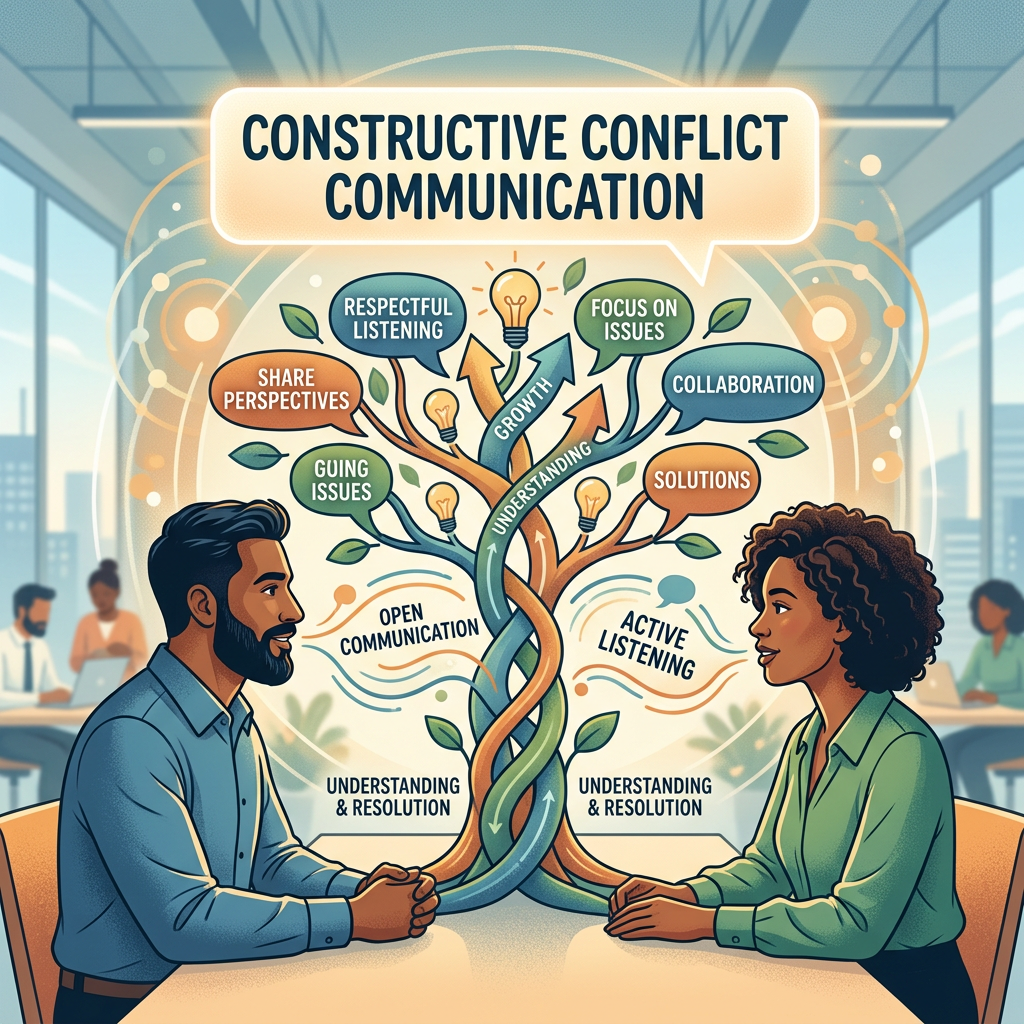

This post is adapted from my final learning journal for Communication & Conflict Management. I am sharing it here because the course did not stay inside the classroom for me. It connected directly to Standing on the Ledge: collapse recovery, crisis management, boundaries, communication under pressure, and the systems that shape conflict before anyone says a word.
Reader’s Moment
Have you ever been in a conflict where the argument was not really the whole problem?
Maybe the visible issue was a sentence, an email, a missed expectation, or a tone that landed wrong. But underneath it, something else was already happening. Stress. Role confusion. Poor timing. Weak trust. A bad system. A conversation that should have happened earlier but did not.
That is one of the biggest things this course helped me understand.
Conflict is rarely just about words.
By the end of the course, I was no longer asking only, “Who said what wrong?” I was asking a better question:
What conditions made this misunderstanding or escalation more likely?
That question matters. It shifts conflict away from blame alone and moves it toward structure, responsibility, repair, and prevention.
Why I Am Posting This Publicly
Some people may wonder why I would post a school learning journal publicly on Standing on the Ledge.
The answer is simple: this is part of the work.
Standing on the Ledge has always been about more than telling the story of collapse. It is about studying what happens under pressure, what breaks, what can be rebuilt, and what tools help a person regain agency when life gets unstable.
Communication and conflict management belong directly inside that work.
When life is calm, communication can feel like a soft skill. When life is under pressure, communication becomes structural. It affects trust, safety, accountability, decision-making, conflict, and whether people can work together honestly.
This course gave me better language for patterns I had already started noticing in real life. It helped me connect personal experience, workplace conflict, difficult conversations, boundaries, systems, and emotional regulation into one clearer frame.
My Conflict Default Under Pressure
Early in the term, I completed a conflict-styles activity. I treated the result as a snapshot, not a permanent label.
The scores were:
- Avoid: 6
- Compete: 5
- Accommodate: 6
- Compromise: 8
- Collaborate: 8
That fit what I know about myself.
I prefer collaboration and compromise. I want movement, fairness, and workable outcomes more than I want to “win.” But the course also helped me see the risk inside that pattern.
Under stress, collaboration can quietly slide into over-accommodation. Compromise can become self-erasure. Calm can become avoidance. Professionalism can become swallowed frustration.
That was an important realization.
My challenge is not to become more forceful in every situation. My challenge is to stay clear and direct without over-carrying, smoothing everything over, or waiting too long to name what needs to be named.
Lesson One: Use Tools Instead of Freelancing Under Stress
One of the earliest lessons was that conflict styles only matter if I can use them deliberately.
I noticed something about myself: I do not actually want conflict victories. I want traction. I want clarity. I want movement.
But stress pushes me toward smoothing, delaying, and carrying emotional weight that should not all be mine.
This showed up in how I thought about difficult conversations, help requests, and reputation management. I realized that asking for help is itself a communication skill.
A vague request creates confusion. An emotionally overloaded request creates pressure. A request that is too broad makes it easier for the other person to avoid, misunderstand, or shut down.
A better ask is contained:
- define the task
- narrow the time frame
- state the limit
- leave the other person a real way to say no
My best version in conflict is not aggressive. It is firm and fair:
Clear request. Clear limit. Clear next step.
That sounds simple. It is not always easy when stress is active.
Lesson Two: Workplace Conflict Is Often a Systems Problem First
A major insight came from thinking about workplace dynamics.
It is easy to blame personality. It is harder, but often more accurate, to ask whether the system itself created the conditions for conflict.
Unilateral decisions, weak listening, unclear expectations, poor feedback loops, and top-down changes can create blame cycles long before anyone openly argues.
When people in authority change workflow without observing the work, listening to the people doing it, or clarifying real constraints, the organization starts operating on assumptions instead of signal.
That matters.
If a system punishes truth, people do not tell the truth. They tell what feels safe. Silence then becomes expensive.
This connected strongly with communication climate and psychological safety. Many workplace conflicts are not caused by unwillingness to work. They are caused by unclear expectations, weak feedback loops, and systems that reward image management instead of honest information.
Lesson Three: Separate Facts From the Threat-Story
Later in January, I reflected on how quickly my mind can shift into what I think of as courtroom mode.
That is the mode where I start replaying events, assigning motives, building a case, and drafting responses before I have fully clarified what happened.
This was one of the most useful personal lessons of the course.
There is a difference between facts and the story my nervous system builds around those facts.
If I cannot separate what happened from what I think it means, I will communicate from threat rather than clarity. That leads to escalation, not resolution.
Naming the threat helps. Is the alarm about uncertainty? Fairness? Status? Connection? Safety? Respect?
Once the actual alarm is named, the next step becomes more precise.
One clean move is often better than ten reactive ones.
Sometimes the better move is one measured response, one boundary, or one question that slows the spiral.
Lesson Four: Conflict Grows in the Gaps
The course also pushed me away from thinking of communication as mostly verbal.
In real conflict, tone, timing, omission, silence, channel choice, and nonverbal cues carry enormous meaning.
Conflict often grows in what is not said:
- unclear standards
- missing context
- delayed responses
- unspoken assumptions
- expectations nobody wrote down
- silence that people start interpreting as intent
This matters especially in digital communication.
Email and text strip away nonverbal information. That makes perception more powerful than it should be. People start reading intent into delay, brevity, punctuation, silence, or phrasing.
A message that might feel manageable in person can feel hostile in writing.
One practical lesson stayed with me:
Not responding immediately is not always avoidance. Sometimes it is regulation.
A deliberate pause can prevent a conversation from tipping into escalation. Channel choice matters. The right channel is not just a convenience issue. It is a conflict-management choice.
Lesson Five: Clarity Beats Reassurance
Another important reflection came from naming a pattern I have lived through before: shifting expectations, scope creep, weak communication, and pressure that slowly turns political.
I also recognized a habit in myself.
When I can feel the temperature changing but do not yet have a clean metric for what is wrong, I can be tempted to ask reassurance-based questions.
Questions like:
Are we okay?
But reassurance questions often do very little.
Clarity questions work better:
- What changed?
- What does good mean here?
- What standard are we using?
- Can that expectation be put in writing?
This was one of the most practical takeaways of the term.
Conflict prevention is often structural. Better questions reduce ambiguity before it hardens into resentment.
Documentation, specificity, and clarification are not signs of mistrust. In many situations, they are responsible communication.
Lesson Six: Boundaries Are Conflict Work
By early February, boundaries had become a much clearer issue for me.
I started tracking the point where helping turns into drift.
That drift happens when other people’s responsibilities slide onto my back because I am capable, available, or too tired to fight the pattern.
When that happens, I am no longer helping in a healthy sense. I am becoming the cleanup crew for consequences that do not belong to me.
The blunt lesson was this:
A boundary is not a punishment. It is a structural repair.
The most useful communication skill is not always a long speech. Sometimes it is a short sentence repeated calmly and backed up by behavior.
Follow-through matters more than intensity.
I used to think of boundaries mostly as self-protection. By the end of this course, I saw them more clearly as part of conflict management itself.
A boundary can reduce resentment. It can reduce role confusion. It can stop a bad pattern before it hardens.
Lesson Seven: The Climate Around the Conversation Matters
In March, my reflections started connecting more directly with perception, communication climate, emotional regulation, and belief.
Beliefs collect evidence. They shape what we notice. They shape what we ignore. They shape how we interpret other people’s words and actions.
I also reflected on how “performing fine” can become an early warning light long before something actually breaks.
A real test came in a small situation: an automated billing email triggered the urge to snap back. I could feel the pull toward reaction. But a cleaner boundary was the better move.
That moment mattered because theory became practice.
I also saw more clearly that an open door is not enough if the surrounding climate punishes vulnerability.
A workplace, family, team, or relationship can say, “You can talk to me,” while still creating conditions where honesty feels unsafe.
If people expect humiliation, dismissal, punishment, or moral judgment, they will protect image instead of telling the truth.
Conflict is not only what happens in the argument. It is also built by the atmosphere around it.
Lesson Eight: Positions Are Not Always the Real Issue
The mediation material deepened my understanding of conflict in a major way.
I started paying closer attention to schemas, assumptions, identity triggers, and the difference between positions and interests.
Not every conflict is really about the visible issue.
Sometimes the visible position is only the wrapper. Underneath it may be fear, status concern, respect, credibility, fairness, or the need to feel heard.
Conflict often gets stuck because people stay at the level of positions instead of exploring the interests underneath them.
That matters for accountability too.
Accountability and relationship are not enemies. Tone matters, but tone cannot become an escape hatch from the issue. At the same time, pushing accountability without empathy can turn repair into control.
The challenge is holding both:
Tell the truth. Stay human.
Lesson Nine: Listening Is Not Passive
The final stretch of the course pushed me beyond reflection into deliberate intervention.
I had to think less like someone describing conflict and more like someone assessing and responding to it.
That meant asking better questions:
- What stage is the conflict in?
- What are the visible positions?
- What interests may be underneath?
- What tools actually fit this stage?
- Is this issue still workable, or has it become entrenched and identity-driven?
Timing matters.
It is easier to intervene when conflict is still productive or personalized than after it has become entrenched.
Active and reflective listening also landed more deeply here.
Listening is not passive. It is a way of gathering better information, reducing threat, checking meaning, and helping people feel understood before the conflict escalates further.
Reflective listening is not just politeness. It is a bridge-building tool.
Lesson Ten: The Channel Can Escalate the Conflict
One practical lesson I will carry forward is this: feedback and channel choice are part of conflict management.
If an issue is emotionally loaded, trust-sensitive, or easy to misunderstand, email is often the wrong tool.
A live conversation is usually better, followed by written confirmation.
That may not sound dramatic, but it matters. A lot of workplace conflict grows because the wrong channel gets used for the wrong kind of issue.
Email is useful for records, summaries, confirmations, and details. It is not always useful for emotional repair, accountability conversations, or situations where tone will carry heavy meaning.
What Changed in How I Understand Conflict
The biggest shift in my thinking is this:
Conflict is not just an event. It is often an accumulation.
It grows in ambiguity, silence, weak systems, poor timing, identity threat, and damaged climate long before it becomes visible.
At the start of the course, I was more likely to think in terms of behavior and reaction.
By the end, I was thinking more in terms of systems, conditions, and intervention.
I now see more clearly that many conflicts are not simply about unwillingness, hostility, or poor character. They are often about unclear expectations, defensive climates, misread intent, unspoken interests, and badly chosen communication channels.
I also became more aware of my own patterns.
Collaboration and compromise are strengths for me, but only if they do not slide into over-accommodation or delay.
What I need to practice is clearer now:
- earlier clarity
- better boundaries
- calmer follow-through
- more deliberate listening before reaction
- less smoothing when directness is needed
Systems Communicate Too
One of the more unexpected lessons came from the course itself as a communication system.
At times, the structure felt layered, repetitive, and more difficult to navigate than it needed to be. That created frustration, but it also reinforced one of the course’s central lessons:
Systems communicate.
When a system is unclear, repetitive, or harder to navigate than necessary, it increases cognitive load.
That matters because communication is not only about words on a page. It is also about how information is organized, how expectations are signaled, and how much friction is built into the path.
A confusing process communicates something.
So does a missing standard.
So does an unclear role.
So does a weak feedback loop.
In that sense, the course itself reinforced the lesson that communication problems often begin long before anyone is openly in conflict.
The useful move is not just to complain that a system is frustrating. The useful move is to identify the barrier, explain the effect it is having, and suggest a cleaner alternative.
That is conflict management too.
Where This Fits on the Ledge
For Standing on the Ledge, this course gave me language for something I have been circling since the beginning:
Collapse is not only emotional. It is communicational. It is structural.
People break down under pressure partly because the systems around them stop giving clean signals. Expectations shift. Roles blur. Feedback loops fail. People protect image instead of telling the truth. Boundaries collapse. Silence gets misread. Fear starts writing the story.
That is why communication under load matters.
When you are standing in the rubble, communication is not decoration. It is survival infrastructure.
You need to know what is true. You need to know what is expected. You need to know what belongs to you and what does not. You need to know when to pause, when to document, when to ask a cleaner question, and when to set a boundary.
Conflict, handled well, can become signal.
Sometimes it signals poor structure.
Sometimes it signals unmet needs.
Sometimes it signals weak listening.
Sometimes it signals unclear roles.
Sometimes it signals climate damage.
Sometimes it signals something in me that needs to become more direct, more honest, or more disciplined.
Final Reflection
The strongest lesson I am taking from this course is that communication is not a soft extra.
It shapes trust, accountability, conflict, safety, and whether people can work together honestly.
This course helped me understand why conflict is so often driven by interests beneath positions, why identity concerns can derail simple conversations, why reflective listening matters before escalation, and why channel choice can either reduce or amplify harm.
It also helped me see my own habits more clearly, especially my tendency to smooth, delay, or over-carry when clarity and boundaries would serve better.
I do not see conflict only as a clash to survive or a problem to solve quickly anymore.
I see it more as a signal.
And once something becomes signal, it can be studied. It can be named. It can be worked with.
That feels like real learning.
I am leaving the course with more than concepts. I am leaving it with tools, language, and a more mature understanding of how conflict actually works in lived situations.
That makes the journal meaningful to me.
And hopefully, by placing it here, it becomes useful to someone else standing under pressure and trying to find the next clean move.
Transparency note: This post was adapted from a course learning journal. Generative AI was used as a writing and formatting support tool to help organize ideas, improve clarity, and convert the material into a publishable blog format. The reflections, interpretations, personal insights, and final judgments are my own.
Godspeed.
Discover more from Standing on the Ledge
Subscribe to get the latest posts sent to your email.

