
Topic Focus
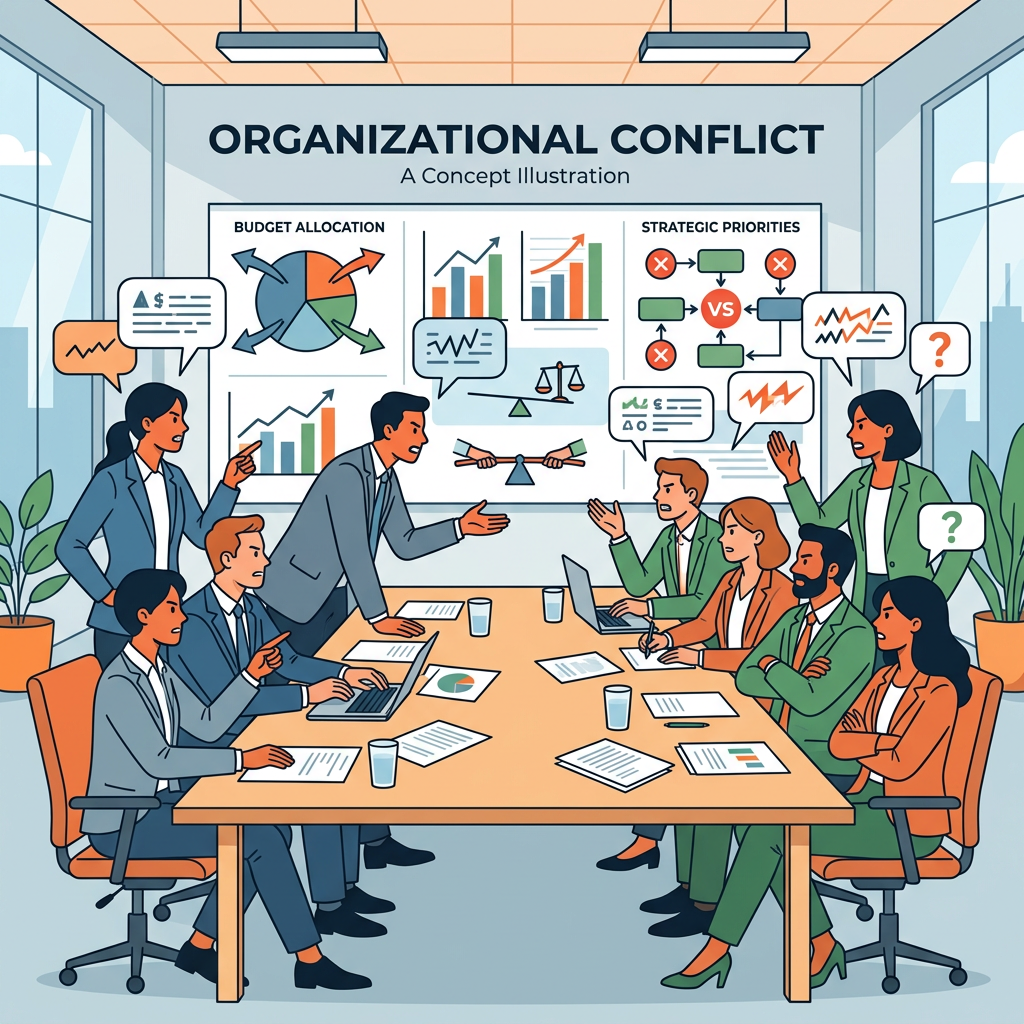
This learning journal examines conflict as a normal feature of organizational life rather than an automatic sign of failure. It distinguishes task conflict from relationship conflict, considers the positive and negative consequences of disagreement, identifies common structural sources of conflict, reviews the major conflict-management styles, and explores negotiation, BATNA, mediation, and arbitration. The central question running through the journal is not how to eliminate conflict, but how to create conditions in which conflict produces information, correction, and better decisions instead of hostility, withdrawal, and organizational damage.
Opening Reflection: Silence Is Not the Same Thing as Peace
Workplaces often describe conflict as though it were a contaminant that entered an otherwise healthy system. The language is familiar: keep the peace, avoid drama, be professional, do not make trouble. That sounds reasonable until peace becomes another word for silence and professionalism becomes the expectation that people should absorb problems without naming them.
Module 9 begins from a more realistic position. Conflict is inevitable because organizations bring together people with different goals, responsibilities, information, values, pressures, personalities, and access to resources. The existence of disagreement is therefore not the real problem. The deeper issue is whether the organization has enough trust, clarity, emotional intelligence, and process to keep disagreement constructive.
Conflict is information. Relationship conflict begins when the issue loses its container and the people become the target.
This distinction matters to me because I have seen workplaces appear calm while frustration was accumulating underneath. People may stop arguing because they have reached agreement. They may also stop arguing because experience has taught them that speaking changes nothing or creates personal risk. A quiet team can be aligned, exhausted, disengaged, intimidated, or simply waiting for the consequences to become visible. Silence alone does not tell us which one is true.
The Positive and Negative Consequences of Conflict
Constructive conflict can improve decision quality by forcing assumptions into the open. It can reveal information that did not reach formal reports, expose weak procedures, stimulate creativity, and motivate necessary change. A team that can challenge an idea without attacking the person has access to more intelligence than a team where everyone protects the first acceptable answer.
Conflict can also become expensive very quickly. It diverts attention from the work, increases stress, consumes time, damages psychological well-being, weakens communication, and breaks down cohesion. Once people begin defending identity, status, or dignity rather than discussing the original issue, the conflict becomes harder to solve because a technical remedy may no longer repair the relational damage.
| Constructive potential | Destructive risk |
|---|---|
| Questions assumptions and improves decisions | Turns disagreement into personal judgment |
| Generates new ideas and alternatives | Consumes time and emotional energy |
| Identifies problems before they grow | Encourages withdrawal, hostility, or retaliation |
| Clarifies values, priorities, and responsibilities | Weakens trust and group cohesion |
| Motivates change and organizational learning | Increases politics, turnover, and disengagement |
The practical lesson is that conflict should not be praised or condemned in the abstract. The organization has to ask what kind of conflict it is, what produced it, how it is being expressed, and whether the process is moving the parties closer to the actual issue or farther away from it.
Task Conflict and Relationship Conflict
Task conflict concerns the work: goals, facts, standards, priorities, methods, responsibilities, or possible solutions. It can be uncomfortable, but it remains attached to something that can be examined. Relationship conflict shifts attention toward the people involved. The disagreement becomes evidence that someone is lazy, dishonest, disrespectful, incompetent, controlling, disloyal, or impossible to work with.
The boundary between the two is not always clean. A disagreement about scheduling can become personal when one person believes their workload is repeatedly ignored. A debate about quality can become relational when feedback is delivered with contempt. A communication failure can become a character judgment when people begin assuming motive instead of checking meaning.
This is where emotional intelligence becomes operational rather than decorative. Self-awareness helps a person notice when anger, fear, pride, or old experience is entering the current disagreement. Self-management creates enough space to avoid turning that feeling into an immediate accusation. Social awareness helps recognize what the other person may be protecting or experiencing. Relationship management then turns the discussion back toward facts, interests, boundaries, and possible resolution.
Where Workplace Conflict Comes From
Module 9 identifies several recurring sources of conflict. What stands out is that most are not simply personality problems. They are built into the way work is organized.
| Source | How it appears at work | What a leader should inspect |
|---|---|---|
| Incompatible goals | One group is rewarded for speed while another is accountable for accuracy, safety, or cost. | Whether the goals can be aligned under a meaningful superordinate goal. |
| Differentiation | Departments develop different language, priorities, assumptions, and professional identities. | Whether each group understands the constraints and contribution of the others. |
| Interdependence | One person or unit cannot succeed without timely input, information, or output from another. | Handoffs, bottlenecks, authority, timing, and shared accountability. |
| Scarce resources | Teams compete for labour, equipment, time, budget, information, or management attention. | Whether the allocation method is transparent, fair, and connected to actual priorities. |
| Ambiguous rules | People do not know who decides, which standard applies, or where one role ends and another begins. | Role clarity, procedures, escalation paths, and decision rights. |
| Communication problems | Important information is delayed, filtered, misunderstood, assumed, or delivered through the wrong channel. | Message content, timing, medium, feedback, and whether people feel safe asking for clarification. |
This systems view changes the first question. Instead of immediately asking which person caused the conflict, the leader should ask what conditions made the conflict likely. Individual behaviour still matters, but accountability becomes more accurate when it includes the structure surrounding the behaviour.
Conflict Prevention Is a Design Responsibility
Conflict prevention does not mean suppressing disagreement. It means reducing unnecessary conflict while protecting the useful kind. Clear roles, stable procedures, visible priorities, realistic workloads, accessible information, fair resource allocation, and dependable communication channels remove many triggers before people are forced to fight through them.
Team norms are especially important. A healthy norm might say that people challenge ideas with evidence, raise concerns early, clarify intent before assigning motive, and do not punish someone for identifying a risk. Psychological safety does not require agreement or endless gentleness. It requires confidence that disagreement can occur without humiliation, retaliation, or exclusion.
A superordinate goal can also help when groups are divided. The purpose is not to erase their different interests, but to identify an outcome important enough that cooperation becomes more useful than continued positional fighting. The goal has to be real. A slogan about teamwork will not overcome reward systems, authority gaps, or resource decisions that keep forcing the groups into competition.
Conflict-Management Styles: No Single Style Is Maturity
The conflict-management styles are often arranged according to assertiveness and cooperativeness. The value of the model is not that one style is always correct. The value is that it forces a person to notice their default response and choose deliberately according to the situation.
| Style | Potential value | Main risk |
|---|---|---|
| Forcing or competing | Useful when a rapid decision is required, a safety or legal boundary must be enforced, or harmful conduct must stop. | Can create compliance without commitment and turn authority into resentment. |
| Problem-solving or collaborating | Useful when the issue is important, the relationship matters, and both sides possess information needed for a durable solution. | Requires time, trust, skill, and a genuine willingness to change positions. |
| Compromising | Useful when time is limited, power is relatively balanced, and each side can give something without damaging the core need. | May split the difference without solving the underlying problem. |
| Avoiding | Useful when the issue is minor, emotions need time to settle, more information is required, or engagement would increase danger. | Can allow unresolved conflict to harden, spread, or become urgent. |
| Yielding or accommodating | Useful when the issue matters more to the other party, preserving the relationship has greater value, or one party recognizes it is wrong. | Repeated accommodation can hide unfairness and train others to expect one-sided sacrifice. |
My Conflict-Style Self-Assessment
My earlier conflict-style assessment produced scores of 8 for collaborating, 8 for compromising, 6 for avoiding, 6 for accommodating, and 5 for competing. The pattern fits my experience. My first preference is usually to understand the whole problem and find a solution that people can live with. When that is not possible, I tend to look for workable compromise rather than forcing a result.
That approach has strengths. Collaboration can uncover the cause beneath the argument and preserve relationships that still have value. Compromise can keep work moving when perfect agreement is unrealistic. The risk is that a strong preference for collaboration assumes the other party is also trying to solve the problem. Sometimes the other party is managing delay, protecting power, avoiding accountability, or using discussion as a substitute for movement.
My moderate avoidance and accommodation scores also deserve attention. Avoidance can be sensible when I need more evidence or when the cost of engagement exceeds the likely benefit. Accommodation can be generous and practical. However, either can become a way of carrying costs that belong to the system or the other party. A person can preserve short-term peace by accepting an arrangement that produces deeper conflict later.
The lower competing score does not mean forcing is never appropriate. A leader sometimes has to make a decision, enforce a standard, protect safety, or state a boundary without pretending that every issue can be negotiated. The growth point for me is not to become more aggressive. It is to recognize earlier when collaboration is real, when compromise is fair, and when a clear decision or boundary is the more honest response.
Culture, Gender, and the Danger of Easy Generalization
Culture influences how people interpret disagreement, authority, directness, emotion, saving face, and acceptable public behaviour. Gender expectations may also shape how the same behaviour is judged. Directness can be read as confidence in one person and aggression in another. Accommodation can be praised as cooperative or dismissed as weak depending on who is displaying it.
The module appropriately warns against treating broad averages as instructions for judging individuals. A leader should remain aware that norms differ while still asking the person in front of them what respectful disagreement looks like, how decisions are usually communicated, and what conditions would make participation safer. Cultural awareness should increase curiosity, not replace evidence with a stereotype.
Negotiation: Positions, Interests, and BATNA
Negotiation is a process through which parties attempt to reach agreement about an issue where their interests are not identical. The quality of negotiation improves when people distinguish positions from interests. A position is the stated demand. An interest is the reason underneath it. Two positions may appear incompatible while the underlying interests still allow several solutions.
BATNA, the best alternative to a negotiated agreement, is one of the most practical concepts in the module. A person who does not understand their alternative may accept a poor agreement out of fear or reject a useful agreement out of pride. BATNA is not a threat. It is the realistic course available if the negotiation fails.
| Negotiation concept | Practical meaning |
|---|---|
| Distributive situation | The parties treat the available value as fixed. One side’s gain appears to require the other side’s loss. |
| Integrative situation | The parties search for differences in priorities, timing, risk, resources, or interests that may allow value to be created or exchanged. |
| Win-lose orientation | The focus is defeating the other party or claiming the largest share, even if the relationship and future cooperation are damaged. |
| Win-win orientation | The focus is a durable agreement that addresses important interests on both sides without pretending all outcomes will be equal. |
| BATNA | The best realistic action available if no agreement is reached. It sets the point below which agreement is worse than walking away. |
A win-win orientation should not be confused with automatic compromise. An agreement is not successful merely because everyone signs it. It must be workable, understood, supported by authority and resources, and better than the parties’ alternatives. Sometimes the honest result is that no agreement is available under the present conditions.
Third-Party Dispute Resolution
When the parties cannot resolve conflict directly, a third party may be required. The approaches differ in how much control remains with the people involved.
- Negotiation: The parties communicate directly or through representatives and retain control over whether an agreement is reached.
- Mediation: A neutral third party helps clarify issues, improve communication, identify interests, and develop options, but normally does not impose the outcome.
- Arbitration: A third party hears the positions and evidence, then makes a decision that may be binding. The parties gain finality but surrender much of their control over the result.
The progression matters. As conflict moves toward arbitration, the process becomes more formal, expensive, and externally controlled. That does not make arbitration wrong. Some disputes require an enforceable decision. It does mean that unresolved ambiguity, weak communication, positional bargaining, and damaged trust have now created a cost that the organization may have been able to address earlier.
Personal Application: When the System Turns a Work Problem into a People Problem
My experience operating a service business makes this module concrete. Contract work creates built-in interdependence. The contractor may be responsible for staffing and performance while another organization controls scope, standards, access, information, scheduling, or payment. When those pieces do not line up, the conflict can appear on the surface as an attitude or performance problem even though incompatible goals, scarce resources, ambiguous expectations, and communication failures are doing much of the work underneath.
I learned that being willing to solve problems can become its own vulnerability. The reliable party may keep absorbing schedule changes, extra tasks, shortages, or unclear direction because preserving the relationship seems more practical than escalating every issue. In the short term, that looks cooperative. Over time, repeated accommodation can quietly change the agreement without anyone openly renegotiating it.
The lesson I carry forward is that healthy collaboration needs boundaries, records, clear decision rights, and an understood BATNA. Good faith should be present, but it should not be the only control in the system. When responsibilities and authority are split across organizations, clarity is not bureaucracy. It is conflict prevention.
A Conflict Under Load Audit
The following audit translates Module 9 into a practical sequence for situations where emotion, urgency, hierarchy, or accumulated history may distort the issue.
- Name the observable issue. What happened without assigning motive or identity?
- Separate task from relationship conflict. What part concerns the work, and what relational damage is now affecting the discussion?
- Identify the source. Are incompatible goals, differentiation, interdependence, scarce resources, ambiguous rules, or communication failures involved?
- Map interests and positions. What is each party asking for, and what need or risk sits underneath that demand?
- Check the power difference. Can each party disagree safely, or does one control employment, information, scheduling, payment, or access?
- Choose the conflict style deliberately. Is this a time to collaborate, compromise, pause, accommodate, or enforce a boundary?
- Define the shared goal. What outcome matters to both parties enough to organize the conversation?
- Know the BATNA. What happens if agreement is not reached, and is that alternative truly workable?
- Record the agreement. Who will do what, by when, using which resources and standard?
- Set a review point. How will the parties know whether the resolution worked or merely postponed the conflict?
- Escalate proportionately. When direct negotiation fails, would mediation help, or is an enforceable third-party decision required?
Application to Organizational Behaviour
- Conflict should be diagnosed before it is moralized. The visible disagreement may be the symptom of a structural problem.
- Task conflict can improve decisions when dissent is protected and relationship conflict is actively limited.
- Emotional intelligence helps people use emotion as information without treating it as proof of motive.
- Conflict-management competence means selecting a style to fit the situation rather than defending a favourite style as universally mature.
- Psychological safety, clear rules, aligned goals, and reliable communication reduce unnecessary conflict while preserving useful debate.
- Negotiation improves when positions are translated into interests and each party understands its BATNA.
- Win-win does not mean everyone gets everything. It means the process searches honestly for a durable agreement without hiding one-sided costs.
- Mediation preserves more party control than arbitration, while arbitration may be necessary when finality and enforceability matter most.
- A leader’s behaviour during conflict teaches the real organizational norm. People watch whether dissent is examined, punished, ignored, or converted into better work.
Questions I Am Carrying Forward
- Is the team actually at peace, or has it learned that disagreement is unsafe?
- What structural condition is being mislabelled as a personality problem?
- When does collaboration become delay, and when does decisiveness become forcing?
- What costs are being carried by the party with less authority simply to keep the relationship functioning?
- Can a conflict remain task-focused when one party controls the consequences of disagreement?
- What would a genuinely shared goal look like, and is the reward system aligned with it?
- Is compromise producing a workable answer or merely dividing an unworkable arrangement in half?
- What is my BATNA, and have I mistaken hope for an alternative?
- What evidence would show that the conflict is resolved rather than temporarily quiet?
- At what point does third-party involvement protect the process rather than represent its failure?
Closing Reflection
The cleanest lesson I take from Module 9 is that conflict is neither automatically healthy nor automatically destructive. It is energy produced by difference, dependence, pressure, and perceived interference. What happens next depends on the container around it.
A healthy organization does not demand the absence of disagreement. It builds enough clarity, trust, emotional intelligence, and procedural fairness that people can disagree without becoming enemies. It understands that some conflict comes from individual conduct, but much of it is created or intensified by incompatible goals, scarce resources, unclear rules, weak communication, and divided authority.
For me, the personal correction is to keep collaboration as a strength without treating it as an obligation to remain in every negotiation indefinitely. Cooperation works best when it is mutual, informed, and bounded. Compromise is useful when both parties are truly giving something. Avoidance is useful when it creates space rather than surrender. Forcing is justified when a necessary boundary must be protected. The mature response is not one style. It is the honest choice of style for the situation in front of me.
Keep the disagreement attached to the issue. Name the structure beneath it. Protect the people without protecting the dysfunction.
That is where organizational behaviour meets the ledge: evidence before accusation, structure before blame, boundaries before resentment, and resolution before the silence becomes another kind of damage.
Godspeed.
Field Card
- One receipt: Silence does not prove agreement. It may prove that the cost of speaking has become too high.
- One next step: Before responding to conflict, name the observable issue, the structural source, the relationship damage, and the desired outcome.
- One boundary sentence: “I am willing to work toward a solution, but I am not willing to solve the problem by pretending the present arrangement is clear or sustainable.”
References
Algonquin College. (2026). Module 9: Conflict, dispute resolution, and negotiation. MGT2382 Organizational Behaviour course materials.
McShane, S. L., & Steen, S. L. (2012). MGM300: Organizational behaviour. McGraw-Hill.
McLaughlin, K. (2026). MGT2382 conflict-management self-assessment and related learning-journal reflections.
Discover more from Standing on the Ledge
Subscribe to get the latest posts sent to your email.
 Standing on the Ledge