
MGT2382 Organizational Behaviour Learning Journal
Date: July 11, 2026
Topic: Organizational change, group behaviour, resistance, leadership, and workplace culture
Working Thesis
Lewin’s model shows that lasting organizational change requires more than introducing a new policy or procedure. Leaders must first loosen the forces holding existing behaviour in place, support people while new behaviour is being learned, and then reinforce the new behaviour until it becomes part of the organization’s normal way of operating.
Opening Reflection: Organizations Are Held in Place by Forces
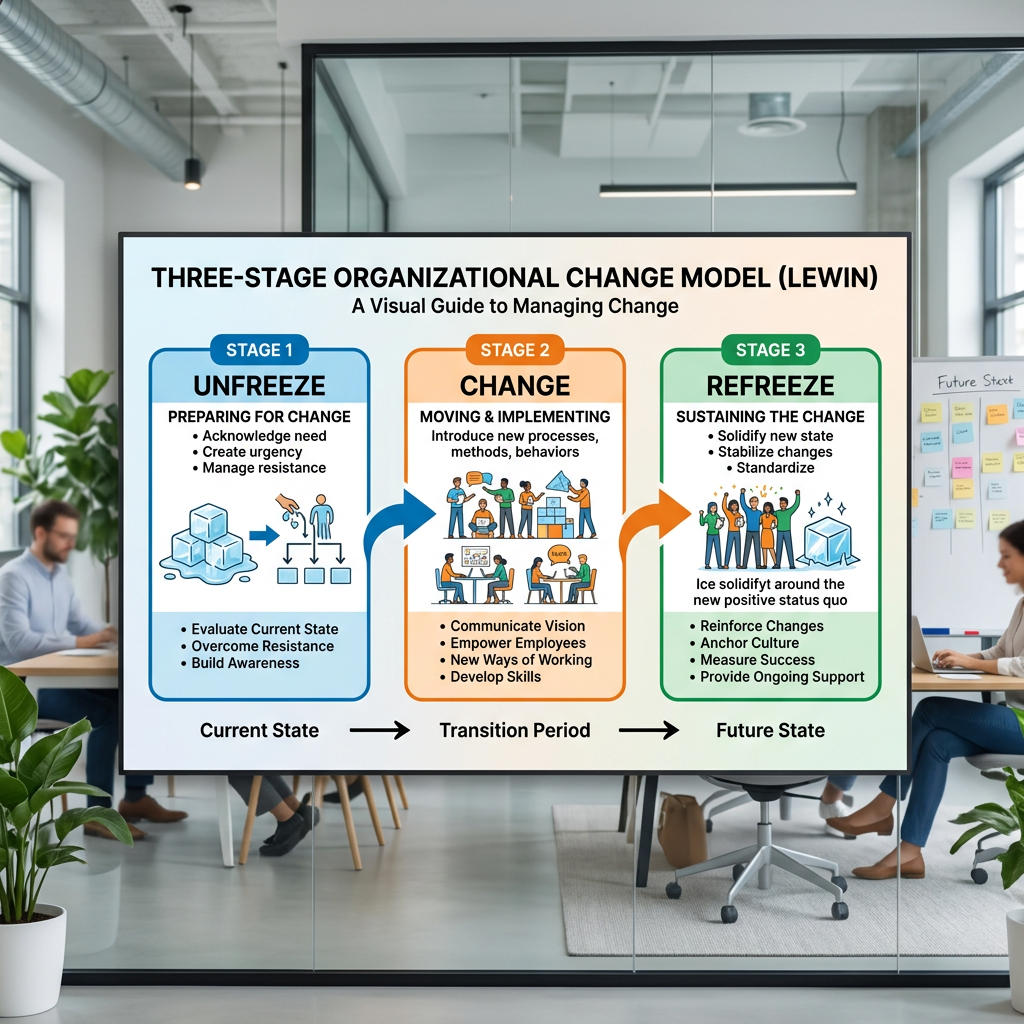
My first impression of Lewin’s change model was that it appears almost too simple. It is commonly explained through three stages: unfreeze, change, and refreeze. Compared with Kotter’s eight-step model, Lewin’s approach looks brief and almost obvious.
However, the more closely I examined it, the more I realized that the model is not really about three management tasks. It is about understanding why individuals and groups continue behaving as they do, even when management believes there is an obvious need to change.
Lewin viewed behaviour as the result of forces operating within a social environment. An organization may appear stable, but that stability does not mean nothing is happening. It may mean that forces supporting change and forces resisting change are balancing one another.
This idea helped me see resistance differently. Employees do not necessarily remain with an existing process because they are lazy, stubborn, or incapable of learning. Their behaviour may be supported by workplace routines, group expectations, reward systems, past experience, limited resources, fear, uncertainty, or a lack of trust in management.
Changing the behaviour therefore requires more than issuing instructions. The organization must understand and alter the forces maintaining the existing situation.
The Three Stages of Lewin’s Model
1. Unfreezing the Existing Situation
Unfreezing means preparing people and the organization to move away from an established pattern of behaviour.
The existing way of working may be inefficient or outdated, but it is still familiar. Employees know what is expected, how to complete their tasks, whom to approach, and how their co-workers are likely to respond. Even an imperfect routine provides some predictability.
A proposed change disturbs that predictability. It may challenge an employee’s knowledge, status, confidence, relationships, workload, or sense of competence. Before people can accept a new process, they must first recognize that the current process cannot simply continue unchanged.
From an organizational behaviour perspective, unfreezing connects to perception, motivation, emotions, communication, psychological safety, organizational justice, and readiness for change.
Employees need credible information explaining:
- Why the change is necessary
- What problem the change is intended to solve
- What will happen if the organization does not change
- How employees will be affected
- What support will be available
- Whether employee concerns will be taken seriously
Unfreezing should not mean frightening employees until they comply. Fear may create immediate movement, but it can also increase stress, defensiveness, silence, mistrust, and withdrawal.
The goal should be awareness and readiness rather than panic.
People are more likely to release an old behaviour when they understand why it is no longer working and believe they will be supported while learning a replacement.
Unfreezing and Resistance
Resistance becomes valuable information during this stage.
If employees oppose a proposed change, leaders should investigate why. The resistance may be connected to poor communication, previous failed changes, fear of job loss, increased workload, inadequate training, loss of influence, conflicting goals, or a belief that management has misunderstood the work.
Some resistance may also be rational. Frontline employees may recognize practical consequences that senior decision-makers have not considered.
This does not mean management must abandon every change when someone objects. It means leaders should diagnose resistance before attempting to overpower it.
Unfreezing is therefore partly a process of weakening restraining forces. Those forces can include:
- Fear of making mistakes
- Unclear expectations
- Inadequate resources
- Strong informal group norms
- Low trust in management
- Past experiences with unsuccessful change
- Reward systems that support the old behaviour
- A lack of participation in decision-making
2. Changing or Moving to a New Level
The second stage is often called changing, moving, or transition. This is the period in which new behaviours, processes, roles, or attitudes are introduced and tested.
This stage can be uncomfortable because the old routine has been weakened, but the new routine is not yet fully established. Employees may understand why change is needed while still being uncertain about how to perform under the new system.
This connects closely to the organizational behaviour concepts of learning, ability, role perception, communication, feedback, self-efficacy, leadership, and employee involvement.
During the change stage, employees may need:
- Training and practical demonstrations
- Clear role expectations
- Opportunities to practise new skills
- Access to equipment and information
- Coaching from supervisors
- Feedback that corrects problems without humiliating people
- Time to adjust
- Permission to identify weaknesses in the new process
This stage reminded me of the MARS model of individual behaviour and performance. Motivation does not automatically produce successful performance. Employees must also possess the required ability, understand their roles, and have supportive situational conditions.
An organization can unfreeze employees by convincing them that change is necessary, but the change will still fail if they are not given the ability or resources to act differently.
Employee Participation During Change
One of the strongest elements in Lewin’s original work is the importance of groups and group decisions.
People do not operate independently of their co-workers. Employees compare their behaviour with group standards. They watch how respected co-workers react. They learn which behaviours are accepted, rewarded, mocked, or discouraged.
This means a change directed only at individuals may fail when the group continues enforcing the old standard.
For example, management may introduce a new safety procedure. An employee may understand and support it, but if the work group treats the procedure as unnecessary or slow, the employee may experience pressure to return to the old behaviour.
Changing group expectations can be more effective than attempting to change each employee separately.
Participation can also increase psychological ownership. Employees are more likely to support a process when they have had a real opportunity to discuss it, contribute knowledge, identify problems, and influence implementation.
However, consultation must be genuine. Asking for employee input after every important decision has already been finalized is not meaningful participation.
Leadership During the Change Stage
Leadership becomes especially visible during transition.
Employees judge the change not only by management’s formal statements but also by management’s behaviour. If leaders demand a new standard while personally ignoring it, the change loses credibility.
Leaders must model the expected behaviour, respond consistently, provide feedback, address barriers, and remain available when employees encounter difficulties.
They must also distinguish between unwillingness and inability. An employee who refuses to follow a new process may require accountability. An employee who has not been trained, lacks the required equipment, or has received conflicting instructions requires support and clarification.
Treating every performance problem as an attitude problem allows management to avoid examining the work environment.
3. Refreezing or Stabilizing the New Behaviour
The final stage is commonly called refreezing, although Lewin’s original article referred to freezing group life at the new level.
The purpose is not to make the organization permanently rigid. It is to prevent employees and systems from automatically returning to the previous pattern once the immediate pressure for change has passed.
New behaviour must be reinforced until it becomes normal, supported, and reasonably stable.
This stage connects to reinforcement theory, organizational culture, social norms, reward systems, performance management, leadership consistency, and organizational learning.
Refreezing may involve:
- Updating formal policies and procedures
- Revising job descriptions
- Providing continued coaching
- Recognizing successful performance
- Aligning performance evaluations with the new expectations
- Ensuring supervisors consistently support the new process
- Removing outdated systems that encourage the old behaviour
- Including the new process in employee orientation and training
- Reviewing results and correcting weaknesses
A change has not been stabilized merely because employees followed it during the first week.
Employees often return to previous practices when management attention moves elsewhere, resources are reduced, deadlines increase, or leaders stop reinforcing the new expectation.
The real test is whether the new behaviour continues after the excitement, pressure, or supervision surrounding the original change has declined.
Refreezing Does Not Mean Refusing Future Change
One criticism of Lewin’s model is that modern organizations operate in environments of constant change. Technology, customer expectations, competition, staffing conditions, and regulations may continue changing before an organization has time to settle into a permanent new state.
This criticism is reasonable if refreezing is interpreted as locking the organization into one method indefinitely.
I do not think that is the most useful interpretation. Refreezing can instead mean stabilizing what has been learned long enough for the new behaviour to become reliable.
An organization can establish a new standard while remaining willing to review and improve it. Stability and adaptability do not have to be opposites.
Without some stabilization, employees may experience continuous uncertainty and change fatigue. Processes may be introduced but never properly learned. Before one initiative is complete, another begins. Employees eventually stop investing in change because they expect every new program to disappear.
Refreezing therefore provides enough structure for people to understand what currently applies while leaving room for future learning.
Force Field Analysis
Lewin’s approach is closely connected to force field analysis. This involves examining the forces pushing toward change and the forces restraining it.
For example, an organization introducing a new reporting system might identify the following driving forces:
- The existing system produces errors
- Clients require better information
- The new system can reduce duplication
- Management supports the change
- Some employees want a more efficient process
The restraining forces might include:
- Employees have not been trained
- The new software is unreliable
- Workers fear increased monitoring
- Supervisors continue requesting the old reports
- Staffing levels leave little time for learning
- Previous technology changes were poorly managed
A weak change strategy focuses only on increasing pressure. Management repeats that the new system is mandatory and threatens discipline for non-compliance.
A stronger strategy also reduces the restraining forces. It provides training, repairs technical problems, explains how the information will be used, eliminates duplicate reporting, and gives employees time to practise.
This is an important OB lesson. Increasing pressure is not always the most effective way to create movement. Reducing barriers may produce better results with less conflict.
Resistance Is Often a System Outcome
Lewin’s model supports a conclusion that has appeared throughout my organizational behaviour studies: individual performance cannot be separated from the environment in which it occurs.
Organizations frequently describe change failure as an employee attitude problem. Workers are called resistant, negative, complacent, or unwilling to learn.
That explanation may occasionally be accurate, but it is often incomplete.
If employees are rewarded for the old behaviour, punished for experimentation, denied necessary information, assigned conflicting priorities, or placed under impossible workloads, the organization itself may be producing the resistance.
Before blaming the employee who has not changed, examine the forces that continue rewarding the employee for remaining the same.
Comparison With Kotter’s Eight-Step Model
Lewin and Kotter approach organizational change at different levels of detail.
Lewin provides a broad framework:
- Prepare the organization to release the old behaviour.
- Support movement toward the new behaviour.
- Stabilize the new behaviour so it lasts.
Kotter provides a more detailed sequence involving urgency, a guiding coalition, vision, broad participation, barrier removal, short-term wins, continued acceleration, and institutionalization.
Kotter’s steps can be understood as activities occurring within Lewin’s larger stages.
Creating urgency, building a coalition, and communicating a vision help unfreeze the organization. Removing barriers, involving employees, and producing early wins support movement. Sustaining progress and embedding the change in culture contribute to refreezing.
Lewin explains the overall behavioural process. Kotter provides a more detailed leadership roadmap.
Critical Evaluation of the Model
The greatest strength of Lewin’s model is its clarity. It reminds leaders that people must be prepared before change, supported during change, and reinforced after change.
It also directs attention toward group norms and workplace forces rather than assuming behaviour is entirely a matter of personal choice.
The model’s simplicity is also its greatest weakness. Real organizational change does not always occur in three separate stages. Unfreezing, changing, and stabilizing may overlap. New resistance can appear during implementation. A stabilized process may need revision. Different departments may move at different speeds.
The model can also be misused as a top-down management formula. Leaders may decide what must change, label employee concerns as resistance, and attempt to manipulate the workforce into compliance.
That approach ignores Lewin’s broader emphasis on participation, group decision-making, social conditions, and research-based problem solving.
There is also an important historical debate. Later textbooks often present a polished “unfreeze-change-refreeze” model as if Lewin personally created the exact modern diagram. Researchers have argued that the simplified model developed partly through later interpretations of his work.
This does not make the framework useless. It means the model should not be separated from Lewin’s wider ideas about field theory, group dynamics, action research, and social forces.
Closing Reflection
Lewin’s model has changed how I think about stability in organizations.
What appears to be a fixed workplace routine may actually be the temporary result of competing forces. Employees continue behaving in a certain way because policies, rewards, relationships, expectations, resources, and group norms are holding that behaviour in place.
Change therefore requires more than telling people to move.
Leaders must understand what is holding the current behaviour in place, reduce unnecessary barriers, involve the people affected, provide the ability and resources to perform differently, and reinforce the new standard consistently.
The most important lesson I take from Lewin is that change is social. Individuals work within groups, and groups operate within systems. A leader who ignores those relationships may create temporary compliance, but not lasting change.
Field Card: Applying Lewin’s Model
Before Change: Unfreeze
- What behaviour or process needs to change?
- What forces currently support the old behaviour?
- Do employees understand why change is necessary?
- What concerns, losses, or risks do employees perceive?
- Have frontline employees been genuinely consulted?
- Which restraining forces can be reduced before implementation?
During Change: Move
- Are roles and expectations clear?
- Do employees have the required training and ability?
- Are equipment, staffing, time, and information adequate?
- Are leaders modelling the expected behaviour?
- Can employees safely report problems?
- Is feedback being used to improve the process?
After Change: Refreeze
- Are policies and systems aligned with the new behaviour?
- Are supervisors reinforcing the new standard consistently?
- Do rewards and performance measures support the change?
- Have obsolete procedures been removed?
- Is the change included in training and orientation?
- Are results being monitored without assuming the process is permanently complete?
Practical takeaway: Lasting change occurs when the forces surrounding behaviour change, not merely when management announces a new expectation.
References
Burnes, B. (2004). Kurt Lewin and the planned approach to change: A re-appraisal. Journal of Management Studies, 41(6), 977–1002. View source.
Burnes, B. (2020). The origins of Lewin’s three-step model of change. The Journal of Applied Behavioral Science, 56(1), 32–59. View source.
Cummings, S., Bridgman, T., & Brown, K. G. (2016). Unfreezing change as three steps: Rethinking Kurt Lewin’s legacy for change management. Human Relations, 69(1), 33–60. View source.
Hussain, S. T., Lei, S., Akram, T., Haider, M. J., Hussain, S. H., & Ali, M. (2018). Kurt Lewin’s change model: A critical review of the role of leadership and employee involvement in organizational change. Journal of Innovation & Knowledge, 3(3), 123–127. View source.
Lewin, K. (1947). Frontiers in group dynamics: Concept, method and reality in social science; social equilibria and social change. Human Relations, 1(1), 5–41. View source.
The Open University. (n.d.). Lewin’s change management model. View source.
Discover more from Standing on the Ledge
Subscribe to get the latest posts sent to your email.

