
MGT2382 Organizational Behaviour Learning Journal
Date: July 11, 2026
Topic: Organizational change, leadership, employee behaviour, and workplace culture
Working Thesis
Organizational change does not succeed simply because management has announced a new direction. Change becomes real only when people understand it, believe it is possible, possess the ability and resources to act, and see the new behaviour reinforced by the organization.
Opening Reflection: Announcing Change Is Not Managing Change
My first reaction to Kotter’s model was that it explains something I have repeatedly observed in workplaces: organizations often confuse making an announcement with implementing change.
A new procedure is introduced. Staffing levels are altered. A reporting system changes. A client establishes a new expectation. Management sends an email, holds a meeting, or distributes revised instructions. From that point forward, employees are expected to behave differently.
When the change does not work, management may conclude that employees are resistant, negative, unmotivated, or unwilling to adapt. Kotter’s model challenges that conclusion by treating change as a process rather than a single management decision.
John Kotter originally developed the model after examining organizational transformation efforts and identifying recurring reasons that change initiatives failed. The model has since evolved from a strictly linear sequence into what Kotter describes as a more flexible set of change accelerators.
From an organizational behaviour perspective, the model is valuable because every step involves human behaviour. It touches motivation, perception, emotions, leadership, communication, power, team dynamics, organizational culture, reinforcement, and resistance.
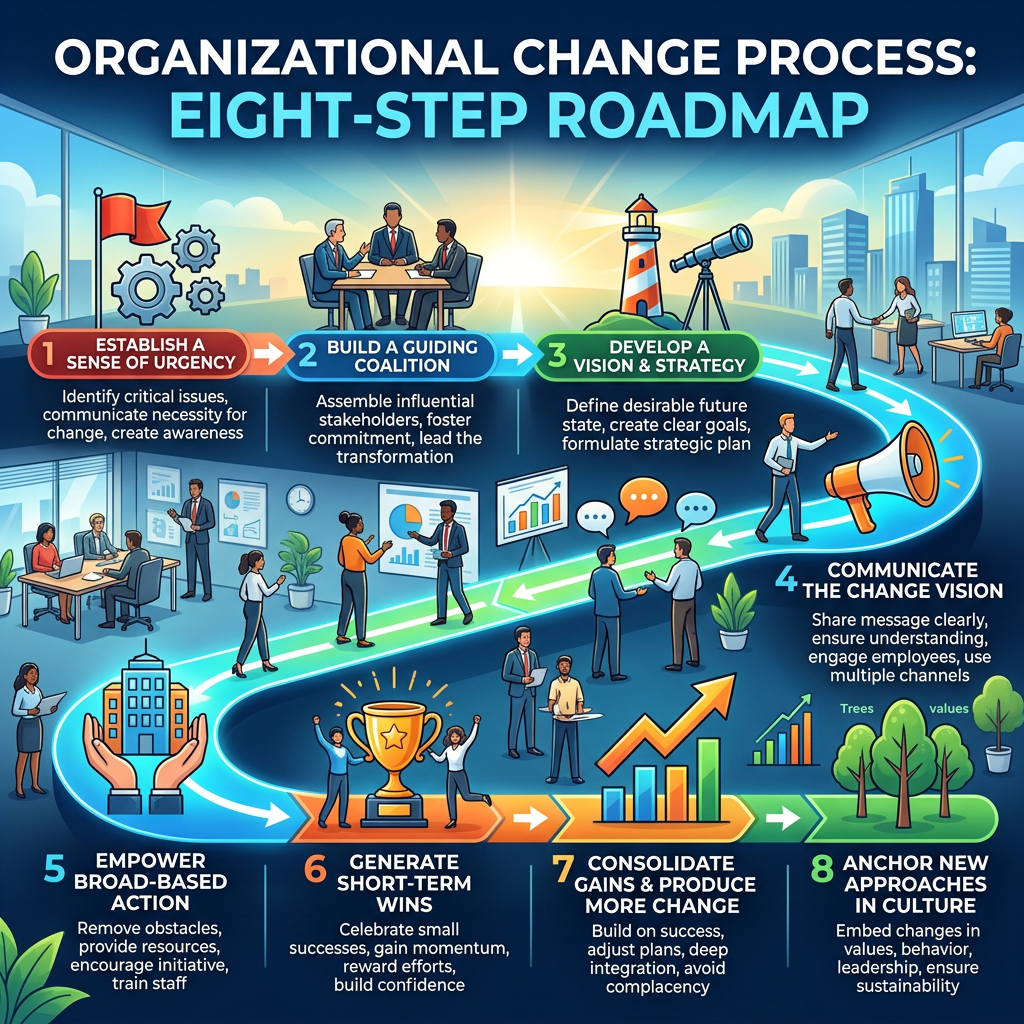
The Eight Steps Through an Organizational Behaviour Lens
1. Create a Sense of Urgency
People need to understand why the present situation cannot simply continue. This connects to perception, emotions, motivation, and sensemaking.
Urgency should not mean creating panic. Fear may produce immediate compliance, but it can also create stress, mistrust, defensive behaviour, and poor decision-making. Effective urgency gives employees a credible reason to move while showing them that their actions can influence the outcome.
This step reminded me that people will not automatically share management’s interpretation of a problem. Employees may have different information, experiences, priorities, or levels of trust. Before expecting movement, leaders must establish a shared understanding of why movement is necessary.
2. Build a Guiding Coalition
Kotter argues that change needs a committed group capable of guiding, coordinating, and communicating the effort.
This is directly related to leadership, informal influence, team composition, power, and social networks. The person with the highest position is not always the person with the greatest workplace credibility. Employees often look toward experienced co-workers, supervisors, or informal leaders when deciding whether a change is legitimate.
A coalition composed only of senior managers may possess formal authority but lack frontline knowledge. A stronger coalition includes people who understand both organizational strategy and the practical realities of the work.
3. Form a Strategic Vision
A vision explains how the future will differ from the past and how the proposed initiatives will create that future.
In organizational behaviour terms, the vision provides direction for goal setting and expectancy. Employees need to see the connection between their effort, their performance, and the desired result. Statements such as “we must improve efficiency” are too vague to guide behaviour.
A useful vision answers practical questions. What are we changing? What will remain the same? What behaviours are expected? How will success be measured? How will this affect employees, clients, workload, authority, and accountability?
4. Enlist People in the Change
Kotter’s updated model emphasizes creating a broad group of people who actively want to contribute rather than relying only on instructions from the formal hierarchy.
This step connects to commitment, social identity, intrinsic motivation, participation, and psychological ownership. People are more likely to support a change when they have a meaningful role in shaping and carrying it out.
There is an important difference between participation and performance. Asking employees for opinions after the major decisions have already been made is not genuine involvement. Employees usually recognize when consultation is only symbolic.
5. Enable Action by Removing Barriers
This may be the most practical step in the entire model.
Organizations frequently demand new behaviour while leaving the old barriers in place. Employees may lack training, equipment, information, time, authority, staffing, or management support. They are then blamed for failing to produce the desired results.
This connects closely to the MARS model. Motivation alone cannot produce performance when ability, role perception, or situational conditions are inadequate.
Research on change management identifies communication, employee coaching, resistance management, stakeholder involvement, motivation, and leadership support as major contributors to successful change.
Removing barriers therefore means more than telling employees to embrace change. It requires changing the conditions surrounding their behaviour.
6. Generate Short-Term Wins
Short-term wins provide evidence that the effort is producing results. They also offer feedback, recognition, reinforcement, and increased self-efficacy.
Kotter describes these wins as results that should be identified and communicated early enough to maintain energy and persistence.
This step connects with motivation theory and organizational behaviour modification. When employees can see progress, they are more likely to believe that continued effort is worthwhile. A distant promise is rarely as motivating as visible evidence that the new approach is working.
However, the wins must be credible. Declaring victory while employees continue experiencing the same problems will reduce trust rather than build it.
7. Sustain Acceleration
Early success can create complacency. The organization may assume the change is complete before the new behaviour has become stable.
Sustaining acceleration involves learning from results, correcting weaknesses, improving systems, and continuing the work rather than returning to familiar routines. This requires feedback, adaptability, learning, and continued leadership attention.
It also means recognizing that different departments and groups may move at different speeds. Research has criticized rigid applications of Kotter’s model because complex organizations may need several overlapping or repeated change cycles rather than one neat sequence of stages.
8. Institute the Change
The final step is to connect the new behaviour to organizational success and embed it in workplace systems, processes, management practices, and culture.
This is where temporary behaviour becomes an organizational norm.
A change has not been institutionalized if employees are expected to follow a new procedure while performance measures, rewards, staffing decisions, leadership behaviour, or informal norms still support the old one. Culture is not changed by slogans. It changes when repeated behaviour is supported by the organization’s actual systems.
Resistance as Information
One of my strongest conclusions is that resistance should not automatically be interpreted as employee failure.
Resistance may reveal confusion, mistrust, unfairness, excessive workload, poor timing, fear of losing status, inadequate training, or practical problems management has overlooked. Research identifies effective and continuous communication as important for building readiness, reducing resistance, and gaining employee support.
This does not mean every objection is correct or that employees should control every decision. It means resistance contains information. Leaders should investigate that information before dismissing it.
Calling people resistant is easy. Determining what the resistance is communicating requires leadership.
Critical Evaluation of the Model
Kotter’s model is useful because it gives leaders a practical structure. It forces management to consider urgency, leadership support, communication, participation, barriers, motivation, reinforcement, and culture.
Its weakness is the temptation to treat it as a checklist.
Real organizational change is rarely clean or sequential. New barriers can appear after early wins. A coalition can lose credibility. The vision may need revision. Different groups may interpret the change differently. Employees may support the goal while opposing the method.
Research continues to find value in Kotter’s framework, but it also suggests that the model must be adapted to the type of change, the organization, and the people affected. It may need to operate cyclically, with communication and employee involvement continuing across all eight stages.
Closing Reflection
Kotter’s model changed how I think about the phrase “resistance to change.”
What appears to be resistance may actually be the predictable result of poor communication, weak leadership, unclear roles, missing resources, unfair procedures, or a lack of trust. An organization cannot create a policy at the top, transfer all responsibility for implementation downward, and then blame employees when the surrounding system remains unchanged.
The central lesson is that change is not something management does to employees. It is a behavioural and social process that must move through the organization.
Successful change requires more than authority. It requires credibility, participation, practical support, visible progress, and alignment between what leaders say and what the organization actually rewards.
Field Card: Before Blaming Resistance
Before concluding that employees are resisting change, ask:
- Do they understand why the change is necessary?
- Do they trust the people leading it?
- Can they see themselves in the proposed future?
- Have they been given meaningful opportunities to participate?
- Do they have the training, time, authority, staffing, and resources required?
- Are early results visible and credible?
- Are leaders reinforcing the change through their own behaviour?
- Have organizational systems been changed, or have employees merely been told to behave differently?
Practical takeaway: Do not demand changed behaviour while preserving the conditions that created the old behaviour.
References
Errida, A., & Lotfi, B. (2021). The determinants of organizational change management success: Literature review and case study. International Journal of Engineering Business Management, 13. View source.
Kotter. (n.d.). The 8 steps for leading change. View source.
Kotter, J. P. (1995). Leading change: Why transformation efforts fail. Harvard Business Review, 73(3), 59–67. View source.
Sittrop, D., & Crosthwaite, C. (2021). Minimising risk—The application of Kotter’s change management model on customer relationship management systems: A case study. Journal of Risk and Financial Management, 14(10), 496. View source.
“`Discover more from Standing on the Ledge
Subscribe to get the latest posts sent to your email.
 Standing on the Ledge