
Disclaimer: This post is offered as personal reflection and general educational content only. It is not medical advice, not mental health advice, and not a substitute for professional care. Sleep problems, late-night patterns, and attention-related struggles can have many different causes. If any of this is seriously affecting your health, safety, work, or day-to-day functioning, please reach out to a qualified healthcare or mental health professional.
Hey there, Standing on the Ledge. How are y’all today?
I want to revisit something I wrote about recently, because there is an important caveat that changes the picture.
I talked about the idea of revenge bedtime procrastination, that pattern where people stay up too late trying to reclaim a piece of the day for themselves. There is truth in that idea for a lot of people. But in my case, and maybe in yours too, there is another factor that has to be acknowledged before we start slapping labels on things.
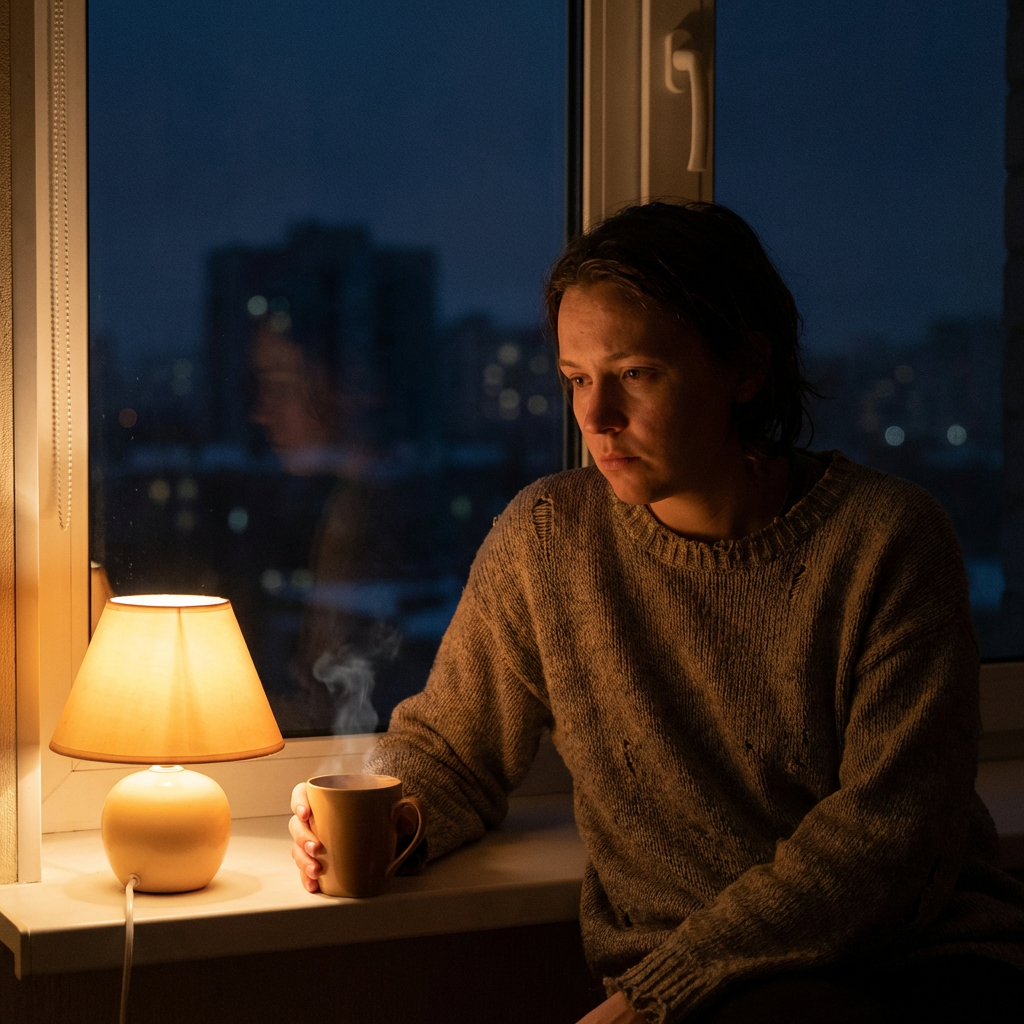
I have always been a late-night person.
Not for the last six months. Not because of social media. Not because adulthood got messy. Not because I suddenly forgot how clocks work. I mean always. Since childhood. I have preferred the quiet of the night, the lower traffic, the fewer people, the reduced noise, the sense that the world is finally leaving me alone long enough to think. I have preferred working nights to days. I have preferred late-night television, late-night activity, late-night solitude. At 56 years old, that is not a passing quirk. That is part of how I am wired.
That matters, because it changes the question.
The issue is not simply, “Why am I staying up late?” The issue becomes, “When does a natural night-owl rhythm cross over into something that starts costing more than it gives?”
That is a much more honest question, and frankly, a much more useful one.
There is a difference between being a person whose system naturally runs later and being a person who is pointlessly sabotaging sleep. Those are not the same thing. They can overlap, but they are not interchangeable. Some of us do not stay up late because we are reckless. Some of us stay up late because the night has always felt more livable than the day.
Less pressure. Less interruption. Less performance. Less social static.
For some people, the morning feels fresh and full of promise. For others, morning feels like an ambush. Night, on the other hand, feels like breathing room. Night feels like room to think. Night feels like your own name sounding like your own name again.
So no, I do not think it is accurate to look at a lifelong pattern like mine and reduce it to some trendy internet phrase as though that explains everything. That would be too neat, too shallow, and too convenient. The reality is more layered than that.
What may be happening is this: the baseline has always been late. The preference has always been late. The comfort zone has always been late. But stress, overload, ADHD-style friction, or the feeling that the day did not belong to me can push that baseline even further. At that point, the night stops being simply my natural rhythm and starts becoming the place where I try to recover agency, quiet, and selfhood.
That is where the “revenge” piece may enter the picture, not as the whole story, but as an added layer.
In other words, I may not be delaying sleep because I am fundamentally fighting my nature. I may be delaying sleep because the one part of my nature that has always been true, being more alive and more at ease at night, is getting stretched past what my body can actually afford.
That is a different problem entirely.
And it deserves a different kind of honesty.
Because if you are a natural night person, the goal cannot be to shame yourself into becoming an artificial morning saint. That is a fool’s game. It will fail, and then you will make it moral. You will call yourself lazy, undisciplined, weak, irresponsible, broken, or immature, when what may actually be true is that you have been trying to force your life through a timing pattern that has never fit you well.
But the opposite mistake is not any better.
You also cannot romanticize the night so much that you ignore the bill it hands you the next day.
That is the trap.
The quiet is real. The comfort is real. The focus can be real. The sense of finally getting your mind back can be real. But if every night becomes the place where you try to recover everything the day took from you, eventually the night starts taking from you too.
That is where this gets serious.
Because then the issue is no longer, “Am I a night owl?” Yes, probably. The issue becomes, “Am I using the night in a way that serves me, or am I using it to compensate for a life structure that keeps stripping me for parts during the day?”
That is a Standing on the Ledge question if there ever was one.
What are you actually protecting when you stay up?
Is it quiet?
Is it autonomy?
Is it decompression?
Is it your ability to think without interference?
Is it the feeling that the day is finally asking nothing more of you?
If so, then the answer is not to sneer at yourself and mutter something about discipline. The answer is to get smarter about where your life is starving you and why the night has become the place where you try to eat.
Because maybe the real problem is not that you love the night. Maybe the real problem is that too little of the day feels inhabitable.
That is a harder truth, but it is also a cleaner one.
For me, I think that is the more accurate frame. I do not think I am a textbook example of someone who suddenly started “revenge bedtime procrastinating.” I think I am someone who has always had a later rhythm, always preferred quieter hours, always functioned better away from noise and crowds, and who may, under pressure, push that rhythm too far because the night feels like the only stretch of time not under siege.
That does not make the pattern harmless. It just makes it understandable.
And once something becomes understandable, it becomes workable.
A better question than “Why don’t I just go to bed?”
Try this instead:
What does the night give me that the day is failing to give me?
That question has teeth. That question gets somewhere. That question does not turn you into your own prosecutor. It turns you into an investigator.
Maybe the answer is silence. Maybe it is control. Maybe it is solitude. Maybe it is the only time your nervous system unclenches. Maybe it is the only time you can hear yourself think. Maybe it is where you feel most like who you actually are.
Once you know that, you can start making adult decisions about it.
Not fake self-help decisions. Not punishment. Not fantasy. Real decisions.
How much of that need can be protected earlier in the day?
How much of it has to remain a nighttime thing because that is simply how you are built?
And where is the line where a natural pattern becomes a costly one?
That is the line worth learning.
Tool: Night Owl or Night Drift?
Before the evening gets away from you, write down three short answers:
- What part of this is my natural rhythm?
- What part of this is me trying to recover from the day?
- What is one way to protect the good part of the night without making tomorrow worse?
Keep it brief. One sentence each. No essay. No drama. No self-attack.
The goal is not to become someone else.
The goal is to stop confusing your nature with your drift, and to stop confusing your drift with your character.
Some of us were always built a little closer to midnight. That does not mean nothing is wrong. It also does not mean everything is wrong.
It just means you need a truer map.
Godspeed.
Discover more from Standing on the Ledge
Subscribe to get the latest posts sent to your email.

