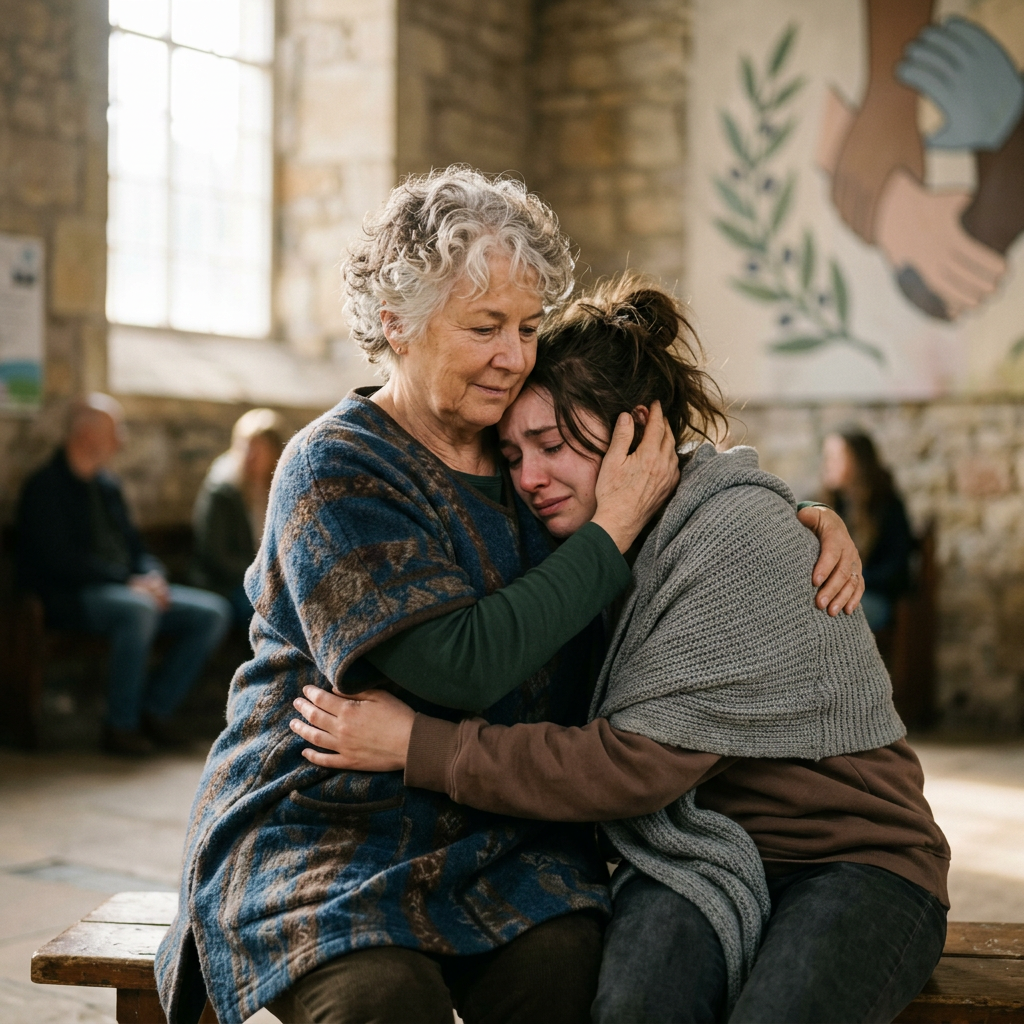

Reader’s Moment: You may know what happened. You may have records, memories, receipts, dates, messages, and a body that still reacts when certain details surface.
But knowing what happened is not always the same as being witnessed.
Sometimes the hardest part of collapse is not the event itself. It is carrying the event without a safe place to put it. No one to hear it without fixing it. No one to sit with the reality of it without turning it into advice, judgment, gossip, strategy, or dismissal.
That is the witness problem.
Standing on the Ledge has named loneliness before. It has named isolation, the inner courtroom, shame loops, overthinking, and the strange pressure to explain yourself when your nervous system is already overloaded.
But underneath many of those patterns is something more basic:
When no safe witness exists, the mind often tries to become its own courtroom, its own evidence locker, its own defense attorney, and its own exhausted jury.
That is too much for one person to carry indefinitely.
What a Witness Is
A witness is not a rescuer.
A witness does not have to fix your life, fight your battle, take your side without thought, or solve the whole situation.
A witness helps reality stay real when your own mind is overloaded.
That matters more than people often realize.
When something destabilizing happens, especially something involving loss, conflict, betrayal, legal pressure, workplace collapse, family rupture, or public humiliation, the mind can start to bend under the pressure. Not because you are weak. Because you are carrying too much input without enough reflection.
A good witness helps you say, “Yes, that happened. Yes, that was real. Yes, I can slow down now. I do not have to keep proving reality to myself every ten minutes.”
That is not rescue.
That is stabilization.
Witness, Rescuer, Audience, Judge
These roles get confused easily, especially under stress.
A witness says:
“I hear you. I understand this matters. Let’s keep this grounded.”
A rescuer says:
“I will take over. I will fix this. I will carry it for you.”
An audience says:
“Tell me more. Make it compelling. Keep my attention.”
A judge says:
“Prove it. Defend yourself. Convince me you deserve support.”
The difference matters.
A rescuer can create dependency. An audience can turn pain into performance. A judge can deepen the wound by forcing a person to plead their case before they have even stabilized.
A witness does something quieter.
A witness stays near the truth without trying to consume it.
That is rare.
What Happens When No Safe Witness Exists
Not every reader has a safe person.
That needs to be said plainly.
Some people are rebuilding alone. Some are surrounded by people, but still have no one safe enough to tell the full truth to. Some are in legal situations where details cannot be shared. Some are in families where honesty gets punished. Some are in workplaces where speaking plainly would cost them income, housing, reputation, or safety.
And some people have learned, through hard experience, that the wrong listener can do more damage than silence.
So the mind adapts.
It starts cross-examining itself.
Did I overreact?
Was it really that bad?
What if I misunderstood?
What if they are right about me?
What if I cannot prove it well enough?
Then comes the overriding.
You tell yourself to move on before you have processed what happened. You minimize your own reaction. You start editing the truth to make it easier for others to tolerate. You soften the language. You cut out the emotional cost. You pretend the wound is already a lesson because lessons are easier to explain than grief.
Then comes the isolation.
You stop trying to explain. You stop reaching out. You carry the unsaid alone.
Then comes the shame loop.
If no one witnessed it, maybe it was not real. If no one understood it, maybe I am the problem. If no one stood beside me, maybe I deserved to stand alone.
That is how the absence of witness becomes a second injury.
The Over-Documentation Trap
Documentation is useful.
Receipts matter. Records matter. Dates, messages, timelines, invoices, screenshots, notes, and written summaries can protect a person from confusion, manipulation, and memory erosion.
That is part of why the Evidence Ledger exists.
But documentation can also become a pressure valve for unwitnessed pain.
When no one safe is there to say, “I see what happened,” the mind may keep building the file.
Another note. Another screenshot. Another explanation. Another draft. Another mental replay. Another argument with an imaginary critic. Another attempt to make the case so airtight that no one could possibly dismiss it.
But here is the hard truth:
No amount of documentation can fully replace being safely witnessed.
Documentation can preserve reality.
It cannot hold your hand.
It can protect the record.
It cannot tell your nervous system that you are no longer alone.
That does not mean the file is useless. It means the file has limits.
Why Standing on the Ledge Became a Witness Container
This is one of the reasons Standing on the Ledge exists.
Not as a confession booth. Not as a revenge platform. Not as a place to name names, relitigate every detail, or turn private pain into public spectacle.
It became a witness container.
When no private witness was available for the full weight of what was happening, the work had to become structured enough to hold the pressure.
Pattern, not allegation.
Tool, not rant.
Lesson, not performance.
Boundary, not revenge.
That distinction matters.
Public writing can become dangerous when it is used as the only witness. The internet is not a therapist. Readers are not a jury. A blog audience is not the same thing as a safe person sitting across from you.
But public pattern writing can still serve a stabilizing function when done carefully.
It can say:
“This happened in a human way. This pattern is recognizable. This tool came from the pressure. This may help someone else carry less alone.”
That is different from dumping the raw wound into public view.
That is the SOTL method.
The Evidence Ledger as a Private Witness
The Evidence Ledger is not just a recordkeeping tool.
It is also a private witness structure.
When your mind starts spinning, the ledger says:
What is known?
What was said?
What happened?
What can be documented?
What is still only fear, interpretation, or projection?
That last question matters.
A witness does not only confirm your pain. A good witness also helps separate fact from panic.
The Evidence Ledger can do part of that work when no person is available.
It does not replace human support. But it can reduce the damage of carrying everything loose inside your own head.
Safer Alternatives When You Do Not Have a Witness
If you do not have a safe witness right now, the answer is not to pretend you do.
The answer is to build safer containers.
1. Make one structured ask
Do not hand someone the whole collapse if they have not proven they can hold it.
Start smaller.
Try:
“I do not need you to fix this. I need twenty minutes where I can explain what happened and have you reflect back the main points.”
Or:
“I am overloaded. Can I send you a short summary and ask whether it makes sense?”
This protects both people.
It also separates witnessing from rescuing.
2. Choose one trusted person, not a committee
Under stress, there can be a temptation to tell the story repeatedly until someone finally responds the right way.
That can become another wound.
Start with one person who has earned some trust.
Not the loudest person. Not the most curious person. Not the person who loves drama. The person who can stay grounded.
3. Use professional support when the load is too heavy
Some stories need more than friendship.
That is not failure. That is load management.
A counsellor, therapist, mediator, legal advisor, clergy member, support worker, or other trained professional may be better suited to hold certain kinds of pressure.
Especially when the situation involves trauma, legal risk, workplace conflict, family rupture, abuse, grief, or prolonged isolation.
4. Keep a private evidence file
If no one can safely hear the details yet, preserve them without performing them.
Keep the file clean.
Dates. Events. Documents. Messages. Actions taken. Questions to ask. Decisions made. Boundaries set.
Do not turn the evidence file into a shame file.
The purpose is not to prosecute yourself.
The purpose is to protect reality.
5. Write the public pattern, not the private wound
If you write publicly, especially under legal, professional, family, or relational pressure, be careful.
Write the pattern.
Write the tool.
Write the lesson.
Write the boundary.
Leave out names, identifying details, speculation, and revenge language.
You do not owe the public the rawest version of your pain.
You owe yourself enough structure to survive telling the truth safely.
The Tool: Witness Check
When you are overloaded, ask four questions before you speak, document, post, or spiral.
1. What do I need right now?
Do I need to be heard, helped, advised, protected, corrected, or simply grounded?
2. Who is safe enough for that role?
Not everyone who loves you can witness you well. Not everyone who listens is safe. Not everyone who agrees is helpful.
3. What is the smallest version I can share?
Start with a summary before handing over the whole archive.
4. What container should hold the rest?
A private file. A journal. A professional appointment. A legal note. A tool draft. A post written as pattern, not exposure.
This is the work of communication under load.
Not perfect expression.
Not total disclosure.
Not silence forever.
Structured truth.
From the Ledge
There are seasons when you do not need someone to save you.
You need someone to confirm that the ground did, in fact, shake.
You need someone who can hear the sentence without grabbing the steering wheel.
You need someone who does not turn your pain into their performance, their curiosity, their judgment, or their rescue fantasy.
And if that person is not available yet, you need tools that do not punish you for being alone.
That is why the ledger matters.
That is why structured asks matter.
That is why private files matter.
That is why careful public writing can matter.
Because sometimes the first witness is not a person.
Sometimes the first witness is the page that lets you say:
“This happened. I am not inventing it. I am not required to carry it all loose inside my own head.”
Post-Closure Card
One receipt: When no safe witness exists, the mind may overwork itself trying to keep reality real.
One next step: Create one clean witness container today: a private evidence note, one structured ask, or one professional support contact.
One boundary sentence: “I do not need to tell everyone everything in order for my experience to be real.”
Godspeed.
Discover more from Standing on the Ledge
Subscribe to get the latest posts sent to your email.
 Standing on the Ledge
One thought on “The Witness Problem: When No One Is There to Hold the Unsaid”