
Content note: This post discusses workplace pressure, family responsibility, relationship strain, subcontracting, accountability, role confusion, and boundary-setting. It is educational and reflective. It is not legal, employment, financial, medical, or relationship advice. If you are dealing with abuse, coercion, retaliation, legal exposure, or unsafe conditions, prioritize safety and seek qualified support.
Reader’s Moment
Maybe you know this pattern.
You are the one expected to make it work.
The shift has to be covered. The house has to stay calm. The project has to land. The client has to be satisfied. The family situation has to be managed. The relationship has to stay functional. The contract has to keep producing results.
But when you reach for the actual levers, they are not in your hands.
You cannot set the budget.
You cannot change the scope.
You cannot hire help.
You cannot enforce the boundary.
You cannot stop the person above you from changing the rules.
You cannot make other adults participate honestly.
And yet, when the thing breaks, somehow the failure lands on you.
That is responsibility without authority.
Responsibility Without Authority
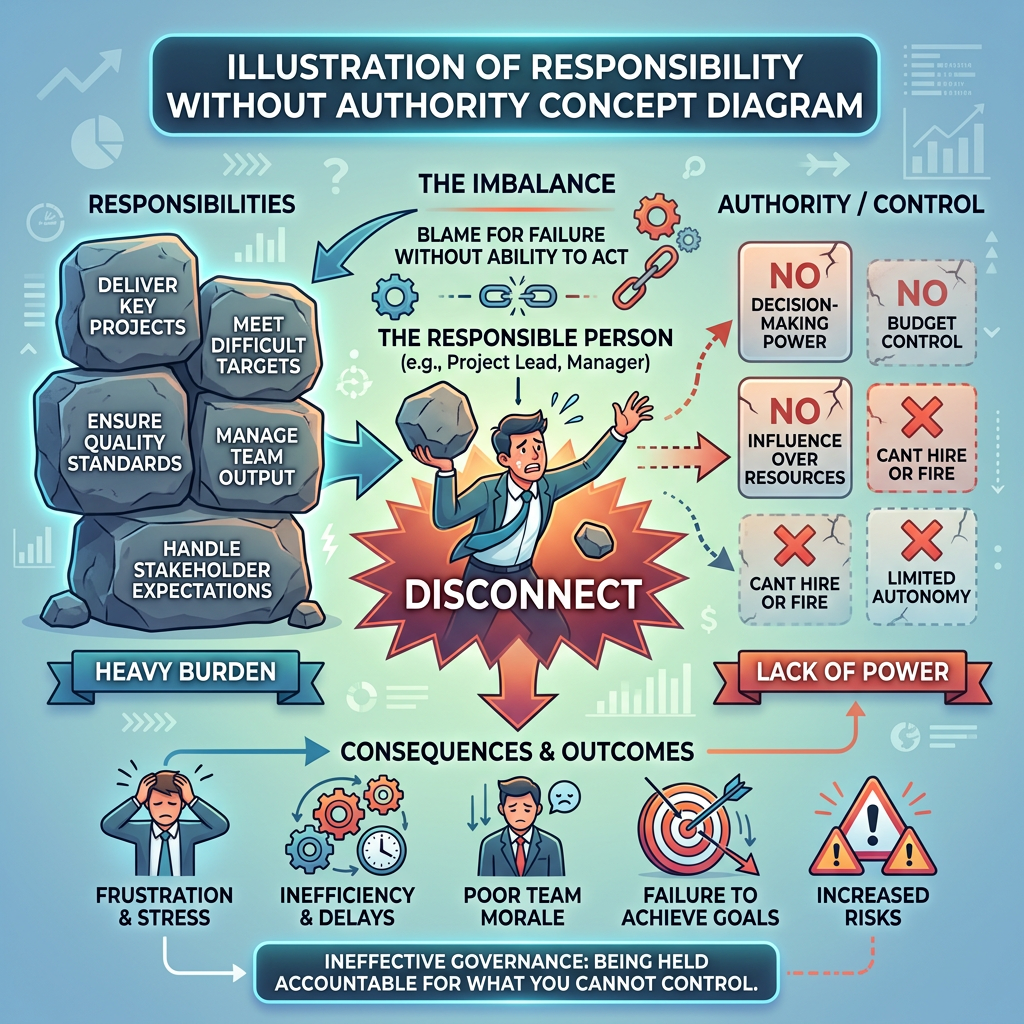
Responsibility without authority means being accountable for an outcome without having control over the conditions that create that outcome.
That sentence matters.
Because many people do not collapse from laziness, weakness, or lack of effort.
They collapse from being made responsible for systems they were never allowed to steer.
Standing on the Ledge has circled this pattern for months. It has shown up in contract pressure, emotional labour, old roles, family obligations, workplace conflict, inner courtroom thinking, and the slow rebuild after a hard hit.
But it deserves to be named directly.
Because once you can name the mismatch, you can stop treating every failure as a personal defect.
Sometimes the problem is not that you failed to carry the load.
Sometimes the problem is that someone handed you the load, kept the steering wheel, removed the tools, and then blamed you when the cart went into the ditch.
The SOTL Lens
In Standing on the Ledge language, responsibility without authority is a pressure-chain problem.
The demand moves downward.
The power stays upward.
The risk lands wherever the person has the least room to absorb it.
This is why the pattern is so dangerous. It does not always look abusive, dramatic, or openly hostile. Often, it looks normal.
It sounds like:
- “Just handle it.”
- “Make it work.”
- “We need the same result with less.”
- “You’re the reliable one.”
- “Don’t make this a bigger issue.”
- “That’s your responsibility.”
- “You should have figured it out.”
The trap is that responsible people often try harder before they ask whether the assignment was structurally fair.
That is how conscientiousness gets turned into a shock absorber.
How the Trap Works
Responsibility without authority usually has four moving parts.
First, the outcome is assigned.
You are told what must happen. The building must be clean. The family event must run smoothly. The customer must be satisfied. The relationship must feel stable. The project must be done by Friday.
Second, the conditions are controlled elsewhere.
Someone else controls the budget, staffing, time, rules, access, information, expectations, or emotional climate.
Third, the resources do not match the demand.
You are expected to produce a result with missing labour, missing money, missing clarity, missing cooperation, or missing authority.
Fourth, the consequence lands on the person closest to the failure.
When the outcome fails, the system simplifies the story.
Instead of asking, “Were the conditions realistic?” it asks, “Who was responsible?”
And if your name is attached to the responsibility box, you become the easiest place to dump the blame.
Example One: The Workplace Mismatch
An employee is assigned to lead a project.
The deadline is tight. The scope keeps changing. Two team members are pulled onto other priorities. A manager insists the final product still has to meet the original standard.
The employee can ask for updates. They can send reminders. They can work late. They can try to influence people.
But they cannot approve overtime. They cannot reduce scope. They cannot assign staff. They cannot move the deadline. They cannot stop leadership from changing priorities midstream.
Then the project slips.
The employee is told they failed to manage it properly.
That is not simple accountability.
That is responsibility without matching authority.
The practical question is not, “Should this person care about the work?”
Of course they should.
The better question is:
What decision rights came with the responsibility?
If the answer is “none,” the role was already unstable.
Example Two: The Family or Relationship Mismatch
This pattern does not only happen at work.
It can happen inside families and relationships too.
One person becomes the organizer, fixer, emotional translator, appointment tracker, peacekeeper, or crisis manager.
They are expected to keep things from falling apart.
But they may not be allowed to set limits, ask others to contribute, change the plan, discuss money honestly, name the real problem, or step back without being accused of selfishness.
In a family, this might look like one sibling carrying elder care logistics while others second-guess every decision but do not share the work.
In a relationship, it might look like one partner being expected to maintain the emotional weather while the other partner controls communication, avoids accountability, shifts the goalposts, or refuses repair.
Not every mismatch is abuse.
Not every unfair pattern is malicious.
But when one person is made responsible for stability while being denied the authority to create healthier conditions, the system will eventually grind that person down.
The practical question becomes:
Am I being asked to keep this system functional, or am I being allowed to help make it healthier?
Those are not the same thing.
Example Three: The Contractor and Subcontractor Mismatch
This one belongs close to the bones of Standing on the Ledge.
A contractor or subcontractor is expected to deliver an outcome: clean building, reliable coverage, low complaints, stable staffing, professional response, no visible disruption.
But the conditions may be controlled upstream.
The price may be fixed. The scope may grow quietly. Wage costs may rise. Travel time may increase. Supplies may cost more. Staffing may become harder. A client may want premium results while still pushing discount math.
The person closest to the work is then expected to absorb the gap.
Work faster.
Pay themselves less.
Delay replacing equipment.
Cover the shift personally.
Eat the added task.
Stay polite.
Keep the account.
Make it work.
But “make it work” is not a business model.
It is often the sentence spoken right before transferred risk becomes personal collapse.
If someone controls the scope, price, complaint standard, and renewal decision, while someone else absorbs the labour pressure, that is a responsibility-authority mismatch.
The practical question is:
Who controls the conditions, and who pays when those conditions fail?
That answer will tell you where the risk is really sitting.
The Four-Box Audit
Here is the tool.
Use it before accepting a role, renewing a contract, taking on a family responsibility, agreeing to a project, or continuing in a relationship pattern that keeps making you the default shock absorber.
| Box | Question | What to Look For |
|---|---|---|
| Responsibility | What outcome am I being asked to own? | Deliverable, role, emotional expectation, standard, deadline, promise, duty. |
| Authority | What can I actually decide, change, approve, refuse, or enforce? | Decision rights, boundaries, schedule control, budget control, staffing power, scope control. |
| Resources | What time, money, people, tools, information, access, and support are attached? | Labour hours, supplies, cooperation, training, documentation, transport, recovery time. |
| Consequences | What happens if the conditions do not support the outcome? | Blame, lost income, conflict, punishment, health cost, reputation damage, legal risk, emotional fallout. |
The mismatch appears when the first and fourth boxes are heavy, while the second and third boxes are empty.
Heavy responsibility.
Heavy consequences.
Low authority.
Low resources.
That is the danger zone.
The Audit Questions
Before you say yes, ask:
- What exactly am I responsible for?
- What am I not responsible for?
- What decisions can I make without chasing permission?
- What resources are guaranteed?
- What happens if the scope changes?
- What happens if the budget does not match the expectation?
- What happens if other people do not cooperate?
- What needs to be documented before this becomes a dispute?
- What boundary protects me from becoming the dumping ground?
These are not attitude questions.
They are survival questions.
What to Document
When you spot responsibility without authority, do not rely on memory.
Memory gets tired.
Stress distorts timelines.
People revise stories when consequences arrive.
Keep receipts.
Document:
- the original request;
- the expected outcome;
- the deadline or standard;
- who controls the budget, scope, schedule, staffing, or decision;
- what resources were promised;
- what resources were missing;
- any scope change;
- any added task;
- any warning you gave;
- any request for clarification;
- any refusal to adjust the conditions;
- any consequence placed on you after the mismatch was ignored.
This is not about becoming paranoid.
It is about refusing to let fog become the official record.
What to Renegotiate
The cleanest renegotiation sentence is this:
I can be responsible for that outcome if the authority and resources match the expectation.
Then get specific.
For work:
I can own this deadline if I have authority to reduce scope, confirm priorities, and get the required staff time.
For family:
I can coordinate this appointment schedule, but I cannot be the only person responsible for transportation, costs, updates, and emotional fallout.
For relationships:
I can work on repair with you, but I cannot be responsible for the health of this relationship by myself.
For contracts:
I can maintain this standard if the scope, labour hours, supply costs, access issues, and price are aligned in writing.
Renegotiation is not complaining.
Renegotiation is reality entering the room.
What to Decline
Sometimes the correct answer is no.
Not because you are lazy.
Not because you are difficult.
Not because you lack commitment.
Because accepting responsibility without authority is how people get trapped in impossible roles.
Useful boundary sentences:
I cannot accept accountability for conditions I do not control.
I am willing to help, but I am not willing to be the sole owner of this outcome.
If the scope changes, the time, price, or expectation has to change with it.
I cannot keep absorbing consequences for decisions made elsewhere.
I need that clarified in writing before I agree.
That last sentence is simple, but powerful.
Fog hates paper.
When to Price It
Some responsibility-authority mismatches can be fixed by pricing the reality.
If the client wants more scope, the price changes.
If the family wants you to manage more logistics, others contribute time, money, transportation, or decision support.
If the workplace wants project ownership, the role needs authority, time, staffing, or adjusted workload.
If the relationship requires emotional repair, both people must contribute behaviour change, not just conversation.
Pricing does not always mean money.
It can mean time.
It can mean shared labour.
It can mean decision rights.
It can mean access to information.
It can mean consequences being distributed honestly.
The point is simple:
If the responsibility expands, something else must expand with it.
Otherwise, the missing cost will be paid in someone’s body, sleep, cash flow, anger, health, or self-respect.
When to Exit
Exit becomes necessary when the mismatch is named, documented, and still preserved.
Watch for these red flags:
- You are blamed for outcomes controlled by someone else.
- The scope keeps growing but the resources do not.
- You are told to be accountable but denied decision-making power.
- Your warnings are ignored until failure arrives.
- Other people reserve the right to criticize but refuse responsibility.
- You are punished for asking for clarity.
- The only way the arrangement works is if you keep absorbing the cost.
At that point, the issue is no longer confusion.
It is structure.
And structure does not change because you exhaust yourself harder.
Phase Fit
This tool belongs in Phase 0 because it prevents collapse before the visible break.
Use it before you accept the role, sign the contract, agree to the family duty, take the project, or keep carrying the relationship pattern.
Ask the four-box question early:
Does the responsibility match the authority, resources, and consequences?
It also belongs in Phase 3 because rebuild work requires system repair.
After collapse, it is not enough to say, “I need better boundaries.”
You need better structures.
Better scopes.
Better written agreements.
Better role clarity.
Better exits.
Better questions before you say yes.
The Bottom Line
Responsibility is not the enemy.
Responsibility can be honourable.
Responsibility can build trust, maturity, leadership, skill, and dignity.
But responsibility without authority is different.
That is not leadership.
That is exposure.
And if you are a ledge walker rebuilding from a hard hit, you cannot afford to keep accepting exposure disguised as duty.
Before you carry the outcome, check the levers.
Before you accept the blame, check the conditions.
Before you call yourself a failure, check the structure.
You may still choose to help.
You may still choose to serve.
You may still choose to take responsibility.
But do it with your eyes open.
Responsibility should come with authority.
Authority should come with resources.
Resources should match the expectation.
And consequences should land where the decisions were actually made.
Post-Closure Card
One receipt: If you are accountable for the outcome but cannot control the conditions, you are not carrying responsibility alone. You are carrying structural risk.
One next step: Pick one current obligation and run the four-box audit: responsibility, authority, resources, consequences.
One boundary sentence: I will not accept accountability for conditions I am not allowed to change.
Godspeed, ledge walkers.
Discover more from Standing on the Ledge
Subscribe to get the latest posts sent to your email.
 Standing on the Ledge