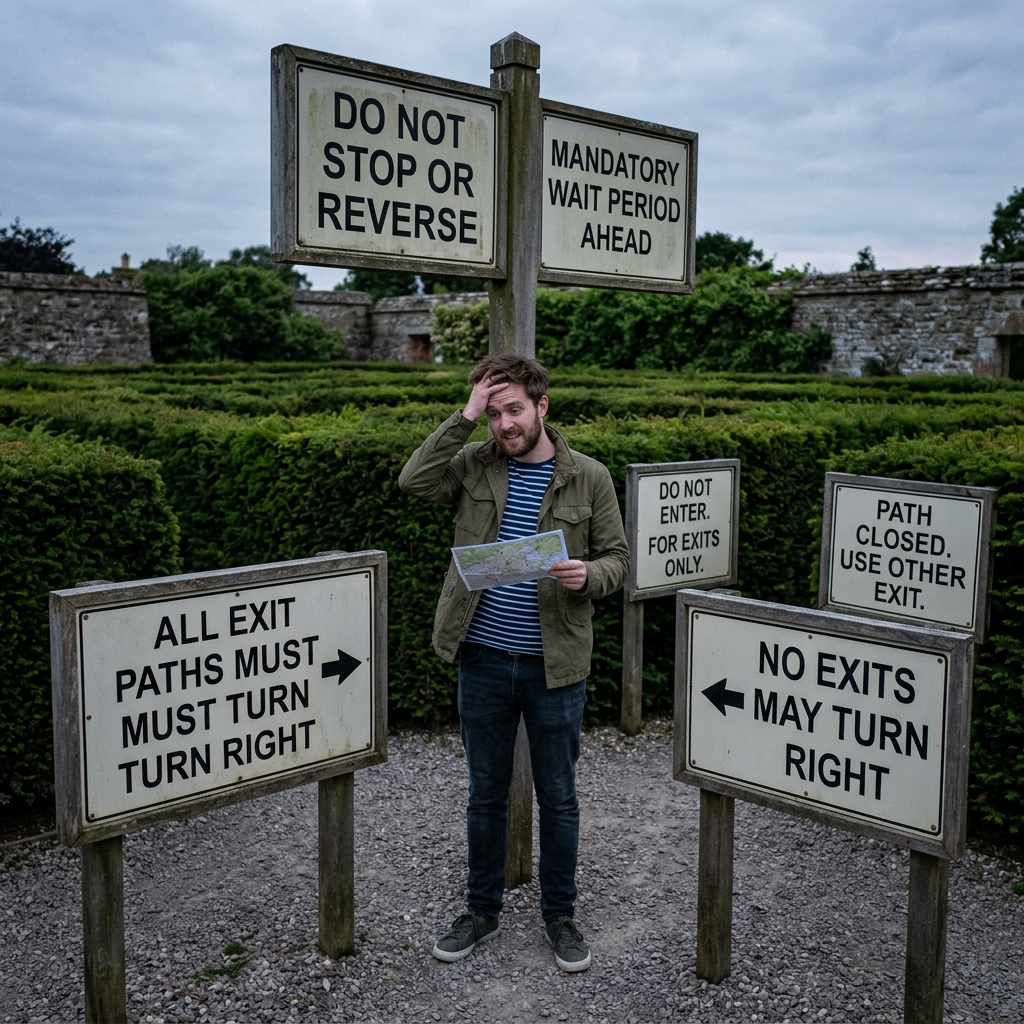

Catch-22
Tonight I went down one of those little rabbit holes that starts with a simple question and ends somewhere considerably deeper than expected.
Where did the phrase Catch-22 actually come from?
Most of us know what it means even if we have never read Joseph Heller’s novel. A Catch-22 is a situation where the solution to the problem is blocked by the rules governing the problem. You need experience to get the job, but you need the job to get experience. You need identification to replace your identification, but the identification you need to provide is the identification you lost. You need help because you’re overwhelmed, but getting that help requires navigating a system you are currently too overwhelmed to navigate.
Catch-22.
The expression comes from Joseph Heller’s 1961 novel Catch-22. Heller had been a B-25 bombardier during the Second World War and flew sixty combat missions. In the novel, Yossarian doesn’t particularly want to continue climbing into aircraft while people are actively trying to kill him.
Seems reasonable.
And that is where the catch comes in.
An airman who is insane can supposedly be grounded. But he has to ask to be grounded. The problem is that anyone who understands that flying repeated combat missions may get him killed, and therefore asks not to fly them anymore, is demonstrating perfectly rational concern for his own survival.
Which means he is sane.
And if he is sane, he has to keep flying.
Beautifully absurd.
Except the more I looked into it, the more interesting it became, because while Heller’s Catch-22 was fictional, the machinery underneath it wasn’t entirely invented.
During the Second World War, the U.S. Army Air Forces had to deal with a very real problem. Combat aircrew were suffering from what was variously described as operational fatigue, flying fatigue, psychiatric exhaustion and other stress-related conditions. Doctors had to decide when someone was medically incapable of continuing to fly and when someone was simply frightened, exhausted, unwilling or understandably desperate to stop.
And there’s the ledge.
Because fear itself wasn’t necessarily considered an illness.
In late 1944, Army Air Forces policy made it clear that fear of combat flying, by itself, was not enough to medically disqualify someone from flying duty. Unless there was a sufficiently serious psychiatric diagnosis, fear, relatively mild psychiatric symptoms or psychosomatic symptoms might not get you grounded.
Think about that for a second.
You climb into a bomber. You know aircraft from your unit have not returned. You have seen people wounded. You know anti-aircraft fire, fighters, mechanical failure or simple bad luck could make this mission your last.
You become afraid.
But being afraid of something that can actually kill you is rational.
Therefore your fear does not necessarily demonstrate that you are medically incapable of doing it.
So you keep flying.
That isn’t literally Heller’s fictional Catch-22, and there is no evidence that I can find showing that Heller took one particular regulation and converted it directly into the novel. In fact, one of the clearest Army Air Forces directives on the subject was issued after Heller had already finished his combat missions.
But he had just spent months living inside the same system that produced those rules.
And I think that’s the more important part of the story.
Because Catch-22 was never really about one regulation.
It was about systems.
It was about what happens when every individual rule can be explained, justified and defended, yet the combination of those rules leaves the person caught inside them with nowhere to go.
The doctor may be following medical criteria. The commanding officer may be following orders. The administrator may be following policy. The clerk may be following procedure. Nobody standing behind any individual desk necessarily created the problem.
But the person moving from desk to desk can still be completely trapped.
And suddenly this stopped being an interesting little piece of Second World War history and started sounding extremely familiar.
Because we still build Catch-22s.
We tell people they need help, then build assistance systems that are almost impossible to navigate while they’re struggling.
We tell someone to provide documentation they cannot obtain until another department approves something, while that department won’t approve it until the first documentation is provided.
We tell people to become financially stable before we will give them access to the thing that might help them become financially stable.
We tell people they need experience before someone will give them the opportunity to gain experience.
And sometimes, when you’re standing on the ledge trying to rebuild your life, you can spend an enormous amount of energy assuming the problem must be you.
Maybe I didn’t fill out the right form.
Maybe I didn’t explain myself properly.
Maybe I didn’t work hard enough.
Maybe I missed something.
Sometimes that’s true. Sometimes we do miss things. Sometimes we do need to change our approach, learn something new, make another phone call, fill out another form or simply put in more work.
But not always.
Sometimes the problem isn’t that you haven’t found the exit.
Sometimes the rules have eliminated the exit.
And recognizing that distinction matters.
One of the things I’ve learned while standing on this particular ledge is that rebuilding isn’t simply about perseverance. Perseverance is useful. Stubbornness can occasionally be useful too. But beating your head against the same wall indefinitely isn’t perseverance.
Eventually you have to ask whether you’re dealing with a difficult problem or an impossible set of conditions.
If it’s difficult, keep working.
If your approach is wrong, change it.
If you lack information, learn.
If you need help, ask.
But if you’ve discovered a genuine Catch-22, working harder at obeying the Catch-22 usually won’t get you out of it.
You may need another route.
You may need someone outside the system. You may need an advocate. You may need to challenge the rule. You may need to stop asking the question the system expects you to ask and start asking a different one entirely.
That doesn’t mean giving up.
It means understanding the terrain you’re standing on.
Joseph Heller gave us a wonderfully simple name for that strange moment when logic folds back on itself and traps the person caught in the middle.
More than sixty years later, we still immediately understand what he meant.
Maybe that’s because Catch-22 was never really confined to bombers flying over Europe.
We’ve all stood inside one eventually.
And sometimes progress begins when we stop asking, “Why can’t I make this work?” and finally ask:
“Can this actually work under the rules I’ve been given?”
Those are two very different questions.
Godspeed, ledge walkers.
Discover more from Standing on the Ledge
Subscribe to get the latest posts sent to your email.

