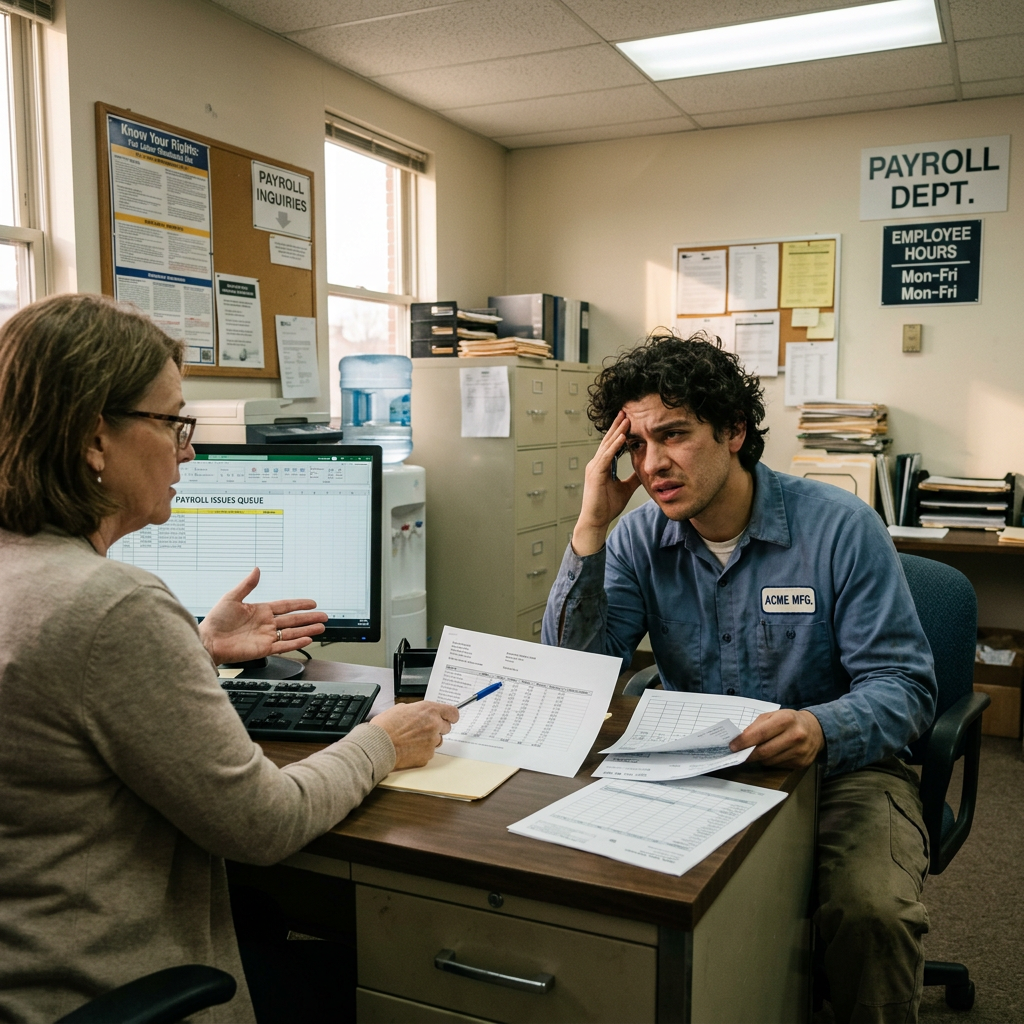

There is a particular kind of sinking feeling that comes with opening your pay and realizing that something you were counting on simply isn’t there. Not because you misunderstood what you were being paid. Not because you forgot something. You did the work. You submitted the hours. Somebody just didn’t pass them along.
This month has been a bit of a roller coaster in general, and work has mostly been one of the more stable parts of it. The company I am working for has been reasonably good to me so far. Until now, I haven’t had any real issues with getting paid, which is why I’m trying very hard not to turn one incident into something bigger before I know what actually happened.
A little while ago, I was asked to put some of my floor-waxing skills to use. It was extra work, outside the normal routine, and I was told that when I was finished I should send in my hours. I did exactly that.
Those hours have now passed through two pay cycles without appearing on my paycheque.
On its own, that could be an administrative screw-up. Things get forgotten. Emails get missed. People make mistakes. What made me start paying a little more attention was discovering that I wasn’t the only person having something disappear between the work being done and payroll actually receiving the information.
My coworker had arranged with our boss to work on the Civic Holiday, a day we normally don’t go in. When her pay arrived, those hours weren’t there either. She spoke with the person who actually administers payroll and discovered that he had never been given the hours. She had also arranged to have vacation time paid out while taking a few days off, and apparently payroll hadn’t received that information either.
That changes the feeling slightly.
Not necessarily because something sinister is happening. Three missing pieces of information can still be three administrative mistakes. But once you notice a pattern, even a small one, you start watching more carefully.
I’ve been down this road with another company before. Extra work would get requested, getting paid for that extra work would become difficult, and eventually the simplest answer became: don’t ask me to do extra work anymore. If doing the work is easy but getting paid for it requires chasing people around afterward, the incentive to help disappears pretty quickly.
And I don’t want to get there with this employer.
That’s an important distinction for me right now. One bad payroll incident is not the same thing as a bad employer. One mistake is not automatically a pattern. At the same time, pretending something doesn’t bother you because you don’t want to seem difficult is how small problems sometimes become normal problems.
There is also a very practical side to this. I was counting on that money being on this pay. Things are a little tight at the moment and I’m falling slightly behind, so those extra hours weren’t imaginary bonus money that I might spend someday. They had somewhere to go.
That is one of the things people sometimes miss when talking about payroll mistakes. From the company’s side, it can look like a clerical issue that can be fixed on the next cheque. From the employee’s side, that missing money may already have been assigned to groceries, hydro, gas, a phone bill, or something else that doesn’t particularly care that payroll made an honest mistake.
Intent and impact are not always the same thing.
So later today I’m going to talk to my boss and ask a very simple question: what happened to those hours?
I’m not going into the conversation assuming dishonesty. I’m also not going to pretend the missing pay doesn’t matter. I did the work. I submitted the hours. I should be paid for them.
Then I’ll watch what happens next.
Maybe somebody says, “I screwed up,” fixes it, and that’s the end of the story. Frankly, I hope that’s exactly what happens. People make mistakes, and a mistake that gets acknowledged and corrected doesn’t need to become a crisis.
But if it keeps happening, then it becomes something different.
Sometimes the uncomfortable part of rebuilding your life isn’t learning how to survive the huge disasters. It’s learning to notice the small things before they quietly become normal. A missed pay entry doesn’t require panic. It does require a question.
For now, that’s where I am: one missing payment, one conversation, and a little more attention than I was paying before.
That’s it. That’s all for now.
Discover more from Standing on the Ledge
Subscribe to get the latest posts sent to your email.

