
MGT2382 Organizational Behaviour Learning Journal
Today’s organizational behaviour reading focused on teams: what they are, why they exist, and how different types of teams function inside an organization.
At first glance, a team sounds simple. Put people together, give them a goal, and call them a team.
But organizational behaviour is more precise than that.
A team is not just a collection of people standing in the same place or working under the same employer. A team is usually defined as two or more people who interact with and influence one another, who are mutually accountable for achieving common goals connected to organizational objectives, and who see themselves as a social unit within the organization.
That last part matters.
A team is not only created by management structure. A team also exists when the members understand themselves as being part of something shared. They recognize that their work connects. They recognize that their actions affect one another. They recognize that they are not just isolated employees completing isolated tasks.
Teams Exist for a Purpose
Teams exist to fulfill some kind of purpose.
That purpose may be ongoing, temporary, narrow, broad, highly structured, or loosely defined. But without some kind of shared purpose, a team begins to collapse into a group of individuals who simply happen to be near one another.
In organizational behaviour, the important piece is that teams are held together by interdependence. Their members need some degree of collaboration in order to achieve a common goal or set of goals.
That means the team is not just about who belongs to it. It is also about how much the members depend on each other to get the work done.
Some Useful Terms
Before getting into the types of teams, it helps to define a few of the terms used to describe them.
Team Permanence
Team permanence refers to how long a team is expected to exist.
Some teams are ongoing. They may continue indefinitely as part of the organization’s normal structure. Other teams are temporary and exist only until a specific project, task, or problem is completed.
A departmental team usually has high permanence because the department itself continues to exist. A task force usually has low permanence because it is formed to address a specific issue and then dissolves after the work is done.
Skill Diversity
Skill diversity refers to the range of different abilities, knowledge, training, and perspectives within the team.
A team with low skill diversity may include people who perform similar work or have similar backgrounds. A team with high skill diversity may include people from several disciplines, departments, trades, roles, or professional viewpoints.
This matters because the more complex the task, the more likely the team will need a wider range of skills. However, higher skill diversity can also create communication challenges because people may not share the same assumptions, language, priorities, or work habits.
Authority Dispersion
Authority dispersion refers to how power, decision-making, and control are distributed within the team.
When authority dispersion is low, decisions are usually concentrated in one leader, manager, supervisor, or formal authority figure. When authority dispersion is high, decision-making power is more widely shared among team members.
This is one of the more important ideas for me, because authority affects responsibility. A team can be told it is accountable for results, but if the actual authority remains elsewhere, that can create tension. People can be responsible for outcomes they do not fully control.
That is where organizational structure starts to matter.
Types of Teams
The course material identifies several types of teams. This is limited to the scope of the course and the textbook material I am working from. I am sure there are other types of teams in broader practice, but these are the ones being emphasized here.
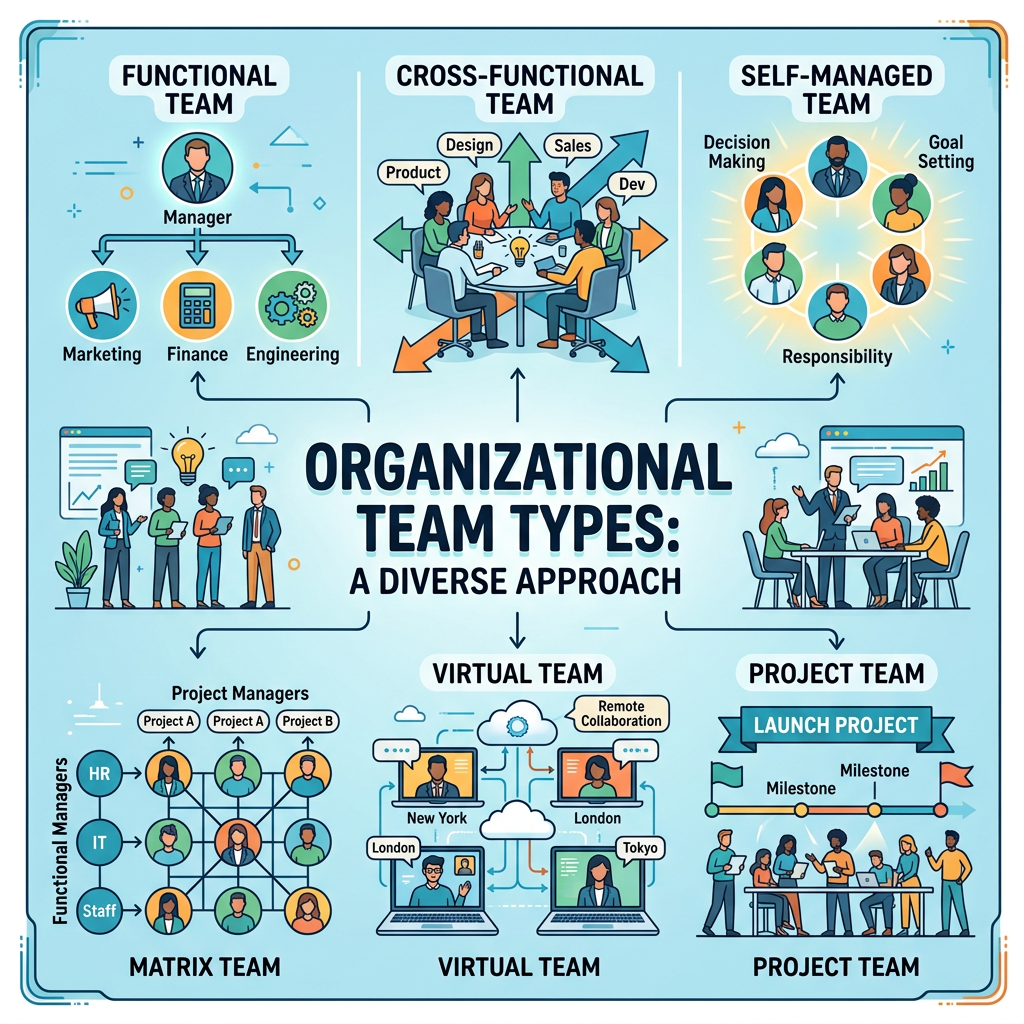
Departmental Teams
A departmental team consists of employees who usually have similar or complementary skills and work within the same functional area of the organization.
These teams tend to have minimal task interdependence. Members may work near each other or report through the same department, but they may not need heavy collaboration to complete every task.
For example, a group of employees in the same department may share goals, procedures, tools, and supervision, but each person may still perform a fairly distinct part of the work.
Departmental teams usually have:
- High team permanence because departments often continue indefinitely.
- Low to medium skill diversity because members often have similar or related skills.
- Low authority dispersion because decision-making usually remains with supervisors, managers, or formal leaders.
From an organizational behaviour perspective, departmental teams are useful because they provide structure, consistency, and specialization. The risk is that they may become siloed. If each department focuses only on its own tasks, the larger organizational picture can get lost.
Self-Directed Teams
A self-directed team is organized around work processes that complete an entire piece of work. These teams usually have substantial autonomy and are trusted to manage more of the work themselves.
This does not mean there is no structure. It means the team has more control over how the work is organized, assigned, adjusted, and completed.
Self-directed teams usually have:
- High team permanence because they often continue indefinitely.
- Medium to high skill diversity because the team may need several different abilities to complete the full work process.
- High authority dispersion because power and decision-making are more widely shared within the team.
The key idea here is autonomy.
A self-directed team is expected to take more responsibility, but it also needs enough authority to make that responsibility realistic. If a team is called self-directed but still needs approval for every meaningful decision, then the title may be more symbolic than practical.
That is where the difference between real autonomy and decorative autonomy becomes important.
Task Forces
A task force is usually a temporary team formed to solve a specific problem, complete a project, investigate an issue, or respond to a defined organizational need.
Task forces are often cross-functional. That means members may be drawn from several departments, disciplines, or areas of expertise.
Task forces usually have:
- Low team permanence because they often disband after the task is completed.
- Medium to high skill diversity because the task may require multiple perspectives or specialties.
- Medium authority dispersion because there is often a project leader, task manager, or assigned authority figure, but members may still contribute specialized knowledge and influence decisions.
A task force can be useful when an organization needs focused attention on something that does not fit neatly into one department.
The advantage is flexibility. The organization can pull the right people together for a specific purpose.
The weakness is that temporary teams can struggle with clarity. Who has the final say? How much time can members dedicate to the task force while still doing their regular jobs? Are recommendations binding, or are they just suggestions? Does the organization actually intend to act on the findings?
A task force can solve problems, but it can also become a way for an organization to appear responsive without changing anything meaningful.
The Practical Lesson
The practical lesson for me is that not every team works the same way.
Some teams are permanent. Some are temporary.
Some teams have similar skills. Some are intentionally diverse.
Some teams are tightly managed from above. Others distribute authority more widely.
That means we should be careful about using the word “team” too casually.
Calling something a team does not automatically make it collaborative, healthy, or effective. A team needs purpose, interdependence, accountability, and some shared understanding of what it is trying to accomplish.
It also needs alignment between responsibility and authority.
If people are expected to achieve a goal together, they need the tools, information, decision-making power, and organizational support to make that goal possible.
Otherwise, the language of teamwork can become a cover for dumping responsibility downward while keeping control somewhere else.
Reader’s Moment
Have you ever been placed on a “team” that did not actually function like one?
Maybe the group had a shared name but no shared authority.
Maybe everyone was responsible for the outcome, but only one person had the power to make decisions.
Maybe the organization talked about collaboration, but the structure rewarded silos, blame, or individual survival.
That is where organizational behaviour becomes useful. It gives us language for patterns we may have felt before but could not clearly name.
A team is not just a label.
A team is a structure of purpose, interdependence, accountability, identity, skill, and authority.
When those pieces line up, teams can do powerful work.
When they do not, the word “team” can become one more pressure point inside the organization.
Godspeed.
Discover more from Standing on the Ledge
Subscribe to get the latest posts sent to your email.

