
Hey there, ledge walkers.
Every now and then, a book opens in the right place.
I picked up my copy of C. Wright Mills’ The Sociological Imagination, opened it to page six, and landed on a line that felt like it had been sitting there waiting for Standing on the Ledge.
Mills argues that no social study has completed its work unless it comes back to “the problems of biography, of history, and of their intersections within a society.”1
That stopped me.
Because, in a lot of ways, that is exactly what Standing on the Ledge has been trying to do from the beginning.
Not in academic language at first.
Not with footnotes and course codes and polished theory.
But instinctively.
Collapse happened. The contract ended. The structure failed. The money pressure arrived. The legal pressure followed. The body reacted. The mind tried to make sense of it. Shame showed up, as shame always does, trying to convince a person that the whole wreckage was personal failure.
But Mills gives us a better question.
Not just, “What happened to me?”
But also:
What kind of society makes this kind of collapse possible?
That is where Standing on the Ledge starts to become more than a recovery blog.
It becomes a map.
The Private Trouble and the Public Structure
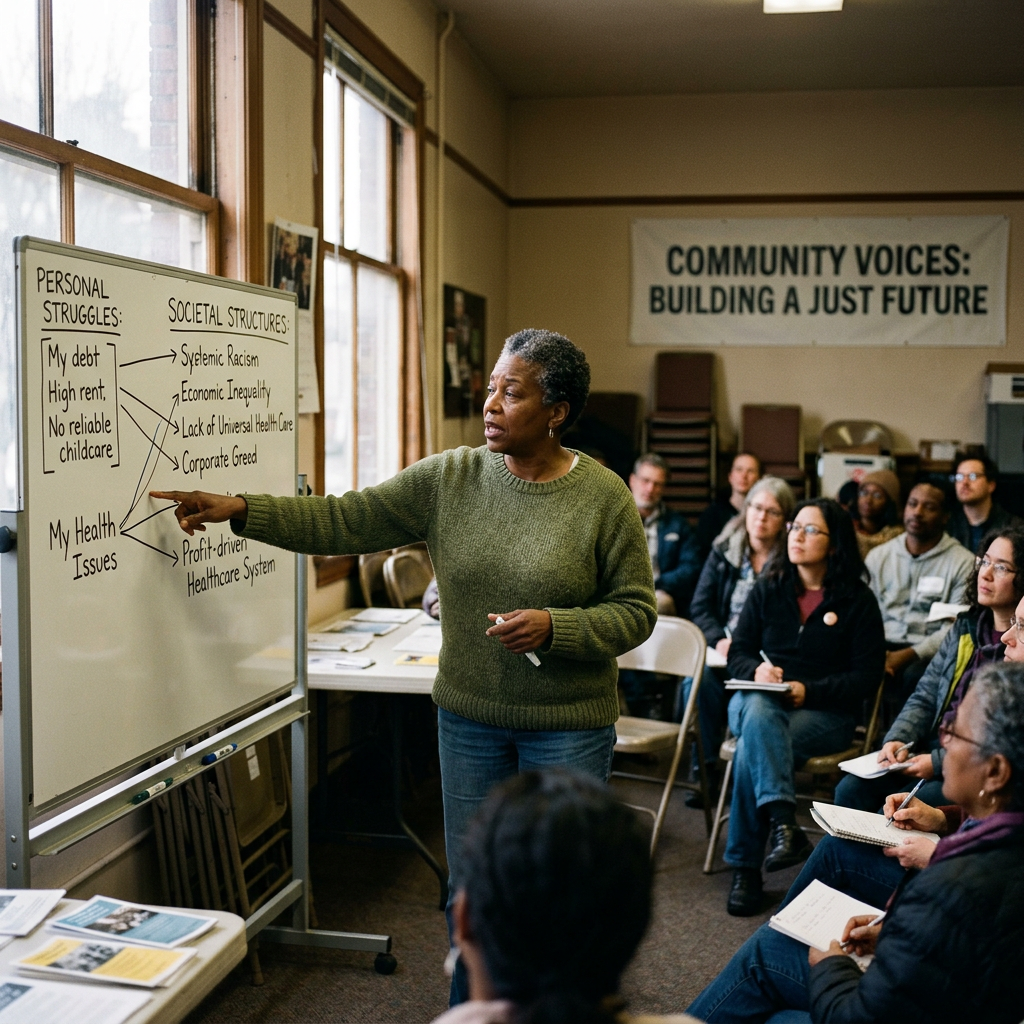
Mills’ great reminder is that personal trouble and public structure are not separate things.
A person can lose a job, lose a contract, lose footing, lose sleep, lose confidence, and feel like the entire thing is private. Their burden. Their failure. Their weakness. Their mess.
But when enough people are one contract, one rent increase, one legal bill, one health problem, one workplace conflict, or one bad month away from collapse, then we are no longer talking only about private trouble.
We are looking at a social pattern.
That matters.
Standing on the Ledge has always dealt with the individual moment: the first seventy-two hours, the shock, the numbness, the shame ledger, the need to stabilize food, sleep, money, heat, transport, documents, and decisions.
But underneath all of that is the larger question:
What structure put the person on the ledge in the first place?
Was it only bad choices?
Sometimes choices matter, yes.
But was it also precarious work? Thin margins? Subcontracting pressure? Rising costs? Weak support systems? Institutions that move slowly while personal crisis moves fast? A culture that praises resilience while quietly removing the supports that make resilience possible?
That is the SOTL lens.
We do not use structure as an excuse to do nothing.
But we also do not pretend collapse always begins inside the individual.
Question One: What Is the Structure of This Society?
Mills asks us to look at the structure of a society as a whole. What are its essential parts? How are they related? What keeps it going? What causes it to change?
For Standing on the Ledge, that question becomes:
What systems are creating the pressure people are trying to survive?
In the world many of us live in, risk is often pushed downward.
The worker carries it.
The subcontractor carries it.
The small operator carries it.
The family carries it.
The person already stretched thin carries it.
Clients want cheaper service. Companies want flexibility. Institutions want compliance. Bills arrive on schedule. Courts and paperwork move at their own pace. Employers restructure. Contracts disappear. Costs rise. The body absorbs the pressure long before the system admits anything is wrong.
Then, when the person finally breaks, they are handed a motivational slogan and told to be stronger.
Standing on the Ledge pushes back against that.
Not by denying personal agency, but by putting agency back in context.
A person standing in the rubble still needs a next step. They still need to make calls, gather documents, pay bills, eat something, sleep when they can, and stop the bleeding.
But they also need to know this:
You are not automatically a failure because a pressure system finally reached your doorstep.
That is not softness.
That is accuracy.
Question Two: Where Does This Society Stand in History?
Mills also asks where a society stands in human history. What period are we in? How is it changing? What makes this moment different from other moments?
For Standing on the Ledge, that question becomes:
What kind of historical moment are people trying to survive right now?
We are living in a period where many people are told to be independent, flexible, entrepreneurial, emotionally intelligent, self-reliant, constantly learning, constantly adapting, and constantly available.
On paper, that can sound empowering.
In real life, it often means people are expected to carry more uncertainty with fewer supports.
The old promises are weaker than they used to be.
Steady work does not always mean steady life.
Education does not always guarantee security.
Hard work does not always protect someone from collapse.
Community is thinner for many people than it once was.
Institutions are complicated to navigate, especially when a person is already exhausted.
That is why Standing on the Ledge exists in this particular moment.
People are not only looking for inspiration.
They are looking for footing.
They need tools that work when the nervous system is overloaded. They need language that does not insult them. They need a way to separate evidence from shame. They need a structure for the first seventy-two hours, the next two weeks, and the long rebuild after the adrenaline wears off.
That is where the historical question matters.
SOTL is not just asking, “How do I feel better?”
It is asking:
How do people rebuild in a time when instability has become normal?
Question Three: What Kind of People Does This Society Produce?
Mills’ third question asks what kinds of men and women prevail in a given society and historical period. What kind of human nature is being formed, selected, liberated, repressed, sharpened, or blunted?
For Standing on the Ledge, this may be the deepest question of all:
What kind of person is formed by life on the ledge?
Modern pressure creates certain kinds of people.
It creates the hypervigilant.
The exhausted.
The over-responsible.
The ashamed.
The person who feels guilty for needing help.
The person who keeps moving because stopping might mean feeling everything.
The person who has learned to expect the next hit before the current one has even landed.
That is one version of the ledge walker.
But it is not the only version.
Because collapse can also produce awareness.
It can produce a person who starts asking better questions.
Not “Why am I weak?”
But “What pattern am I inside?”
Not “Why can’t I handle this?”
But “What load am I carrying, and who handed it to me?”
Not “How do I pretend I am fine?”
But “What is the next honest action that keeps me from making the wreckage worse?”
That is where the rebuilder from the rubble appears.
The rebuilder is not untouched.
The rebuilder is not magically healed.
The rebuilder is the person who starts converting pain into structure.
A checklist.
A boundary.
A receipt.
A phone call.
A document folder.
A tool.
A ritual.
A field manual.
The SOTL Version of Mills’ Three Questions
If we bring Mills into Standing on the Ledge, we can turn his three questions into something practical.
1. What structure put this person on the ledge?
Do not begin with shame.
Begin with mapping.
What systems, relationships, contracts, costs, expectations, obligations, institutions, habits, and pressures brought the person to this point?
2. What historical moment is this person trying to survive?
Is this about unstable work?
Rising costs?
Loss of community?
Legal complexity?
Burnout?
The collapse of old career promises?
The demand to be self-reliant without being properly supported?
3. What kind of person is being formed by this pressure?
Is the person becoming numb?
Defensive?
Ashamed?
Isolated?
Or are they becoming more conscious?
More precise?
More boundaried?
More capable of seeing the pattern before it consumes them again?
These are not abstract academic questions.
These are survival questions.
Why This Matters
Standing on the Ledge is strongest when it refuses two traps.
The first trap is shallow self-help.
That version says, “Just change your mindset.”
That is not enough.
Mindset matters, but mindset does not pay the bill, rewrite the contract, replace the lost income, repair the nervous system, or magically produce support.
The second trap is total helplessness.
That version says, “Everything is structural, so there is nothing you can do.”
That is not enough either.
Structures matter, but the person still needs a next step by morning.
SOTL lives in the harder place between those two traps.
Yes, the system matters.
Yes, history matters.
Yes, biography matters.
And yes, you still need to stabilize your life today.
That is the work.
From the Ledge
There is something powerful about realizing that your story is personal, but not merely personal.
That your collapse has details that belong only to you, but patterns that belong to a wider world.
That your shame may be loud, but it may not be the most accurate narrator in the room.
That your life can be studied, not to reduce it, but to understand it.
Biography.
History.
Society.
The person.
The period.
The pressure.
The ledge.
That is the intersection.
And maybe this is where Standing on the Ledge finds one of its clearest academic foundations:
A private collapse can become a public map.
Not because everyone’s story is the same.
But because enough of us are standing near the same edge, under the same weather, carrying loads we were told were ours alone.
They are not always ours alone.
And once we can see that, we can stop using all our energy to hate ourselves for being tired.
We can start mapping the terrain.
We can start naming the structure.
We can start rebuilding from the rubble with our eyes open.
The Tool
When you find yourself standing on the ledge, try asking these three questions before you let shame write the whole story:
1. What part of this is biography?
What happened in my life? What choices did I make? What wounds, habits, hopes, fears, obligations, or decisions shaped this moment?
2. What part of this is history?
What is happening in this wider period of work, money, family, technology, community, health, housing, law, or culture that affects this situation?
3. What part of this is society?
What systems, institutions, relationships, contracts, rules, expectations, or power structures shaped the pressure I am under?
Then ask one final SOTL question:
What is the next grounded action I can take with this clearer map?
That is where theory becomes footing.
That is where sociology becomes a field manual.
That is where the ledge becomes a place to stand long enough to choose the next step.
Reference
- C. Wright Mills, The Sociological Imagination (New York: Oxford University Press, 1959), 6. ↩
Discover more from Standing on the Ledge
Subscribe to get the latest posts sent to your email.

