
Hey there, ledge walkers.
Sometimes, if you want to understand how the world works, you do not have to start with the world.
You can start with the town.
The main street.
The local businesses.
The names everyone knows.
The people who always seem to be in the room before the room officially opens.
The families who have been there forever.
The newer money trying to become old money.
The workers who keep the place running, but rarely get invited into the decisions that shape it.
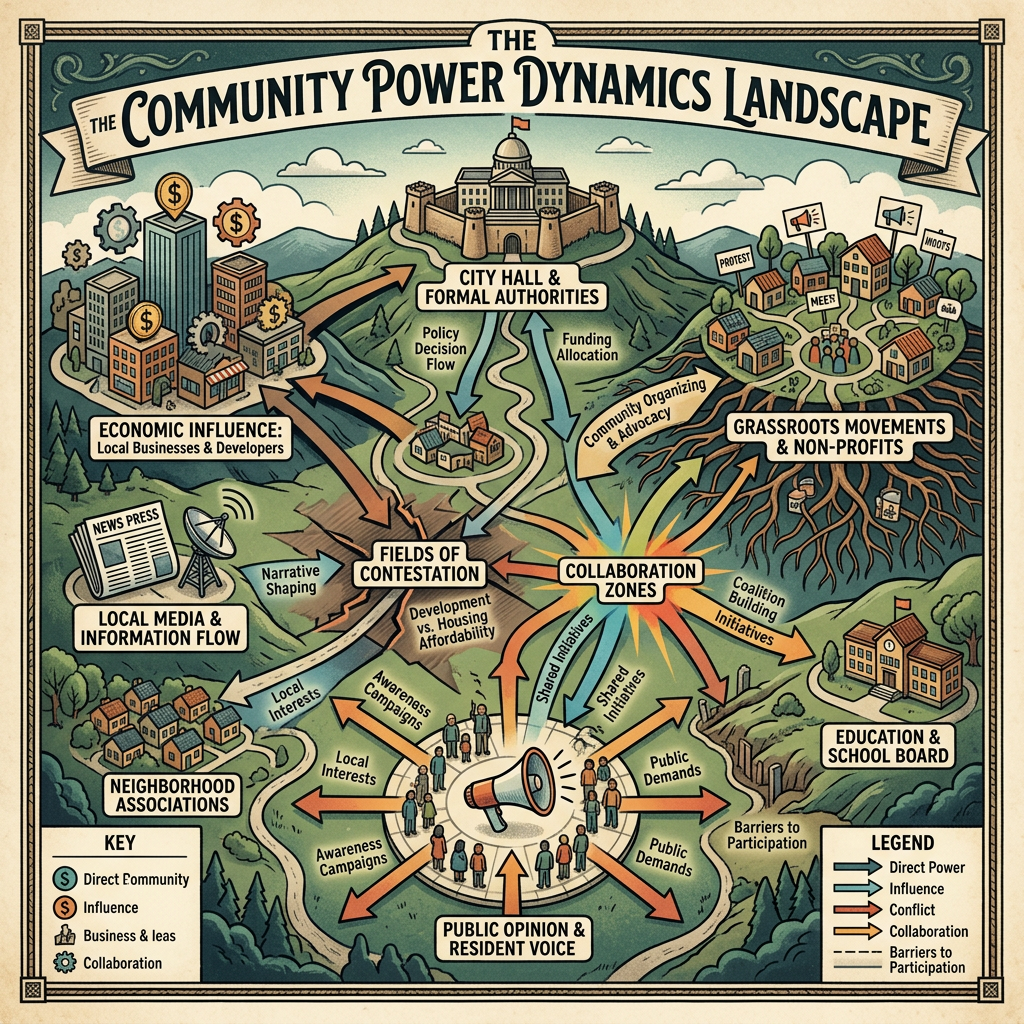
I was reading C. Wright Mills’ The Power Elite, in the chapter called “Local Society,” and he talks about how every town and small city has its own upper set — people with more property, more influence, more access, and more ability to shape what happens locally.1
That hit me.
Because Standing on the Ledge has never just been about collapse after it happens.
It has also been about learning to see the ground before it gives way.
Power Is Not Always Far Away
When we talk about power, it is easy to imagine something distant.
Governments.
Corporations.
Head offices.
Courts.
Executives.
People whose names show up in national news.
But power is not always far away.
Sometimes power is local.
Sometimes it is the person who owns the building.
The person who knows the banker.
The person who has the contract.
The person whose family name opens doors.
The person whose mistake gets explained away while yours becomes your whole reputation.
And if you are standing on the ledge, that matters.
Because you may be blaming yourself for something that was never only about you.
The Rules Are Not Always the Same for Everyone
One of the harder lessons in life is realizing that people can live in the same town, work in the same economy, and walk the same streets, but not be playing by the same rules.
Some people have cushions.
Some people have connections.
Some people have names that carry weight.
Some people can survive a bad month, a bad contract, a bad decision, or a failed business move.
Other people hit one bad turn and the whole floor drops out.
That does not mean personal choices do not matter.
They do.
But choices happen on terrain.
And terrain matters.
You do not walk a ledge the same way you walk a sidewalk.
When You Are Trusted, But Not Protected
This is something people in working-class jobs understand more than they are often allowed to say.
You can be trusted with the keys and still not be trusted with a voice.
You can clean the office, secure the building, open the doors, lock the doors, carry the load, keep the place running, and still be treated as replaceable when the numbers change.
You can know the rhythm of a place better than the people who own it.
And still, when the contract shifts, you are the one carrying the damage.
That is not bitterness.
That is observation.
And observation matters.
Why This Belongs on Standing on the Ledge
This belongs here because SOTL is not only about what to do after the fall.
It is also about learning what made the fall more likely.
Sometimes that means looking at your own habits.
Sometimes it means looking at your finances.
Sometimes it means looking at your relationships.
Sometimes it means looking at contracts, employers, institutions, or local power.
Not so you can become paranoid.
So you can become clearer.
Because clarity is protection.
If you know who owns the ground, you walk differently.
If you know who controls the story, you document differently.
If you know who carries the risk, you plan differently.
If you know who has room to fail and who does not, you stop mistaking exposure for weakness.
The SOTL Question
So maybe the question is not only:
What happened to me?
Maybe the better question is:
Where was I standing when it happened?
Was I protected?
Was I exposed?
Was I depending on one person, one contract, one employer, one client, one gatekeeper, one promise?
Did I have a backup?
Did I have paperwork?
Did I have witnesses?
Did I understand who had power in the room?
These are not comfortable questions.
But they are useful ones.
From the Ledge
The town has a memory.
So does the workplace.
So does the contract.
So does the community.
And sometimes, long before you fall, the structure already knows who will be protected and who will be left to absorb the hit.
That is why we map the terrain.
Not to hate everyone with power.
Not to turn every relationship into suspicion.
But to stop walking blind.
Standing on the Ledge is about rebuilding, yes.
But it is also about learning where the cracks were.
Because if we can see the cracks earlier next time, maybe we do not have to fall so far.
A Small Tool for the Week
This week, look around your own local world and ask:
Who has room to make mistakes?
Who does not?
Who controls access?
Who carries the risk?
Where am I exposed?
What is one thing I can document, clarify, or strengthen before it becomes a crisis?
That is not overthinking.
That is Phase 0.
That is prevention.
That is learning to read the terrain before the ledge starts to crumble.
Godspeed.
Reference
- C. Wright Mills, The Power Elite (New York: Oxford University Press, 1956), chap. 2, “Local Society,” 30. Page number may vary by edition. ↩
Discover more from Standing on the Ledge
Subscribe to get the latest posts sent to your email.

