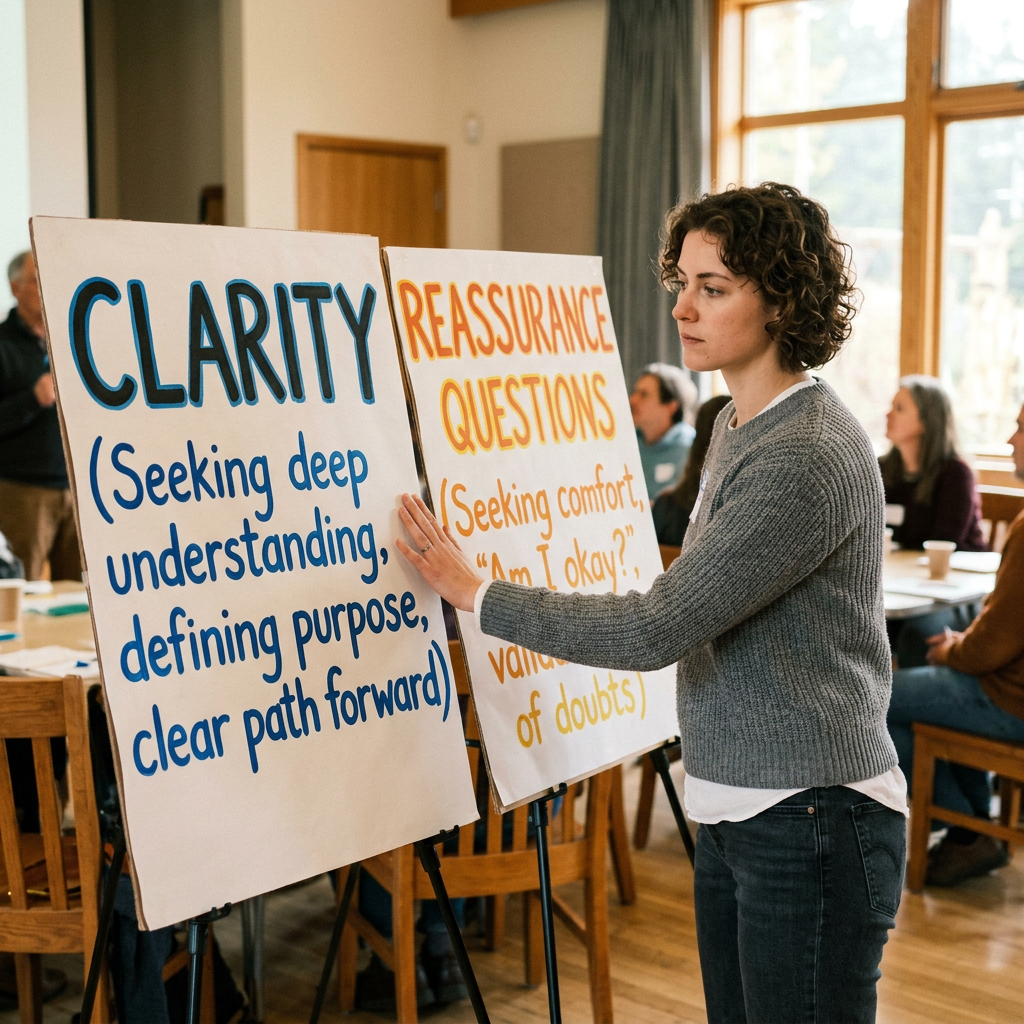

Reader’s Moment: You can tell something is off, but you do not yet have a clean handle on what changed, so you reach for reassurance and hope the answer calms the nervous system.
Why this matters: Because reassurance questions rarely protect you. Clarity questions do.
From the Ledge: I know the urge. When the temperature changes, the mouth wants to ask the soft question: Are we okay? Are we good? Did I do something wrong? It feels polite. It feels emotionally honest. It also tends to produce fog.
Reassurance questions invite broad feelings, evasive answers, and temporary sedation. They do not usually tell you what standard changed, what expectation shifted, or what action now needs to happen. Clarity questions do that.
Questions that usually do not help
- Are we okay?
- Do you still want me here?
- Is something wrong?
Questions that usually help more
- What changed?
- What does good look like here now?
- What standard are we using?
- What part of this needs to be corrected first?
- Can that expectation be put in writing?
This is not coldness. It is regulation. When things are unclear, your nervous system wants certainty. If you cannot get certainty, get definition. Definition narrows the problem. It makes repair possible. It also creates receipts, and receipts matter when the story starts drifting away from the facts.
One of the most useful rebuild skills is learning how to ask a better question while your stomach is doing backflips. A better question does not beg. It clarifies. It turns a fog bank into something measurable.
When things get slippery, replace validation-seeking with signal-seeking.
Clarity Questions Card
Use this when the temperature changes and you catch yourself reaching for reassurance instead of information.
Replace this
- Are we good?
- Did I do something wrong?
- Is there a problem?
With this
- What changed?
- What does good look like here now?
- Which part needs correction first?
- What standard are we using?
- What is expected from me by when?
- Can that expectation be put in writing?
- Is this a priority change, a scope change, or a communication gap?
Use note
These questions are not for argument. They are for definition. Ask slowly. Write down the answer. If the answer stays vague, that is information too.
Godspeed.
Discover more from Standing on the Ledge
Subscribe to get the latest posts sent to your email.


One thought on “Stop Asking “Are We Good?””