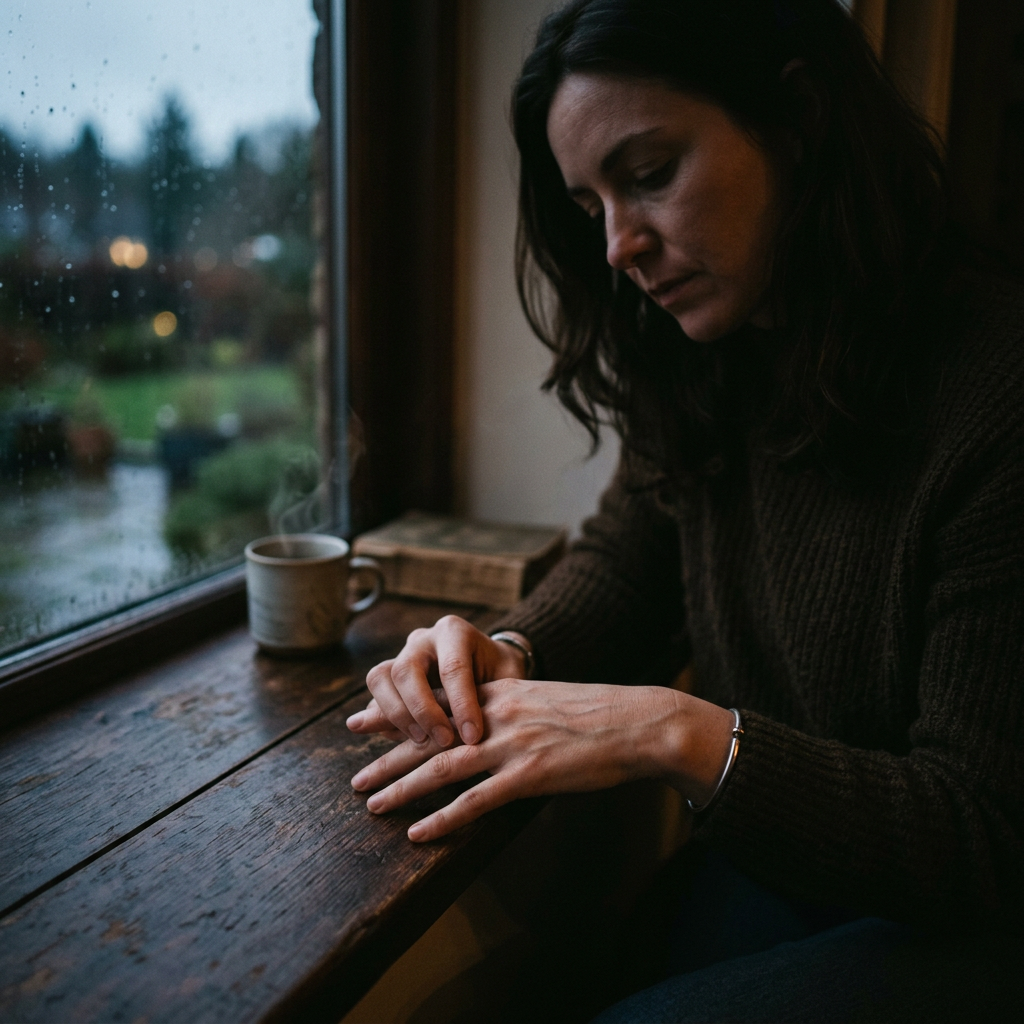

It has been a strange day.
At some point today, without thinking about it, I found myself fiddling with a wedding ring that no longer exists.
I was turning it with my thumb, feeling the texture of the metal against my finger. I could almost hear the faint clink as it moved. For a moment, the experience felt completely ordinary, as though the ring had never left my hand.
Except there was no ring.
There has not been a ring on that finger for many years.
I may have continued wearing it for three or six months after my former wife and I separated, but eventually it came off. Since then, I have not worn another ring on that hand. I have not even thought much about the physical sensation of wearing one.
Yet today, my hand remembered.
That may be the strangest part of memory. We tend to think of memory as something that happens inside the mind. We imagine photographs, conversations, faces, places and moments from another time.
But memory also lives in movement.
It lives in the way a hand reaches toward a light switch in a house we no longer live in. It lives in the way we expect a step to be where a staircase used to be. It lives in the empty space beside us where a person, animal or object once belonged.
Sometimes the past does not return as a thought.
Sometimes it returns as a movement of the hand.
My fingers remembered the weight of the ring. My skin remembered its pressure. My thumb remembered the small, repetitive movement of turning it around my finger. My mind apparently remembered the sound well enough to provide that too.
It was not that I believed the ring was really there. I knew it was gone. I could look directly at my bare finger and see that there was nothing on it.
But knowing something is gone and no longer carrying a memory of it are two very different things.
A wedding ring is a small object, but it can represent an enormous part of a person’s identity. It can represent commitment, belonging, responsibility, hope and the belief that a certain version of life will continue into the future.
When that life ends, the object disappears, but the person who wore it does not immediately disappear with it.
Parts of that person remain.
Not necessarily because we want the old life back. Not because we have failed to move forward. Not because we are secretly wishing to return to something that ended long ago.
Sometimes the body simply remembers what the conscious mind has already placed in the past.
Perhaps something today brought that old identity closer to the surface. Perhaps I was tired. Perhaps I was stressed. Perhaps my hand accidentally made a familiar movement and my brain completed the rest of the experience.
Or perhaps there is no deeper explanation beyond the simple fact that I wore that ring for a significant part of my life.
Once I became aware of the movement, I could not seem to stop noticing it. My thumb kept returning to the empty finger. The more I thought about it, the more present the missing ring seemed to become.
That is another lesson in itself.
Attention has a way of feeding the things we are trying to understand. We notice a feeling, begin examining it, and suddenly it appears everywhere. We ask ourselves why it is happening, and the question keeps drawing us back toward the experience.
So rather than fighting it, I am trying to acknowledge it.
There is no ring there.
My hand remembers one.
That does not mean I am trapped in the past. It means the past was real enough to leave an impression. It means that an earlier version of me once lived inside a life where that movement was normal.
Recovery does not always mean erasing that person.
Sometimes it means recognizing them when they unexpectedly appear, understanding why they might still be there, and then continuing forward without allowing the memory to take control of the present.
The ring is gone.
The marriage is gone.
That chapter of my life is gone.
But apparently, somewhere inside the machinery of memory, my hand still knows how to turn the ring.
And tonight, I am left thinking about how much of our history remains inside us, waiting for the smallest movement to bring it briefly back to life.
Discover more from Standing on the Ledge
Subscribe to get the latest posts sent to your email.


It’s been said, there’s cellular memory…the body remembers because it has a consciousness of its own.
LikeLike