
Reader’s Moment
Some people do not just think under pressure.
They hold court.
The prosecutor stands up first.
You should have known.
You always do this.
You trusted too easily.
You were weak.
You are guilty.
Then the defense rushes in.
But I tried.
But they changed the terms.
But I had no choice.
But it was not fair.
Then the judge arrives, tired and severe, ready to issue a verdict before the facts are even sorted.
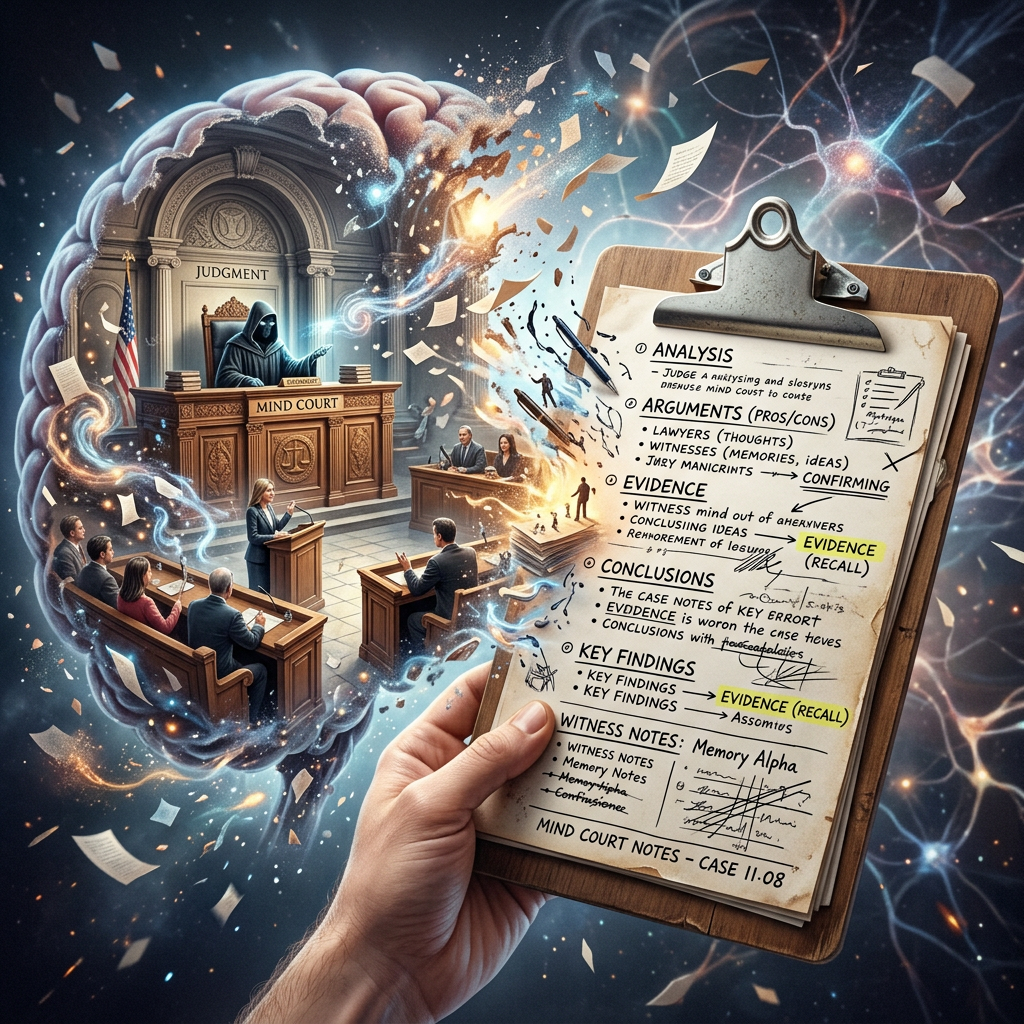
That is the inner courtroom.
The Courtroom-to-Clipboard Converter exists because the courtroom may be loud, but it is not where the work gets done.
Why the inner courtroom forms
The inner courtroom is often an attempt to create order.
When something painful happens, the mind wants a case. It wants charges, defense, evidence, blame, motive, verdict, and sentence.
This can feel productive because it is active. You are thinking. You are reviewing. You are replaying. You are preparing arguments.
But much of the time, the inner courtroom does not produce agency. It produces exhaustion.
You argue with people who are not in the room.
You defend yourself against accusations nobody has actually made.
You convict yourself on partial evidence.
You rehearse speeches that do not change the situation.
You mistake mental litigation for movement.
The courtroom has a use, but not the final say
The inner courtroom is not always useless.
It may reveal where you feel accused. It may show what you fear others believe. It may point toward unfinished business. It may identify a real injustice or a real responsibility.
But it cannot stay in charge.
The field question is not, “How do I win the trial in my head?”
The field question is, “What usable action can come from this pressure?”
That is where the clipboard comes in.
The converter
The Courtroom-to-Clipboard Converter has three questions:
What pattern am I noticing?
What boundary may need to change?
What is the next practical step?
That is it.
Not because the situation is simple. Because the mind under pressure needs a short bridge out of the trial.
Question one: what pattern am I noticing?
The courtroom asks, “Who is guilty?”
The clipboard asks, “What pattern is visible?”
Pattern language is less explosive and more useful.
Instead of “They never respect me,” try:
“There is a repeated pattern of last-minute changes being treated as my responsibility.”
Instead of “I always fail,” try:
“When expectations are vague, I over-function instead of asking for clarification.”
Instead of “This person is impossible,” try:
“Conversations with this person often shift from practical issues to character judgments.”
Pattern language lets you work without pretending the pattern does not hurt.
Question two: what boundary may need to change?
The courtroom wants a verdict.
The clipboard wants a boundary.
A boundary might be practical:
“I need changes in writing.”
“I will not accept new responsibilities without identifying resources.”
“I will not respond to messages after a certain hour unless there is an emergency.”
“I will not discuss my character when the issue is a task.”
“I will not keep rescuing a system that refuses to clarify expectations.”
Boundaries are not punishments. They are structure.
A clean boundary converts emotional recognition into future protection.
Question three: what is the next practical step?
The courtroom loves final answers.
The clipboard asks for one step.
Save the email.
Make the call.
Write the timeline.
Ask for clarification.
Delay the response.
Update the Evidence Ledger.
Eat before answering.
Send the document to counsel.
Tell the safe witness what happened.
Refuse the bait.
One step may feel too small for the size of the emotion. That is exactly why it helps. Crisis wants total resolution. Agency usually returns through partial movement.
A worked example
Courtroom statement:
“I am an idiot for letting this happen again.”
Pattern:
“I accepted responsibility before the authority and resources were clear.”
Boundary:
“I will not agree to future responsibility without written expectations and the authority to meet them.”
Next step:
“Review the last three emails and write a clarification request.”
Notice what changed.
The original sentence attacked identity.
The converted version identified a pattern, created a boundary, and named an action.
That is the work.
When the courtroom comes back
It will come back.
Do not treat that as failure. The inner courtroom may be an old survival habit. It may have been built when self-prosecution felt safer than uncertainty, rejection, or helplessness.
Thank it for trying to find order.
Then move the file to the clipboard.
Pattern.
Boundary.
Next step.
Again and again, until the body learns that not every pressure point requires a trial.
The field rule
You do not have to win every argument inside your head before you are allowed to move.
You do not have to reach the perfect verdict before you take the next useful step.
When the inner courtroom gets loud, do not stay there all night.
Convert the case.
Name the pattern.
Set the boundary.
Take the next step.
Godspeed.
Field Manual Expansion Series: This post is part of a 20-part Standing on the Ledge sequence expanding the core tools, protocols, and pressure points behind the Field Manual.
Previous: The Responsibility/Authority Mismatch Audit — [link previous post]
Next: Legal Silence Is Not the Same as Silence — [link next post once published]
Discover more from Standing on the Ledge
Subscribe to get the latest posts sent to your email.

