
Module focus Resistance to change, Lewin’s force field analysis, unfreezing, movement and refreezing, urgency, communication, learning, involvement, stress management, negotiation, coercion, action research, appreciative inquiry, large group interventions, parallel learning structures, coalitions, and pilot projects
Lens Resistance is not always refusal to move. It may be information about fear, loss, distrust, poor design, or the cost being transferred to people who had little voice in the change.
Topic Focus
This learning journal examines why people resist organizational change and how change agents should respond. It explores Lewin’s force field analysis and the stages of unfreezing, moving, and refreezing; strategies involving communication, learning, employee involvement, stress management, negotiation, and coercion; the creation of credible urgency; and formal approaches including action research, appreciative inquiry, large group interventions, and parallel learning structures. It also considers coalitions, social networks, and staged pilot projects. The central question is whether leaders are trying to overpower resistance or understand enough of it to design change that can survive contact with the people and systems expected to carry it.
Opening Reflection: Resistance Is Often the First Honest Review of the Plan
Leaders often speak about resistance as though it were an obstruction located inside difficult employees. The change is described as necessary, rational, and inevitable. Anyone who questions it becomes negative, afraid, or unwilling to adapt.
Sometimes that description is accurate. People can resist because they prefer familiar routines, fear uncertainty, protect status, or do not want to learn. But resistance can also be a form of information. The people closest to the work may see a missing resource, an unrealistic timeline, a contradiction with another system, or a human cost that the change plan has placed outside its frame.
Resistance does not automatically prove the change is wrong. It does prove that the present explanation, design, trust, or distribution of cost is not yet enough.
Module 13 warns that forcing change can drive resistance underground. That matters because visible disagreement is easier to work with than quiet sabotage, withdrawal, surface compliance, or the informal network that agrees publicly and restores the old system privately.
The goal should not be to eliminate resistance by making people afraid to express it. The goal should be to separate resistance that protects comfort or privilege from resistance that protects knowledge, dignity, safety, or the organization’s ability to function.
Why People Resist Organizational Change
Resistance has both personal and organizational sources. Several can operate at the same time.
| Source of resistance | What the person may be experiencing | What the change agent should examine |
|---|---|---|
| Lack of understanding | The purpose, process, timeline, or personal impact is unclear | Whether communication has produced shared meaning rather than merely delivered information |
| Fear of the unknown | The present system is imperfect but predictable; the future is not | What uncertainty can be reduced and what support is available |
| Direct cost or loss | The person may lose income, status, autonomy, relationships, convenience, identity, or opportunity | Who benefits, who pays, and whether the burden is fair and acknowledged |
| Broken routines | Established habits and competence no longer produce expected results | Whether people have time, practice, tools, and psychological room to learn |
| Saving face | Accepting change may feel like admitting that past decisions or expertise were wrong | Whether the change honours prior contribution while updating the method |
| Low trust | Employees do not believe the stated reason, promised support, or hidden impact | The organization’s history, credibility, transparency, and treatment of earlier change |
| Incongruent systems | Rewards, structure, technology, workload, policy, or authority still support the old behaviour | Whether the surrounding operating system has actually changed |
| Team norms and social pressure | Belonging to the group may require resisting, delaying, or quietly undoing the change | Which informal leaders and networks shape local meaning |
| Change fatigue | Employees have experienced repeated launches, reversals, unfinished projects, or unsupported transitions | Whether this change is credible, resourced, prioritized, and different from previous attempts |
The same behaviour can have different causes. A person who does not attend training may be disengaged. They may also be covering work because the organization added training without creating time to attend. Diagnosis has to come before judgment.
Resistance as a Power Question
Change redistributes more than tasks. It can redistribute information, authority, status, visibility, relationships, workload, and control. People who benefit from the current system may resist because they have something to lose. People with little formal power may resist because the change transfers additional cost downward.
The power difference also affects how resistance appears. A senior leader can oppose a change by delaying resources, questioning strategy, or requesting further review. A frontline employee may have only withdrawal, work-to-rule, informal complaints, turnover, or quiet non-compliance.
Leaders should therefore ask not only who is resisting, but who is allowed to resist professionally and whose resistance is immediately treated as a character problem.
Lewin’s Force Field Analysis
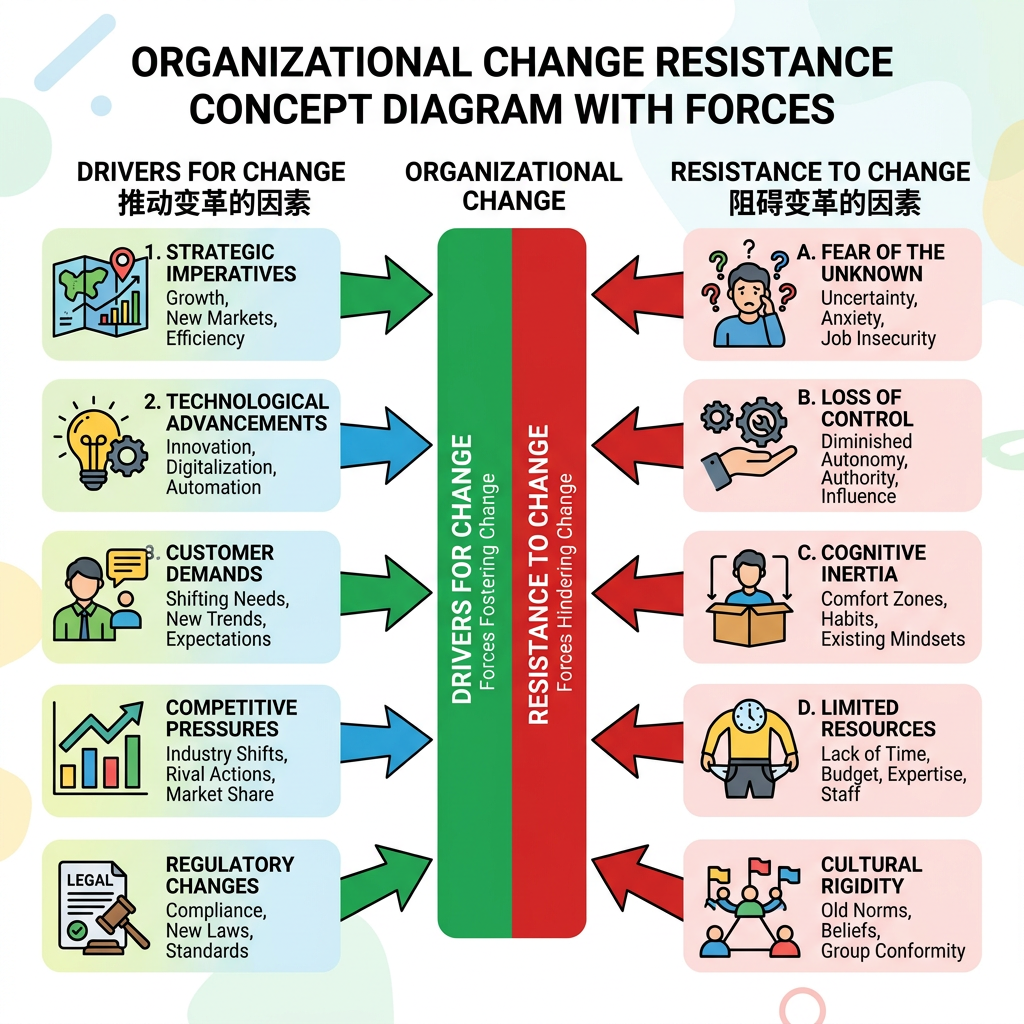
Lewin’s force field analysis treats the current state as an equilibrium between forces driving change and forces restraining it. Change becomes more likely when driving forces are strengthened, restraining forces are reduced, or both.
| Driving forces | Restraining forces |
|---|---|
| Customer needs, safety concerns, market pressure, new technology, funding limits, leadership vision, legal requirements, employee ideas, and performance evidence | Fear, habit, low trust, skill gaps, conflicting rewards, workload, group norms, status loss, poor communication, past failures, and inadequate resources |
The model is useful because it prevents leaders from assuming that more pressure is always the answer. Adding urgency, targets, monitoring, or executive authority may increase the driving force. It can also increase fear and defensive resistance.
Often the cleaner strategy is to reduce the restraining force. Training can reduce skill fear. Honest communication can reduce uncertainty. Involvement can improve the plan and create ownership. Workload support can create capacity. Alignment of rewards and authority can remove contradictions.
Change does not always need a stronger push. Sometimes it needs fewer reasons to brace against it.
Unfreezing: Making the Present State Discussable
Unfreezing creates readiness to move away from established behaviour. It is not simply announcing that the old way is over. It involves weakening the assumptions, routines, and social support that keep the current state stable.
Credible unfreezing requires evidence. People need to understand the gap between present performance and required performance, the consequences of remaining still, and why the proposed direction is relevant.
Unfreezing also requires psychological permission to reconsider. Employees may have built identity and competence around the old system. Leaders who ridicule the past make change harder because people are forced to defend their own history. A better message is that the previous method may have served a real purpose and that current conditions now require a different response.
Movement: Turning Direction into New Behaviour
The movement stage is where people learn and practise the new behaviour. This is usually the most visible part of change: new technology, roles, procedures, reporting relationships, measures, or expectations.
Movement fails when the organization treats implementation as installation. A new system can be installed while the old habits, workload, authority, rewards, and informal workarounds remain untouched. Employees then create a hybrid system: the new process for official visibility and the old process for getting the work done.
Successful movement requires clear roles, training, feedback, local problem-solving, resources, time, leadership availability, and permission to identify where the design does not fit reality.
Refreezing: Making the New State the Normal State
Refreezing stabilizes the change by embedding it in daily behaviour, norms, values, systems, and relationships. The word can sound rigid, but the purpose is not to freeze the organization permanently. It is to stop the change from dissolving as soon as attention moves elsewhere.
Refreezing requires alignment:
- Job descriptions and decision rights reflect the new work.
- Performance measures reward the new behaviour.
- Technology and procedures support it.
- Supervisors coach and reinforce it.
- Stories and recognition make the new norm visible.
- New employees are socialized into it.
- Old workarounds are retired only after the new process can carry the load.
If leaders rush this stage, employees learn that the initiative is temporary. They wait for attention to pass and the old equilibrium returns.
Creating Urgency Without Manufacturing Panic
Urgency helps people understand why delay has a cost. External pressures such as customer needs, funding constraints, safety evidence, legal requirements, or market change can create a clear rationale.
Internal foresight is harder to communicate because leaders may see a threat before it becomes visible to everyone else. Employees may believe leadership is changing for the sake of change or exaggerating danger.
Credible urgency has several qualities:
- It is evidence-based. The threat or opportunity is specific and supported.
- It is proportionate. The message does not exaggerate uncertainty into catastrophe.
- It connects to shared interests. People understand how the issue affects customers, employees, purpose, and organizational survival.
- It includes a workable direction. Urgency without agency produces anxiety, not movement.
- It remains open to questions. Leaders do not treat requests for evidence as proof of disloyalty.
False urgency spends trust. If every initiative is a crisis, employees learn that urgency is a management style rather than information.
Communication
Communication is central to change because employees must understand the need, desired state, process, timing, impact, and available support. Repetition matters, but repetition alone does not create understanding.
Change communication should answer practical questions:
- What is changing and what is not?
- Why is the change necessary?
- What evidence supports the need?
- Who made the decision and who was consulted?
- How will roles, workload, authority, pay, location, identity, or security be affected?
- What support and training are available?
- What remains uncertain?
- How can employees raise problems safely?
Honest uncertainty is more credible than false certainty. People can often tolerate not knowing when leaders explain what is known, what is undecided, and when the next information will arrive.
Learning and Employee Involvement
Learning reduces resistance when the barrier is skill, confidence, or understanding. Training has to be connected to real work and supported with practice, feedback, and time.
Employee involvement improves change in two ways. It creates participation, and it improves the design because employees closest to the work possess information that planners may not have.
Involvement does not mean every decision becomes a vote. It means consultation is proportionate to the knowledge people hold and the consequences they will carry. Leadership can retain final authority while still allowing the plan to be corrected by reality.
Involvement is not surrendering leadership. It is refusing to confuse authority with complete information.
Stress Management
Change consumes cognitive and emotional capacity. Employees must perform current work while learning new work, managing uncertainty, and interpreting social signals about their future.
Stress management should therefore include more than wellness advice. Leaders can reduce unnecessary strain through realistic timelines, workload adjustment, sequencing, staffing, clear priorities, accessible support, predictable communication, and recovery time.
An organization cannot create instability across several systems and then treat employee distress as a private resilience problem. Stress may be a normal response to load that has not been designed honestly.
Negotiation and Coercion
Negotiation may be appropriate when the change creates real costs or when employee support depends on adjustments to workload, timing, resources, compensation, or job security. Negotiation acknowledges that affected parties have interests rather than treating every concern as emotional resistance.
Coercion uses authority, threats, or consequences to force compliance. It may be necessary when urgent safety, legal, or survival conditions leave little room for delay. It is also high risk. Coercion can create surface compliance while driving opposition underground. It consumes trust and may prevent the organization from hearing valid information.
| Approach | When it may help | Main risk |
|---|---|---|
| Negotiation | When interests differ and a workable exchange or accommodation is possible | Can become delay if the decision is fixed but leaders pretend everything is negotiable |
| Coercion | When immediate action is required to protect safety, legality, or organizational survival | Produces resistance, concealment, low commitment, and damaged trust |
If a decision is final, leaders should say which parts are fixed and which parts remain open to influence. False participation is often more corrosive than an honest directive.
Coalitions, Champions, and Social Networks
Coalitions of champions can build credibility and momentum. People often interpret change through trusted peers before they trust official communication. Informal leaders can translate the change, surface local concerns, and model new behaviour.
Coalitions become manipulative when champions are chosen only to sell a predetermined message while concerns are filtered out. Their value comes from two-way credibility. They must be able to carry the organization’s reasoning into the network and carry the network’s reality back to leadership.
Social networks can accelerate change or restore the old equilibrium. Leaders need to understand where trust, expertise, and influence actually sit rather than assuming the formal chart identifies every important change agent.
Action Research
Action research treats change as a cycle of diagnosis, planning, action, and evaluation. Data is gathered about the current problem, the organization develops and implements an intervention, and results are examined so the next action can be adjusted.
The strength of action research is that it builds learning into the change. The organization does not pretend the first plan is perfect. The risk is that data collection becomes endless consultation without decision, or that employees provide information but never see how it affected the action.
- Diagnose. Gather evidence about the current state, causes, stakeholders, and constraints.
- Plan. Develop an intervention connected to the diagnosis.
- Act. Implement the change with clear responsibilities and supports.
- Evaluate. Compare results with expectations and gather feedback.
- Adjust. Continue, revise, expand, or stop based on evidence.
Appreciative Inquiry
Appreciative inquiry focuses attention on strengths, successful experiences, possibility, and shared potential. It does not begin by asking only what is broken. It asks when the organization has been at its best and how those conditions can be expanded.
The module identifies principles such as positive focus, the role of language in constructing reality, the idea that inquiry itself begins change, and the possibility of framing organizational experience in different ways.
| Stage | Core question |
|---|---|
| Discovery | What is working, and when have we been at our best? |
| Dreaming | What could the organization become? |
| Designing | What systems, relationships, and practices would support that future? |
| Delivering | What will we do, who will do it, and how will learning continue? |
Appreciative inquiry can create energy and reduce defensive focus. It must not become compulsory optimism. Some systems require direct naming of harm, failure, power, and loss. Strength-based inquiry works best when it expands agency without erasing evidence.
Large Group Interventions
Large group interventions bring many stakeholders together to create shared understanding, examine the whole system, and develop coordinated action. They can reduce the distortion that occurs when information passes through several management layers.
Their value comes from scale, diversity of perspective, and simultaneous learning. Their risk is performance. A large event can create visible enthusiasm without changing authority, resources, or systems. Broad participation has to connect to decisions and follow-through.
Parallel Learning Structures
A parallel learning structure is a group or system created alongside the formal organization to explore change, experiment, and solve problems without being fully constrained by the normal hierarchy. It may include representatives from several levels and functions.
This structure can protect learning and innovation while the main organization continues operating. It can also become a side committee with ideas but no authority. The connection back to the formal system must be designed: who receives recommendations, who decides, what resources are available, and how successful learning becomes standard practice.
Pilot Projects and Staged Change
Pilot projects allow an organization to test change on a smaller scale. They can reduce fear, reveal design problems, generate evidence, and build credible local examples.
A pilot should not be used dishonestly. If the change is inevitable and the pilot has no real ability to influence design or continuation, leadership should not present it as an open trial. It may still be useful as a staged implementation, but the purpose should be named accurately.
A good pilot has a defined scope, measures, decision rights, support, feedback channels, review date, and criteria for expansion, revision, or stopping.
Personal Reflection: Standing on the Ledge as a Change Process
Standing on the Ledge began after a rupture, but the framework that followed can be read as a change process. The old equilibrium had already failed. The immediate task was not motivation. It was to understand what had changed, what remained, and what could still be influenced.
Unfreezing occurred through the collapse of assumptions that had previously organized work, identity, security, and purpose. The danger in that stage was trying to restore the former system simply because it was familiar.
Movement involved inventory, evidence, triage, boundaries, new routines, learning, and the smallest usable next step. It was not one dramatic transformation. It was repeated adjustment under incomplete information.
Refreezing is still the harder part. A new insight does not become a stable life merely because it has been written down. It has to become routine, boundary, calendar, decision rule, support, and practice. The new structure must carry some of the load that willpower previously carried.
This is where Module 13 corrects the idea that change happens because a leader announces a desired state. Change becomes real when the forces around daily behaviour change. People need a reason, capacity, support, aligned systems, and enough repetition that the new response no longer depends on emergency attention.
The module also sharpens my view of resistance. Not every return to an old pattern is laziness or failure. Sometimes the old force field remains stronger. The question becomes practical: what restraining force was never reduced, what support was removed too soon, and what part of the new system never became load-bearing?
A Change Under Load Audit
The following audit translates Module 13 into a practical sequence for change where uncertainty, power differences, history, and stress may distort both leadership and resistance.
- Define the present state. What behaviour, result, or condition exists now?
- Define the desired state. What specifically will be different in behaviour, process, authority, or outcome?
- State the evidence for change. What threat, opportunity, customer need, safety issue, or performance gap makes movement necessary?
- Map the driving forces. What supports movement toward the desired state?
- Map the restraining forces. What fear, cost, habit, norm, skill gap, workload, system, or power interest holds the present state in place?
- Diagnose resistance before judging it. Which concern protects comfort, and which concern carries useful information?
- Audit the distribution of cost. Who benefits, who pays, who decides, and who can safely say no?
- Create credible urgency. Can people see why delay matters without being manipulated by panic?
- Clarify fixed and flexible elements. What has been decided, and what can employees still influence?
- Build communication loops. How will information travel to employees and reality travel back to decision-makers?
- Provide learning and capacity. Are time, training, staffing, tools, and support adequate?
- Involve relevant knowledge holders. Have the people closest to the work helped test the design?
- Choose the intervention. Is action research, appreciative inquiry, a large group intervention, a parallel structure, negotiation, or a pilot appropriate?
- Use coercion only proportionately. Is immediate direction necessary, lawful, ethical, and limited to what cannot wait?
- Define review and stop rules. What evidence will trigger expansion, revision, pause, or abandonment?
- Refreeze through systems. Which roles, rewards, measures, routines, stories, and onboarding practices will hold the new behaviour?
- Watch for hidden restoration. Where might the old system return through informal workarounds?
Application to Organizational Behaviour
- Resistance can come from fear, direct loss, broken routines, low trust, saving face, incongruent systems, team norms, and change fatigue.
- Resistance should be diagnosed because the same visible behaviour can arise from very different causes.
- Force field analysis directs attention to both driving and restraining forces rather than assuming more pressure is always required.
- Unfreezing creates readiness, movement creates new behaviour, and refreezing embeds the change in daily systems and norms.
- Urgency should be credible, evidence-based, proportionate, and connected to agency.
- Communication must create shared understanding and acknowledge what remains uncertain.
- Learning and employee involvement reduce resistance while improving the quality of the change design.
- Stress management includes workload, staffing, sequencing, recovery, and clarity, not only individual coping advice.
- Negotiation acknowledges real interests; coercion may produce compliance but carries high trust and resistance costs.
- Coalitions and social networks can increase credibility when they carry information in both directions.
- Action research builds diagnosis, action, evaluation, and adjustment into the change process.
- Appreciative inquiry uses strengths and possibility but should not erase problems that require direct naming.
- Large group interventions create system-wide understanding only when participation connects to real decisions.
- Parallel learning structures need a designed path back into formal authority and operations.
- Pilot projects should have honest purpose, measures, feedback, and decision rules.
Questions I Am Carrying Forward
- What is this resistance protecting: comfort, status, identity, safety, knowledge, or fairness?
- Which restraining force could be reduced instead of adding more pressure?
- Is the urgency supported by evidence, or is urgency being used as a leadership style?
- What has actually been decided, and what participation remains real?
- Who carries the cost of the change, and how much influence did they have over its design?
- Are employees resisting the desired outcome or the unsupported path chosen to reach it?
- What old reward, policy, workload, or authority pattern still reinforces the previous behaviour?
- Has communication produced understanding, or only proof that the message was sent?
- Does the coalition carry frontline truth upward, or only carry leadership messaging downward?
- Would an action-research cycle produce better evidence before full implementation?
- Is appreciative inquiry creating agency or pressuring people to speak positively about unresolved harm?
- Will the large group event change a decision, resource, or system after the room empties?
- Does the pilot have genuine power to change the plan?
- What will hold the new behaviour after executive attention moves elsewhere?
- When an old pattern returns, what does that reveal about the force field rather than the person’s character?
Closing Reflection
The cleanest lesson I take from Module 13 is that organizational change is not the announcement of a future state. It is the deliberate reshaping of forces, systems, meaning, capacity, and daily behaviour.
Resistance is part of that process. Some resistance protects habit or privilege. Some protects expertise, identity, safety, and fairness. A competent change agent does not romanticize resistance, but does not silence it before learning what it contains.
The personal lesson is that lasting change needs more than insight. It needs a structure strong enough to hold the new behaviour after urgency fades. The old pattern often returns not because the person learned nothing, but because the old environment remained better organized.
Do not measure change by the announcement, the meeting, or the first week. Measure it by what the system makes easier after attention has moved on.
That is where organizational behaviour meets the ledge: urgency without panic, movement without abandonment, resistance treated as evidence, and a new footing strong enough that survival no longer depends on constant emergency effort.
Godspeed.
Field Card
- One receipt: Surface compliance does not prove change has occurred. The receipt is the behaviour that remains after pressure and attention decline.
- One next step: Take one desired change and list the driving forces, restraining forces, and the single restraint that can be reduced first.
- One boundary sentence: “I am willing to participate in the change, but support cannot mean absorbing undefined costs, unclear authority, and preventable risk in silence.”
References
Algonquin College. (2026). Module 13: Organizational change, resistance, and change interventions. MGT2382 Organizational Behaviour course materials.
McShane, S. L., & Steen, S. L. (2012). MGM300: Organizational behaviour. McGraw-Hill.
McLaughlin, K. (2026). MGT2382 Organizational Behaviour learning journals and Standing on the Ledge field notes on change, evidence, resistance, boundaries, and movement from rupture to agency.
Discover more from Standing on the Ledge
Subscribe to get the latest posts sent to your email.

