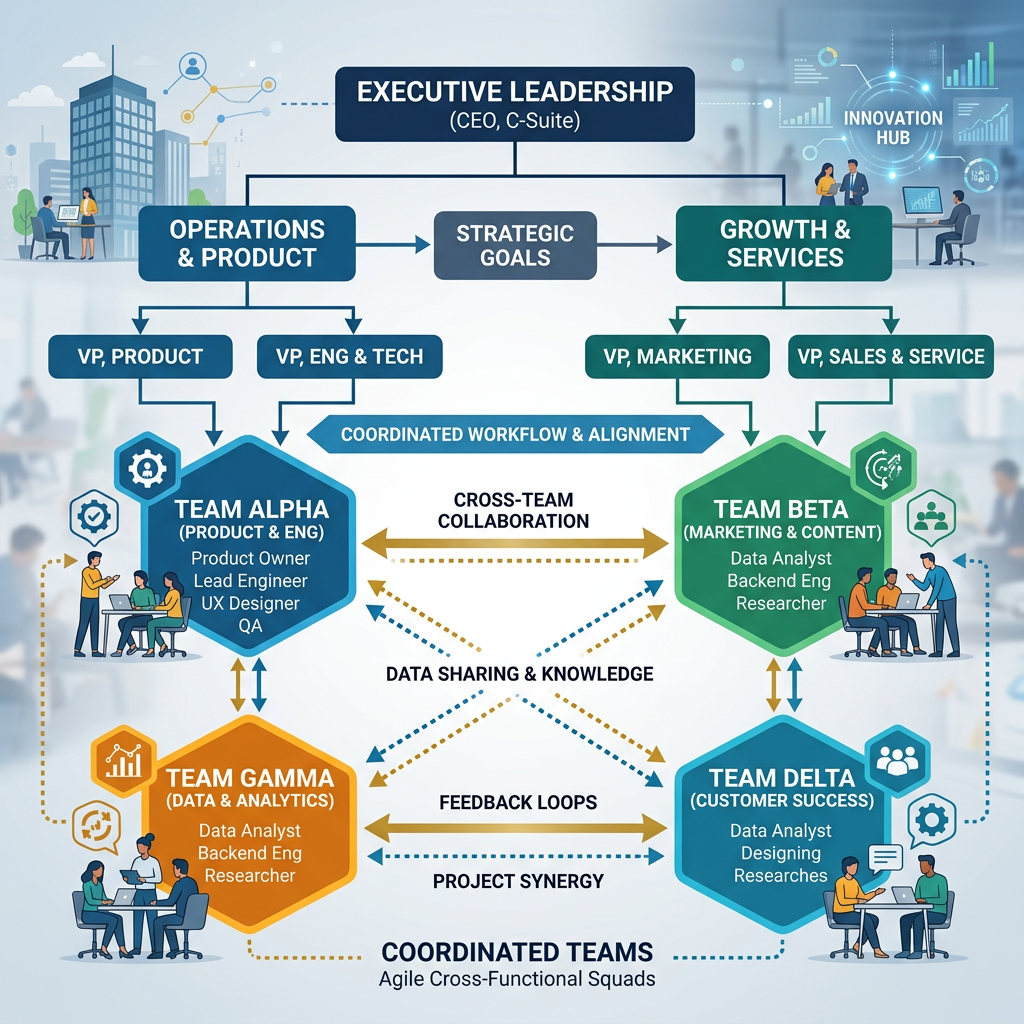

Module focus Organizational structure, division of labour, coordination, span of control, centralization, formalization, mechanistic and organic structures, departmentalization, and structural contingencies
Lens Structure is not merely boxes and reporting lines. It is the system that distributes information, authority, workload, delay, and consequence.
Topic Focus
This learning journal examines organizational structure as the formal and informal arrangement through which work is divided and coordinated. It considers informal communication, liaison and integrator roles, hierarchy, standardization, span of control, centralization, formalization, mechanistic and organic structures, and functional, divisional, team-based, matrix, network, and globally integrated forms. It also examines how external environment, organizational size, technology, and strategy should shape structural design. The central question is whether the structure helps the work move or merely creates a chart that looks orderly while employees compensate for the gaps.
Opening Reflection: A Box on the Chart Does Not Complete a Handoff
Organizational structure is often presented as an organizational chart: boxes, titles, reporting lines, and one large box at the top. The chart can be useful. It can show formal authority, identify departments, and help people understand where they belong.
The chart does not show the whole work.
It does not automatically show who carries the missing information, who repairs the handoff, who has practical knowledge without decision authority, who is overloaded because their position sits at a bottleneck, or which employee has become the unofficial bridge between departments that rarely communicate directly.
The formal chart shows where authority is supposed to travel. The lived structure shows where the work, pressure, and consequences actually travel.
Module 12 begins with two basic processes: division of labour and coordination. Division of labour separates work into roles and specialties. Coordination reconnects the separated pieces so the organization can produce a shared result. Every structural problem begins somewhere inside that tension. Specialization can create expertise and efficiency, but every division creates a boundary that must be crossed.
If the organization divides the work without designing the connection, employees become the connection. They chase information, interpret contradictory priorities, repair delays, negotiate resources, and absorb the frustration created by a structure that appears complete on paper.
Organizational Structure as a Behavioural System
Structure influences organizational behaviour because it shapes who communicates, who decides, who controls resources, who receives information, and who is accountable for outcomes. It can encourage cooperation or competition. It can speed decisions or trap them. It can make responsibility clear or spread it so widely that no one owns the result.
A structure therefore does more than organize positions. It creates repeated experiences:
- How many approvals are required before action can occur?
- Can people closest to the work make reasonable decisions?
- Do departments share information or protect it?
- Does authority match responsibility?
- Can a problem move upward without being filtered?
- Does the design make coordination routine or heroic?
These repeated experiences become culture. Structure and culture are therefore connected. A siloed structure can teach territorial behaviour. A highly centralized structure can teach people to wait. A badly designed matrix can teach employees that every priority is urgent because several managers can issue demands without resolving the conflict among themselves.
Division of Labour: The Strength and Cost of Specialization
Division of labour separates tasks into jobs, specialties, functions, or stages. This supports work specialization. People can develop expertise, use equipment efficiently, and avoid duplicating tasks.
The cost is fragmentation. The person performing one part may not see the whole process, the customer consequence, or the conditions facing the next role. Specialization can create local excellence while the total system performs poorly.
| Structural benefit | Possible cost | Design question |
|---|---|---|
| Specialized skill and efficiency | Narrow perspective and reduced flexibility | How will specialists understand the wider process? |
| Clear task ownership | Boundary disputes and “not my job” behaviour | Who owns the handoff and final outcome? |
| Reduced duplication | Single points of failure and bottlenecks | What backup knowledge and capacity exist? |
| Standardized performance | Reduced discretion and innovation | Where is judgment necessary? |
| Economies of scale | Distance from customers and local conditions | How will feedback travel back into the function? |
The structural mistake is to treat specialization as though coordination will happen naturally. Every time work is divided, someone has to design the connection.
Coordination: Reconnecting What the Structure Divides
Coordination aligns separate activities toward a shared outcome. The module identifies informal communication and formal hierarchy as major coordination mechanisms. Organizational behaviour also shows that coordination can be strengthened through liaison roles, integrators, temporary teams, standard procedures, shared goals, training, and information systems.
| Coordination mechanism | How it works | Main limitation |
|---|---|---|
| Informal communication | People speak directly and adjust work through relationships and mutual understanding | Can depend on personalities, memory, and access rather than a dependable system |
| Formal hierarchy | Authority resolves disputes, sets priorities, allocates resources, and establishes accountability | Can slow decisions and filter information as it moves upward |
| Standardization | Rules, procedures, training, and shared outputs reduce the need for repeated negotiation | Can become rigid when work requires judgment or conditions change |
| Liaison roles | A person connects two units that must exchange information or resources | The liaison may carry responsibility without enough authority |
| Integrator roles | A coordinator manages dependencies across several units or specialties | Can add another layer if decision rights remain unclear |
| Temporary or cross-functional teams | People from different areas work together on a shared problem or project | Members may face competing demands from the project and their home departments |
Informal communication is fast and human. It is also easy for organizations to exploit without noticing. A workplace may appear to coordinate well because experienced employees know whom to call, which rule can bend, how to translate one department’s language into another, and where the real decision is made. That is valuable social capital. It is also fragile if the organization has never documented or distributed the knowledge.
When coordination depends on one person’s private map, the system is borrowing stability from that person.
Span of Control
Span of control is the number of employees who report directly to a manager. A narrow span means fewer direct reports and usually more management layers. A wide span means more direct reports and often a flatter structure.
| Span condition | Potential advantage | Main risk |
|---|---|---|
| Narrow span | Closer supervision, more coaching, and greater management attention | Higher cost, slower communication, micromanagement, and more hierarchy |
| Wide span | Fewer layers, faster communication, greater autonomy, and lower management cost | Overloaded managers, weak support, inconsistent feedback, and hidden problems |
The correct span depends on the work. Routine tasks, experienced employees, clear standards, geographic closeness, and strong information systems may support a wider span. Complex work, new employees, high risk, varied tasks, distance, and frequent exceptions may require a narrower span.
A wide span is not empowerment when the manager has no time to coach, communicate, or notice warning signs. A narrow span is not support when every decision is pulled upward and employee judgment is treated as a threat.
Centralization and Decentralization
Centralization concentrates decision authority at higher levels. Decentralization distributes authority closer to the people and locations doing the work.
Centralization can improve consistency, control scarce resources, protect standards, and support coordinated action during crisis. It becomes a problem when distant decision-makers lack local information or when employees must wait for approval to address obvious operational needs.
Decentralization can improve speed, responsiveness, development, and local ownership. It becomes dangerous when responsibility is distributed without competence, information, resources, or clear boundaries.
Decentralization is not the removal of support. It is the deliberate movement of decision authority to people equipped to use it.
The practical test is whether the person carrying the consequence can influence the decision. Perfect alignment is impossible, but chronic separation between authority and consequence creates frustration, delay, and defensive behaviour.
Formalization
Formalization is the degree to which work is governed by written rules, procedures, job descriptions, and standardized practices. High formalization can improve reliability, safety, fairness, training, and legal compliance. It is essential in many high-risk or tightly regulated environments.
Formalization becomes harmful when rules replace thought, when procedures lag behind reality, or when employees are punished for exercising necessary judgment. Low formalization can support adaptability and creativity, but it can also create inconsistency, ambiguity, favouritism, and dependence on unwritten knowledge.
The right question is not whether rules are good or bad. It is what must be standardized, what requires judgment, and how the organization will learn when the rule no longer fits the work.
Mechanistic and Organic Structures
Mechanistic and organic structures represent different ways of organizing authority, communication, and work.
| Feature | Mechanistic structure | Organic structure |
|---|---|---|
| Specialization | High and narrowly defined | Broader roles and cross-functional contribution |
| Departmentalization | Rigid and clearly separated | Flexible and team-oriented |
| Chain of command | Clear and vertical | More cross-hierarchical interaction |
| Span of control | Narrow | Wide |
| Decision authority | Centralized | Decentralized |
| Formalization | High | Low |
| Information flow | Primarily vertical and controlled | Freer, lateral, and networked |
| Best fit | Stable conditions, routine technology, strong control requirements | Dynamic conditions, complex problems, innovation, and rapid adaptation |
Neither form is universally superior. A mechanistic design may be appropriate where consistency, precision, and risk control are critical. An organic design may be better where information changes quickly and employees must collaborate across boundaries.
Most real organizations need both. A hospital may require mechanistic medication protocols and organic cross-disciplinary problem-solving. A service company may require clear quality standards while allowing local judgment about scheduling and customer needs. Good design identifies which part of the work needs control and which part needs adaptation.
Functional Structure
A functional structure groups people by occupational specialty, such as operations, finance, human resources, marketing, or information technology. It supports specialization, reduces duplication, and creates clear professional homes.
The main risk is the silo. Each function may optimize its own goals while the customer or overall process suffers. Language, measures, time horizons, and professional identity can become so different that coordination feels like negotiation between separate organizations.
A functional structure therefore needs strong cross-functional processes, shared goals, and reliable handoffs. Without those, efficiency inside the department creates delay between departments.
Divisional Structures
Divisional structures group work around products, services, customers, clients, or geographic regions. Each division may contain several functions needed to serve its particular market or output.
The advantage is focus. Decision-makers can respond more directly to a product, region, or customer group. The cost is duplication. Several divisions may each maintain their own finance, human resources, marketing, or operations capacity.
| Divisional basis | Main strength | Main risk |
|---|---|---|
| Product or service | Clear responsibility for a particular offering and faster market response | Duplicated functions and competition among product groups |
| Geographic | Responsiveness to local laws, customers, labour markets, and conditions | Inconsistent practices and distance from central expertise |
| Customer or client | Services and expertise designed around distinct customer needs | Duplication and conflict over customers that cross categories |
Team-Based, Matrix, Network, and Globally Integrated Structures
A team-based structure organizes much of the work around self-directed or cross-functional teams. This can improve responsiveness and reduce barriers, but only when teams possess clear purpose, authority, information, and accountability.
A matrix structure overlays two forms of departmentalization, commonly function and product or project. An employee may report to both a functional manager and a project manager. The matrix can share expertise across several priorities. It can also create role conflict, competing demands, slow negotiation, and political pressure when managers do not resolve priorities together.
A network structure keeps a core organization while contracting or partnering for other activities. Networks can create flexibility and access to specialized capability. They also create dependency, coordination challenges, weaker cultural control, and the risk that accountability becomes harder to locate across organizational boundaries.
A globally integrated enterprise coordinates resources and expertise across national borders rather than treating each country as a self-contained operation. This can improve global scale and knowledge sharing while increasing complexity, cultural distance, time-zone challenges, and dependence on sophisticated information systems.
Departmentalization: The Logic Used to Group the Work
Departmentalization is the process of grouping jobs and activities. Every grouping method highlights one form of coordination while making another boundary more difficult.
Grouping specialists together improves expertise but increases the distance between functions. Grouping around products improves product focus but duplicates specialties. Grouping around geography improves local response but can weaken consistency. Matrix designs attempt to hold two priorities at once but create dual authority.
Structural design is therefore not a search for a form with no disadvantages. It is a decision about which disadvantages the organization is prepared and equipped to manage.
Contingency One: External Environment
Stable environments usually allow more mechanistic structures because information changes slowly and efficiency can be gained through standardization. Dynamic, complex, or unpredictable environments require faster information flow, local judgment, and cross-functional learning.
Environmental uncertainty does not mean every part of the organization should become equally organic. The organization may need an adaptive boundary facing customers and change while maintaining standardized internal processes where reliability matters.
Contingency Two: Organizational Size
Small organizations often rely on direct communication, broad roles, and a simple structure. The owner or manager can know much of the work personally. This creates speed, but it can also create dependency on one person.
As organizations grow, direct communication becomes less reliable. More formal roles, procedures, departments, and coordination mechanisms become necessary. The danger is adding layers merely because growth makes hierarchy feel safe. Structure should be added to solve a coordination problem, not to display maturity.
Growth also creates a transition problem. Work that was once handled through memory and relationships must be made visible. If the organization formalizes too late, experienced people carry an unsustainable amount of unwritten coordination. If it formalizes too quickly, bureaucracy can suffocate the flexibility that made the organization effective.
Contingency Three: Technology
Technology affects interdependence, standardization, skill requirements, information flow, and the location of work. Routine technology often supports formalization and centralized control. Complex, non-routine technology usually requires expertise, communication, and decentralized judgment.
Information systems can widen span of control and improve coordination, but they do not eliminate the need for interpretation. A dashboard can make data visible while still hiding context. Technology can connect departments while also creating new silos between people who understand the system and people who merely receive its output.
Contingency Four: Strategy
Structure should support strategy. An organization pursuing cost efficiency may rely on standardization, scale, and centralized purchasing. An organization pursuing innovation may need cross-functional teams, experimentation, and decentralized authority. A customer-intimacy strategy may require decision-making close to the customer.
The problem appears when the strategy changes but the structure does not. Leadership may announce innovation while preserving approvals, rewards, and formalization designed for control. It may promise local responsiveness while keeping every decision at head office. In that case, employees receive two instructions: the strategic message and the structural reality. Structure usually wins.
Personal Reflection: When Coordination Becomes Invisible Labour
Small service operations often look simple from the outside. There is a customer, a contract, a schedule, employees, supplies, equipment, and a required standard. The lived structure can be much more complicated. Different organizations may control scope, access, payment, performance expectations, labour, supplies, and communication.
That creates a network of interdependence without a single complete chain of command. The person closest to the work may be accountable for the result while lacking authority over several conditions that determine whether the result is possible.
In that environment, coordination becomes invisible labour. Someone translates unclear messages, repairs schedule conflicts, finds missing resources, manages relationships, and keeps the customer from seeing the structural gap. The output continues, so the larger system assumes the structure works.
Standing on the Ledge gives me a sharper way to name the pattern: a system can look functional because somebody is absorbing what the structure does not. Module 12 adds that this is not only a workload problem. It is a design problem. The organization has divided authority, information, and responsibility without adequately coordinating them.
The correction is not to eliminate informal problem-solving. Informal communication is essential. The correction is to stop treating heroic coordination as proof that formal design is unnecessary. When the same handoff repeatedly depends on rescue, the rescue is evidence.
A Structure Under Load Audit
The following audit translates Module 12 into a practical tool for examining whether the structure supports the work.
- Map the actual workflow. How does the work move from need to final outcome?
- Compare the formal and lived charts. Who has official authority, and who actually moves information, resources, and decisions?
- Identify the divisions. Where has labour been separated into roles, functions, locations, products, or organizations?
- Inspect every handoff. What information, timing, standard, authority, and feedback are required at each boundary?
- Find the coordination mechanism. Is the handoff supported by direct communication, hierarchy, rules, liaison roles, integrators, teams, or technology?
- Locate bottlenecks and single points of failure. What stops when one person, approval, system, or supplier is unavailable?
- Test span of control. Can managers realistically communicate, coach, monitor, and support the number and complexity of their direct reports?
- Test centralization. Are decisions held at the level with the best information and appropriate accountability?
- Test formalization. Which work requires consistency, and which work requires judgment and adaptation?
- Identify the structural form. Is the organization functional, divisional, team-based, matrix, networked, globally integrated, or a hybrid?
- Name the trade-off. Which benefit is the structure designed to produce, and which disadvantage must be actively managed?
- Check the contingencies. Does the design fit the environment, size, technology, and strategy?
- Audit authority and consequence. Do people held responsible have enough information, resources, and decision rights?
- Make hidden coordination visible. Which employees are privately bridging gaps the structure should address?
- Set a redesign trigger. What evidence would show that the current structure no longer fits?
Application to Organizational Behaviour
- Organizational structure divides labour and coordinates the separated activities toward shared outcomes.
- Every structural boundary creates a coordination requirement.
- Informal communication is fast and valuable but becomes fragile when coordination depends on private relationships or one person’s knowledge.
- Hierarchy can resolve disputes and allocate resources while also slowing information and concentrating decisions too far from the work.
- Span of control should reflect task complexity, employee capability, distance, risk, and the support managers are expected to provide.
- Centralization improves consistency and control; decentralization improves speed and local response when authority is matched with competence and information.
- Formalization supports reliability but must not eliminate necessary judgment or prevent procedures from being corrected.
- Mechanistic and organic structures are different tools, and many organizations need a deliberate combination.
- Functional, divisional, team-based, matrix, network, and globally integrated structures each solve one coordination problem while creating another.
- Structure must fit the external environment, organizational size, technology, and strategy.
- When strategy and structure conflict, employees usually follow the authority, rewards, and processes built into the structure.
Questions I Am Carrying Forward
- Where does the work actually travel compared with the lines on the chart?
- Which employee has become a coordination system without the title, authority, or protection?
- What handoff repeatedly produces delay, rework, conflict, or blame?
- Is a wide span of control creating autonomy or managerial absence?
- Is centralization protecting a necessary standard or keeping decisions away from relevant information?
- Which rule prevents error, and which rule mainly prevents judgment?
- What part of the organization needs mechanistic reliability, and what part needs organic adaptation?
- Is the team-based structure supported by authority and information, or is responsibility simply being pushed downward?
- In a matrix, who resolves competing priorities before the employee is forced to choose?
- Does the network structure preserve accountability across contractors and partners, or allow responsibility to disappear between organizations?
- Has the organization outgrown direct informal coordination but failed to build a reliable replacement?
- Does the current structure support the strategy, or quietly defeat it?
- What hidden cost is being paid to make this structure appear functional?
Closing Reflection
The cleanest lesson I take from Module 12 is that organizational structure is not neutral. It distributes authority, information, workload, opportunity, delay, and risk. It shapes the behaviour that later gets described as attitude, teamwork, initiative, or resistance.
No structure removes every problem. Specialization creates boundaries. Centralization creates distance. Decentralization creates variation. Formalization creates rigidity. Organic structures create ambiguity. The work of design is to choose the trade-offs deliberately and build coordination where the chosen form is weakest.
The personal lesson is to treat repeated workarounds as structural evidence. When one reliable person must constantly translate, chase, cover, decide, and repair, the organization may not have a strong employee. It may have an incomplete structure being held together by a strong employee.
Do not confuse the person bridging the gap with proof that no gap exists.
That is where organizational behaviour meets the ledge: authority beside responsibility, coordination before blame, enough structure to support the work, and enough flexibility to let reality correct the chart.
Godspeed.
Field Card
- One receipt: A recurring workaround is evidence that the formal structure is not carrying the full work.
- One next step: Map one repeated handoff from request to completion and mark every delay, decision, information gap, and unofficial repair.
- One boundary sentence: “I can remain accountable for my part of the outcome, but I cannot accept responsibility for decisions and resources that remain outside my authority.”
References
Algonquin College. (2026). Module 12: Organizational structure, coordination, and design. MGT2382 Organizational Behaviour course materials.
McShane, S. L., & Steen, S. L. (2012). MGM300: Organizational behaviour. McGraw-Hill.
McLaughlin, K. (2026). MGT2382 Organizational Behaviour learning journals and Standing on the Ledge field notes on teams, power, information flow, authority, and responsibility under load.
Discover more from Standing on the Ledge
Subscribe to get the latest posts sent to your email.

