
Date: Calendar week: July 28-August 4, 2026
Category: Field Lab Learning Journals > MGT2382 Learning Journal
Course link: MGT2382 Organizational Behaviour – Week 12: Organizational Structure; McShane Chapter 13.
Lens: Critical lens: structure is not just a chart; it decides how authority, information, responsibility, and pain move through the organization.
Opening reflection
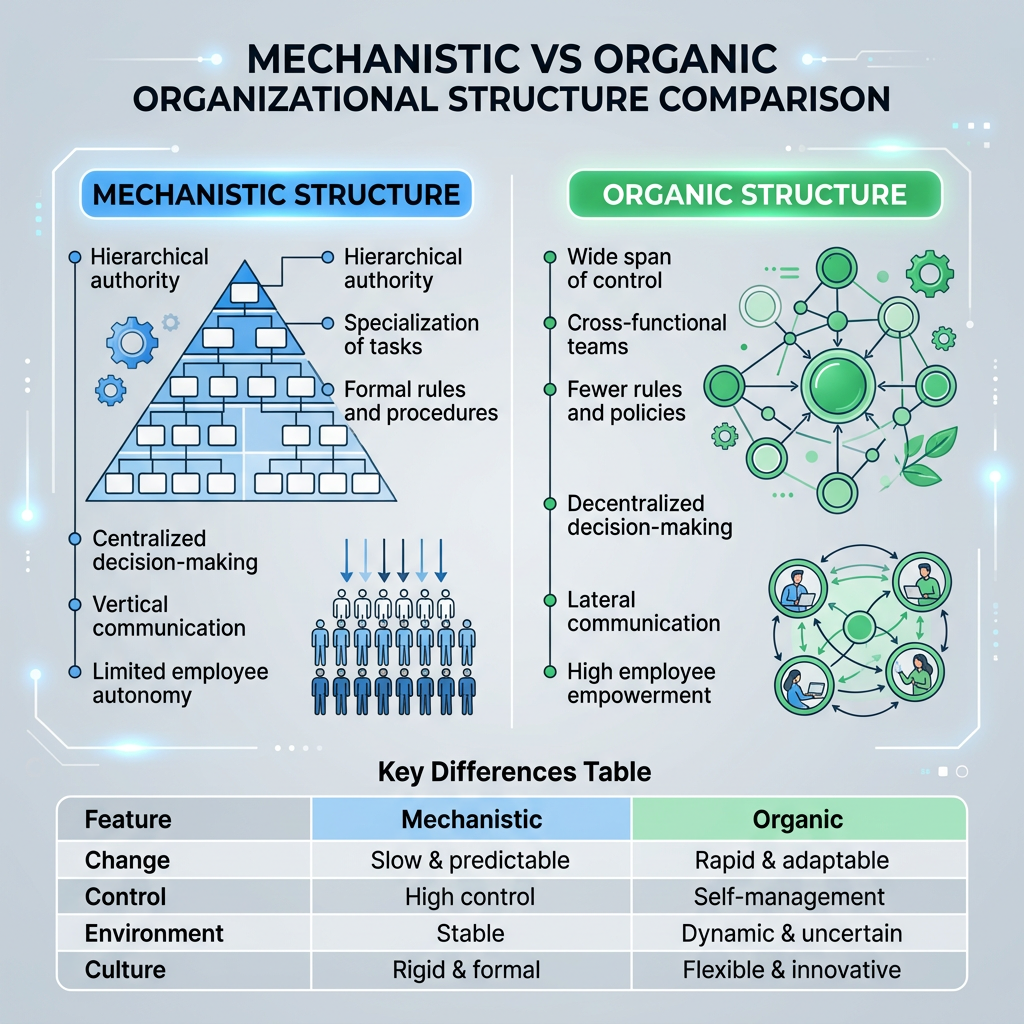
This week’s material on organizational structure can look dry at first: reporting lines, centralization, decentralization, mechanistic models, organic models, product structures, market structures, and geographic structures.
But structure matters because it shapes the daily reality of work. It decides who can act, who must wait, who gets information, who carries responsibility, and who has authority to fix problems.
The real question is not whether the structure looks neat on paper. The real question is whether the structure supports the work or forces the work to bend around the structure.
Structure decides how truth travels
A good structure allows important information to move to the people who need it. A weak structure traps information in silos, delays decisions, and leaves people guessing.
When truth cannot travel, the organization becomes slower and more fragile. Problems are discovered late. Workers improvise without support. Leaders may believe the system is functioning because the structure filters out bad news before it reaches them.
That is why structure is not neutral. It can either connect reality to decision-making or protect decision-makers from reality.
Mechanistic structure and its limits
A mechanistic structure can be useful where consistency, safety, compliance, and repetition matter. Clear roles and formal procedures can reduce confusion.
The risk is rigidity. If the rule becomes more important than the result, the organization can stop thinking. Workers may follow procedure even when the procedure no longer fits the situation.
That type of structure can also push responsibility downward while keeping authority upward. The person closest to the problem may be expected to carry the consequence without having the power to change the cause.
Organic structure and its limits
An organic structure can be useful in changing environments. It allows more flexibility, more collaboration, and faster adaptation.
The risk is vagueness. If roles, authority, and decision rights are unclear, flexibility can turn into confusion. People may spend too much energy figuring out who owns the decision.
Organic structure works best when values, communication, and accountability are strong enough to support freedom. Without that foundation, it can become disorder with nicer language.
Centralization and local knowledge
Centralization can protect standards and make coordination easier. It can also slow response and ignore local knowledge.
Decentralization can empower people closer to the work. It can also create inconsistency if expectations are unclear or if support is weak.
The question is not which model is always better. The question is what the work requires. Some decisions need consistency. Some need speed. Some need local judgment. A healthy structure knows the difference.
Working application
My working test for structure is simple: where does the structure send responsibility, authority, information, and pain?
If responsibility and authority are separated, the structure will frustrate people. If information is hoarded, the structure will create dependency. If pain always flows downward, the structure is protecting the wrong level of the organization.
A structure should make good work easier. If workers have to create unofficial workarounds just to function, the informal structure may be doing what the formal structure failed to do.
Closing reflection
The main lesson this week is that structure is not just an administrative design. It is a moral and practical design because it shapes what people are able to do.
A healthy structure connects authority to responsibility, information to action, and problems to the people who can actually solve them.
A poor structure may still look organized. But if it hides truth, delays repair, or makes workers carry dysfunction without power, then the chart is only clean because the mess has been pushed somewhere else.
Field card
- One receipt: Structure decides how authority, information, responsibility, and pain move.
- One next step: Look for gaps between who is responsible for a problem and who has authority to fix it.
- One boundary sentence: “I can be responsible for my work, but I cannot be responsible for authority I was never given.”
Discover more from Standing on the Ledge
Subscribe to get the latest posts sent to your email.
 Standing on the Ledge