
Decision-Making and Creativity
Student: Kevin McLaughlin
Course: MGT2382 Organizational Behaviour
Date: July 10, 2026
Central reflection: A decision process can be rational without pretending that the people making the decision are perfectly rational.
Introduction
Module 7 changed the way I think about decision-making because it does not present decisions as a simple contest between logic and emotion. Instead, it shows decision-making as a structured process carried out by people who have incomplete information, limited time, personal experience, emotional reactions and organizational pressures.
The rational choice model is useful because it forces a leader to identify the actual problem, develop alternatives, choose an option, implement it and evaluate the result. At the same time, the module makes it clear that no leader has perfect information or an unlimited ability to process it. Good decision-making therefore requires both discipline and humility.
This was especially relevant to me because much of my working life has involved making operational decisions in environments where there was no opportunity to pause until every fact was available. Staffing, supplies, client expectations, equipment failures and unexpected absences often had to be dealt with immediately.
I learned through experience that speed matters, but so does knowing when a fast solution is only temporary. The module gave me language for several habits I had already observed in myself and others, including satisficing, anchoring, escalation of commitment and the use of intuition.
The Rational Choice Process
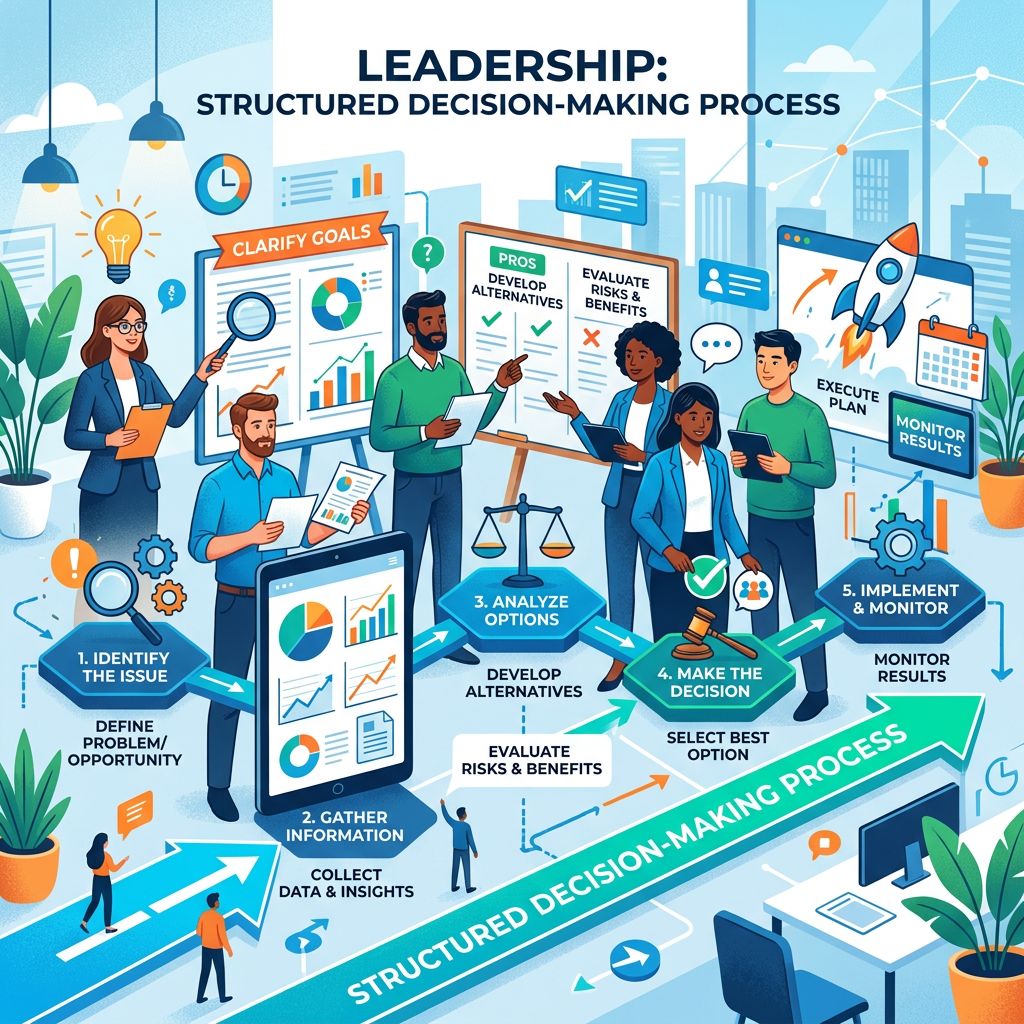
The rational choice paradigm assumes that a decision-maker should use logic and the available information to select the alternative with the highest value. The six-step process presented in the module involves:
- Identifying the problem or opportunity.
- Choosing the most appropriate decision process.
- Developing alternative solutions.
- Choosing the best alternative.
- Implementing the selected alternative.
- Evaluating the outcome.
What stands out to me most is the final step. A decision is not finished simply because it has been announced or put into practice. It must be reviewed against its intended result. When the result is poor, the process should be repeated rather than the original decision being defended out of pride.
In practical terms, identifying the correct problem is often the most difficult step. A surface problem might be that a task is not being completed on time. The deeper problem could be unrealistic labour hours, poor training, unreliable equipment, unclear priorities or a communication failure.
When a manager defines the problem incorrectly, even a carefully analyzed solution may fail. I have seen situations where more pressure was applied to employees when the actual issue was a system that made successful performance unlikely. The rational process is valuable because it slows the manager down long enough to ask whether the problem being solved is the real problem.
A decision matrix could strengthen this process by requiring the decision-maker to state the criteria being used and assign a relative weight to each one. In a staffing decision, for example, cost cannot be the only measure. Reliability, safety, service quality, employee workload, training time and long-term sustainability also have value.
Making those criteria visible improves transparency and makes it more difficult to quietly change the standard after a preferred option has already been chosen.
Bounded Rationality and “Good Enough” Decisions
The concept of bounded rationality is one of the most realistic parts of the module. People cannot access every piece of relevant information, consider every possible alternative or accurately predict every consequence.
As a result, decision-makers often satisfice. They choose an option that is acceptable rather than searching indefinitely for the theoretical best choice. This is not always poor management. During an urgent operational problem, a workable answer delivered quickly can be more valuable than a perfect answer delivered too late.
The danger is that satisficing can become a default rather than a deliberate choice. A temporary workaround may quietly become the permanent system.
When I think about my own management experience, I can see times when I accepted “good enough” because the immediate problem had stopped demanding attention. The better approach would have been to clearly label the solution as temporary, establish a review date and decide what evidence would show whether a more permanent change was required.
Bounded rationality cannot be eliminated, but its effects can be managed through documentation, consultation and scheduled evaluation.
Biases and Heuristics
The module identifies several mental shortcuts that can distort judgment. Anchoring occurs when an initial figure, assumption or opinion has too much influence over later thinking. Availability bias causes recent, memorable or emotionally intense events to seem more common or likely than they actually are.
Representativeness leads people to judge a situation according to how closely it resembles a familiar pattern rather than by examining its objective probability. An implicit favourite appears when a decision-maker has already selected a preferred option and evaluates every alternative mainly by comparing it with that favourite.
These biases matter because they can make a decision appear rational after the outcome has already been chosen. A manager may gather information, hold meetings and compare options, but still use the process only to justify the first idea.
I recognize this risk in myself. Experience can create strong pattern recognition, but it can also make a familiar answer feel correct before the present situation has been properly examined.
One safeguard is to ask what evidence would prove my preferred choice wrong. Another is to invite someone who was not involved in creating the original plan to challenge the assumptions behind it.
The prospect theory effect also helps explain why leaders may behave differently when they believe they are avoiding a loss. People frequently feel the pain of losing something more strongly than the satisfaction of gaining something of equal value.
This can make leaders overly cautious when change threatens something familiar. It can also make them excessively willing to gamble when trying to recover what has already been lost. Clearly naming the potential loss can help separate the emotional reaction from the actual future value of the available options.
Intuition and Emotion
I appreciated that the module does not dismiss intuition as irrational. Intuition can be understood as rapid and largely unconscious recognition built through experience.
In work involving repeated exposure to similar problems, an experienced person may notice warning signs before being able to fully explain them. I have encountered situations where a staffing plan, client request or operational change simply did not feel right. Sometimes that reaction was based on small inconsistencies that I had noticed without consciously listing them.
However, intuition should be treated as a signal to investigate rather than automatic proof. The same feeling can come from bias, fear, fatigue or a previous bad experience that does not accurately match the present situation.
My preferred approach is therefore to let intuition raise the question and allow evidence to test it. When time permits, I should ask:
- What specifically am I noticing?
- What previous experience does this resemble?
- What facts support my concern?
- What facts contradict it?
This respects experience without allowing instinct to bypass accountability.
Emotion also carries information. Frustration may reveal that a process is repeatedly wasting effort. Anxiety may indicate uncertainty or risk that has not been addressed. Anger may point toward a perceived violation of fairness or values.
The leadership problem is not that people experience emotion. The problem begins when an unexamined emotion is allowed to control the decision. Effective leaders acknowledge the emotional climate, including their own reactions, while continuing to use a transparent process.
Creativity, Divergent Thinking and Employee Involvement
The module connects decision quality with creativity and employee involvement. Divergent thinking means reframing the problem and producing multiple approaches rather than immediately narrowing the discussion to one acceptable answer.
This requires an environment where employees can suggest alternatives without being punished for questioning a manager. Employees closest to the work often know where procedures fail, what customers actually request and which proposed solutions will be difficult to implement.
Involving employees does not mean that every decision must be made by committee. The appropriate level of involvement should match the decision. A safety emergency may require immediate direction, while a change involving scheduling, workflow or equipment should normally include the people who will be affected.
I have found that employees are more likely to support a difficult decision when they can see the criteria, understand the constraints and know that their practical knowledge was considered. Involvement also improves implementation because it exposes potential obstacles before the plan is launched.
Creativity is not simply the production of unusual ideas. The module defines creativity as developing original ideas that make a socially recognized contribution. In a workplace, a creative idea must therefore be useful, ethical and connected to organizational goals.
A leader supports creativity by allowing questions, giving employees enough psychological safety to admit uncertainty and separating early idea generation from immediate criticism. Evaluation still matters, but it should occur after the team has been given enough room to explore realistic alternatives.
Escalation of Commitment and Admitting Failure
The most important lesson for me was escalation of commitment. This occurs when people continue to support a failing course of action because time, money, reputation or personal identity has already been invested in it.
The statement “we have come this far” can sound like determination, but it may also be evidence that past investment is being used to justify future waste. Resources that have already been spent cannot be recovered. The decision should instead be based on the likely value of continuing from the present point.
Escalation of commitment becomes more likely when the person evaluating the outcome is also the person who made or publicly defended the original decision. Admitting failure may feel like admitting incompetence. However, doubling down often causes greater damage to productivity, morale, finances and trust.
The module’s argument that strong leaders admit mistakes is persuasive because transparency can protect credibility. Employees generally know when a plan is failing. Pretending otherwise teaches them that protecting appearances matters more than following the evidence.
A better leadership response is to define stop conditions before implementation. A plan might be reviewed after a set period, when it reaches a particular cost threshold or when quality falls below an agreed standard.
This makes stopping part of the original decision rather than a humiliating retreat. A post-decision review should ask what assumptions were incorrect, what warning signs were missed and what the organization will do differently in the future. Failure then becomes information rather than something that must be hidden.
Application to My Practice
The module gives me a practical framework that I can use in future leadership and organizational decisions. I do not need to turn every small decision into a lengthy exercise, but higher-impact choices deserve a visible process.
This is especially true when the decision affects staffing, workload, safety, employment stability, client relationships or significant organizational costs.
My Decision-Making Checklist
- Define the issue: Am I addressing the real cause or only the visible symptom?
- Identify the constraints: What information, time, authority and resources are actually available?
- Develop alternatives: Have I generated more than one serious option?
- Challenge bias: What evidence would prove my preferred option wrong?
- Use experience carefully: Is my intuition based on a relevant pattern, or am I reacting to fear or familiarity?
- Include employees: Who has practical knowledge that could improve the decision or its implementation?
- Set review measures: What result, deadline or threshold will show whether the decision is working?
- Plan an exit: Under what conditions will I change direction or stop?
This checklist addresses a weakness I have noticed in many organizations: decisions are often remembered as announcements rather than as testable choices.
By recording the problem, criteria, assumptions and review conditions, an organization can later evaluate a decision honestly. Documentation also reduces the ability to rewrite the original purpose after the result is known.
Conclusion
My main learning from Module 7 is that effective decision-making requires a balance between structure and self-awareness. The rational choice process provides discipline, but bounded rationality means that no decision will be based on complete information.
Biases and heuristics can distort judgment, while intuition and emotion can either provide valuable signals or pull a decision off course. Creativity and employee involvement widen the range of possible solutions, while clear evaluation prevents a decision from becoming permanent simply because it was once approved.
The most credible leader is therefore not the person who claims to be right every time. It is the person who makes the reasoning visible, listens to challenges, measures outcomes and changes direction when the evidence requires it.
Admitting that a decision has failed is not a rejection of leadership. When done honestly and early enough, it is one of the clearest demonstrations of responsible leadership.
References
Algonquin College. (n.d.). Module 7: Decision-making and creativity [Course module].
McShane, S. L., & Steen, S. L. (2012). MGM300: Organizational behaviour. McGraw-Hill.
Discover more from Standing on the Ledge
Subscribe to get the latest posts sent to your email.

