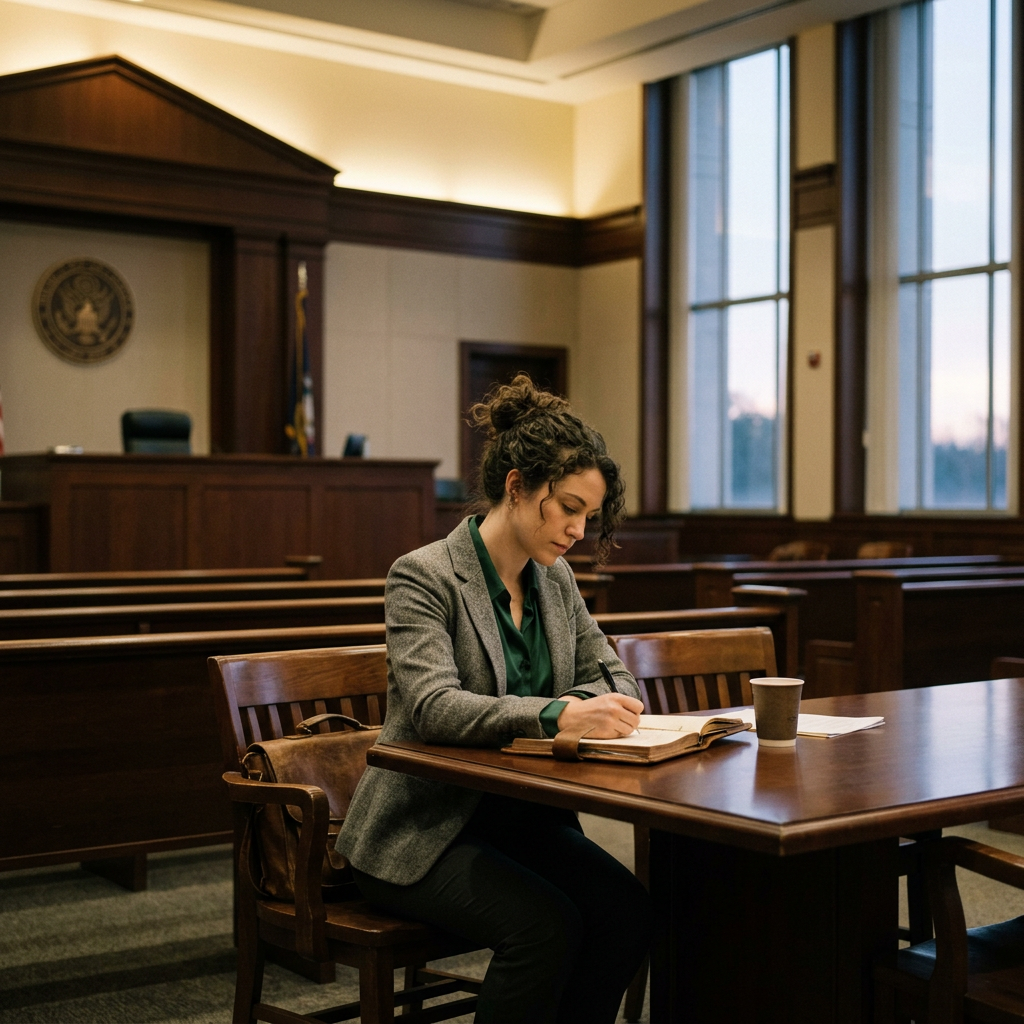

Loneliness is not always about having no one around. Sometimes it comes from having no safe place to say the thing that matters most.
Reader’s Moment
Maybe you know this room.
You are driving, working, lying awake, opening an email, waiting on a reply, or trying to explain something that should be simple — and suddenly you are no longer in the moment.
You are in court.
Not a real courtroom.
The inner one.
The place where imaginary critics already have their arguments ready.
They accuse you of overreacting. Of not doing enough. Of being bitter, weak, careless, dramatic, too sensitive, not professional enough, not calm enough.
And before the real conversation even begins, you are already defending yourself.
You are explaining. Producing receipts. Rehearsing answers. Fighting someone who is not actually in the room.
That is the inner courtroom.
The SOTL Lens
One of the things I am beginning to understand about Standing on the Ledge is that it was never only about losing a contract.
The contract loss was the impact point. The visible break. The thing people could point to and say, “Yes, that happened.”
But underneath that was something harder to explain.
There was a courtroom in my head.
What happened? What did I miss? What should I have done? Who will believe me? How do I explain this? What happens next? How bad can this get?
Standing on the Ledge became one way of voicing that courtroom.
It moved the argument out of my head and onto the page.
Into posts. Into tools. Into print. Into something I could look at, sort through, and slowly turn into structure.
That matters.
Because when fear has nowhere to go, it does not simply disappear. It loops. It hardens. It becomes irritability, numbness, checking, shame, or endless rehearsal.
Writing gave the fear a container.
When There Is No One to Bounce It Off
People say, “Talk to someone.”
That is good advice — when there is someone safe enough to hear the full truth.
But what if the people around you can handle updates, not fear?
What if they can handle facts, not the full emotional weight?
What if they want the short version because the long version makes them uncomfortable?
What if you are used to being the person others lean on, and suddenly there is no obvious place for your own weight to go?
That is where the inner courtroom gets louder.
The thoughts have nowhere to land, so they bounce around inside your skull.
Again and again.
After a while, they are no longer just questions.
They become the atmosphere you live inside.
What Is Really Happening
Psychologically, this is often rumination dressed up as preparation.
At first, you are trying to be clear. Trying to be ready. Trying not to be caught off guard.
But then preparation turns into prosecution.
You stop asking, “What do I need to say?”
You start asking, “How do I survive every possible accusation?”
That is when the mind starts reading motives before anyone speaks. A delayed reply feels like rejection. A neutral question feels like blame. A possible objection becomes a total collapse.
Sometimes danger is real. SOTL does not ask anyone to ignore that.
But not every alarm is evidence.
Sometimes the alarm belongs to an older room: the last unfair conversation, the last power imbalance, the last time someone controlled the story while you were left trying to explain the damage.
Sociologically, this is not just private anxiety. The inner critic often carries the voices of systems and people that had power over you — bosses, clients, institutions, family patterns, contracts, employers, or anyone who could affect your money, reputation, work, housing, or dignity.
That is why the courtroom feels so loud.
It is not one critic.
It is a committee.
Courtroom Energy vs. Clipboard Energy
Some preparation is useful.
It helps to gather receipts. It helps to know your point. It helps to decide what you will not argue about. It helps to choose whether a conversation belongs in person, by phone, by email, through documentation, or not at all.
That is clean preparation.
The problem begins when rehearsal becomes a trial.
You start defending against accusations nobody has made. You start answering questions nobody has asked. You walk into the real conversation already tired, braced, and resentful.
That is courtroom energy.
Courtroom energy tries to win.
Clipboard energy tries to sort.
SOTL needs the clipboard more often than the courtroom.
The courtroom asks: Who is guilty? How do I defend myself? How do I prove I am not what they think I am?
The clipboard asks: What happened? What is documented? What needs a response? What is the next clean step? What can I control today?
That is the move.
From courtroom to clipboard.
The Tool: Writing the Courtroom Out
If you are carrying your own inner courtroom, take one page and write these four lines:
The accusation I keep defending against is:
Write one sentence.
The fear underneath that accusation is:
Write one sentence.
The evidence I actually have is:
List only what is real, observable, documented, or directly experienced.
The next clean step is:
Write one action.
Not the whole future.
Not the final verdict.
One step.
This is how you stop letting imaginary critics run the room.
What I Have Not Said Yet
There are still fears I have not fully named.
There are things I have only circled.
There are parts of the collapse I have translated into tools because tools felt safer than confession.
There are things I can describe structurally before I can describe them emotionally.
That is not always avoidance.
Sometimes it is pacing.
Sometimes it is survival.
Sometimes the mind gives you the map before it lets you touch the wound.
So I am working on it.
In public where I can.
In private where I must.
Through posts, tools, books, notes, revisions, and the slow act of turning noise into language.
Post-Closure Card
One receipt: Writing helped move the courtroom out of my head and onto the page.
One next step: I will keep turning fear into language, and language into structure, at a pace I can survive.
One boundary sentence: I can discuss the facts without putting my whole character on trial.
Closing Reflection
Standing on the Ledge began after impact, but impact was not the whole story.
The contract loss was the visible break.
The inner courtroom was part of the hidden aftermath.
Writing became a way to let that courtroom speak without letting it consume me.
It gave the fear somewhere to go.
It gave the arguments a page instead of a nervous system.
It gave the chaos a structure.
Maybe that is what some of this has been all along.
Not a finished recovery.
Not a polished lesson from someone safely on the other side.
A working record.
A field manual written from inside the weather.
A way of saying:
I am not done unpacking this.
I have not said everything yet.
But I am no longer leaving it locked inside my head with only the critics for company.
That matters.
That is movement.
That is the first sound of return.
Godspeed, ledge walkers.
Discover more from Standing on the Ledge
Subscribe to get the latest posts sent to your email.

