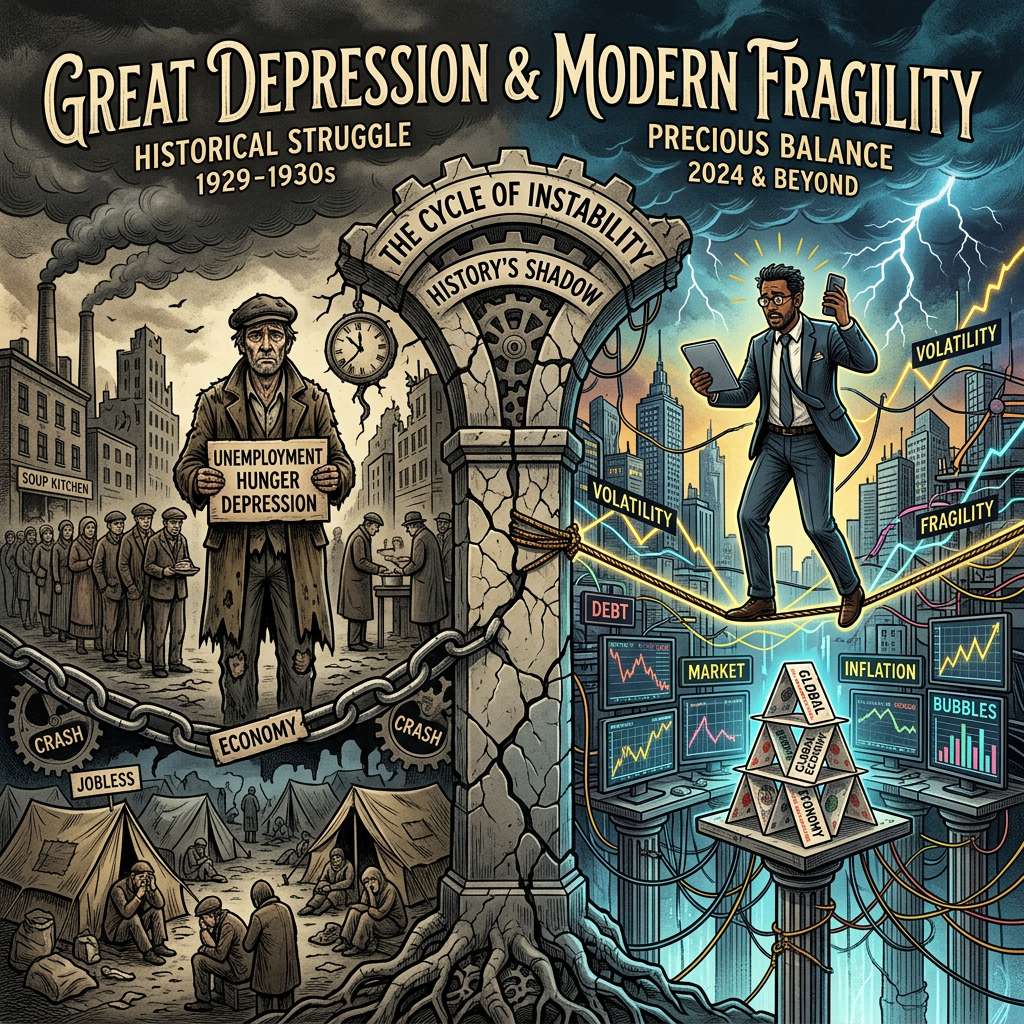

There is a mistake people make when they talk about the Great Depression.
They speak as if it began with one event.
The stock market crashed, and then everything fell apart.
That is the simple version. It is also the dangerous version.
The Great Depression did not begin with one bad day on Wall Street. The crash was the moment the floor gave way. But the beams had been rotting for years.
Debt. Speculation. Inequality. Weak banks. Overproduction. Underpaid workers. Fragile farmers. Political denial. Trade conflict. Environmental exhaustion. Low trust. Bad policy. Social anger. The belief that prosperity had become permanent.
That is the part worth studying.
Not because history repeats itself perfectly.
It does not.
But history does rhyme. And sometimes the rhyme is loud enough that we should stop pretending we cannot hear it.
The Depression Was Not Just Economic
When people discuss the Great Depression, they often go straight to money.
The stock market. The banks. The unemployment numbers. The breadlines.
All of that matters. But the deeper story is larger than economics. The Depression was a systems failure.
It was what happened when financial speculation, social inequality, environmental misuse, political blindness, and weak public trust all arrived at the same door.
It was not only a market crash.
It was a crisis of confidence.
It was a crisis of leadership.
It was a crisis of work.
It was a crisis of land.
It was a crisis of ordinary people discovering that the systems they had been told to trust were not as solid as advertised.
That is where the present starts to feel uncomfortable.
The Surface Looked Strong
The 1920s were not remembered as a time of obvious collapse. They were remembered as the Roaring Twenties.
Technology was changing daily life. Cars, radios, appliances, mass production, advertising, consumer credit, and stock investing all created a sense that a new world had arrived.
People were told progress had solved the old problems.
Sound familiar?
Today we have our own version of that confidence. Artificial intelligence. Automation. financial markets. new platforms. new tools. new promises that technology will make everything more efficient, more profitable, and more connected.
And maybe some of it will.
But the warning from the 1920s is this: technological progress does not automatically create social stability.
A society can be innovative and fragile at the same time.
It can have new machines and old inequalities.
It can have booming markets while workers are stretched thin.
It can have growth on paper while families are quietly drowning.
Prosperity Was Uneven
Before the Depression, wealth and income were not evenly distributed. Many people were participating in the boom only from the edges. Farmers were already struggling. Workers were producing more, but the gains were not shared evenly enough to keep purchasing power healthy.
That matters because an economy is not just production.
It is circulation.
If too much wealth pools at the top, the system starts depending on debt, speculation, and confidence to keep things moving. People borrow to maintain a life their wages no longer support. Businesses produce more than ordinary people can afford to buy. Markets rise because people believe they will keep rising.
That is not strength.
That is pressure in a sealed pipe.
Today, we see a similar pressure in a different form. Housing costs, grocery costs, energy costs, tuition, medical costs, debt payments, and job insecurity are all part of the modern squeeze. The numbers may not be Depression numbers, but the feeling is familiar: people are working, yet many are not gaining ground.
That is a social warning sign.
When people feel the system is asking more from them while giving less back, they stop trusting the system.
Speculation Became a Substitute for Security
In the 1920s, the stock market became a symbol of modern confidence. Buying on margin allowed people to invest with borrowed money. Prices rose. Optimism fed more optimism. The market became not just a place to invest, but a place where people imagined escape.
Then reality arrived.
Today’s equivalent is not identical, but the pattern is recognizable.
Speculation has spread through stocks, crypto, real estate, private credit, hype cycles, and technology promises. Too many people are looking for rescue through asset appreciation because wages, pensions, stable careers, and affordable homes no longer feel like reliable paths.
That is not just a financial issue.
It is psychological.
When people no longer believe the ordinary road leads anywhere, they start gambling on extraordinary roads.
That was true then.
It is true now.
The Banks Were Not the Only Fragile Institutions
Bank failures were central to the Depression. When banks failed, savings vanished, credit dried up, businesses collapsed, and fear spread.
Today, the banking system is stronger in many ways. Deposit insurance exists. Central banks understand liquidity crises better than they did in the early 1930s. Governments have more tools.
That is important.
We are not living in 1929.
But risk does not disappear just because it changes address.
Modern fragility may sit in private debt, shadow banking, overleveraged households, commercial real estate, government debt, supply chains, energy dependence, cyber systems, and financial instruments most ordinary people will never hear about until after they break.
The lesson is not that the same banks will fail in the same way.
The lesson is that complex systems often hide their weakest points until stress arrives.
Trade Conflict Made the Wound Deeper
The Smoot-Hawley Tariff Act did not cause the Great Depression by itself, but it made a bad situation worse. Countries retaliated. Trade contracted. Cooperation weakened when cooperation was needed most.
That is one of the clearest historical warnings for today.
We are again living in a world of tariffs, sanctions, export controls, trade barriers, supply-chain nationalism, and economic blocs. Some of this may be understandable. Countries want security. They want domestic capacity. They do not want to be helpless when supply chains break.
But there is a line between resilience and isolation.
There is a line between protecting workers and starting trade wars that raise prices, weaken cooperation, and make every country poorer.
The 1930s showed what happens when nations turn inward at the same time.
Everyone says they are protecting themselves.
Then everyone becomes more vulnerable.
The Land Was Already Warning Them
The Dust Bowl is sometimes treated as a separate disaster, but it belongs in the same conversation.
The land had been overworked. Farming methods, drought, wind, and economic pressure combined into catastrophe. The soil itself became part of the collapse.
That should make us pause.
The Depression was not only caused by human decisions in banks and government offices. It was also worsened by a damaged relationship with land.
Today, climate pressure is not background noise. It is part of the economic story, the food story, the migration story, the insurance story, the housing story, and the political story.
Droughts, floods, wildfires, crop failures, energy shocks, and infrastructure failures are not separate from the economy.
They are the economy.
They are the physical world reminding us that spreadsheets do not override soil, water, weather, and fuel.
People Lost Trust Before They Lost Everything
One of the most dangerous parts of any pre-collapse period is the slow collapse of trust.
People stop trusting banks.
They stop trusting employers.
They stop trusting politicians.
They stop trusting newspapers.
They stop trusting courts.
They stop trusting neighbours.
They stop trusting the future.
Once that happens, even good policy has a harder time working because people no longer believe the people delivering it.
That is one of the strongest connections to the present.
Across much of the modern world, institutional trust is thin. Political tribes do not merely disagree on policy; they increasingly disagree on reality. Facts become partisan. Every crisis becomes a weapon. Every institution is suspected of being captured by someone.
That kind of atmosphere does not create collapse by itself.
But it makes recovery harder when trouble comes.
A society with low trust has less shock absorption.
Scapegoats Arrive When Systems Fail
When people are afraid, they look for explanations.
Sometimes they find honest ones.
Sometimes they are handed scapegoats.
The Depression years fed political extremism around the world. People who felt humiliated, abandoned, hungry, or betrayed became vulnerable to strongmen, conspiracy theories, and movements that promised restoration through blame.
That is another warning for today.
When housing is unaffordable, blame the immigrant.
When wages stagnate, blame the outsider.
When communities hollow out, blame the city, the rural voter, the poor, the elite, the foreigner, the neighbour, the wrong generation, the wrong party.
Some grievances are real.
But real pain can still be pointed in false directions.
That is how systems protect themselves: they convince the wounded to fight each other instead of examining the structure that wounded them.
The Policy Failure Was Also Moral
Governments in the early Depression often responded too slowly, too cautiously, or through old assumptions that did not fit the scale of the crisis. In Canada, unemployment relief camps became a symbol of how poorly society understood the dignity and needs of unemployed men. The On-to-Ottawa Trek was not just an economic protest. It was a human response to being treated like a problem to be managed instead of citizens to be heard.
This matters now.
When people fall through the cracks, the question is not only, “What program failed?”
The question is, “What did society believe about the people who were falling?”
Were they treated as lazy?
Disposable?
Unskilled?
Replaceable?
Unworthy?
The moral language around struggle matters. It shapes policy. It shapes employers. It shapes neighbours. It shapes how long people are allowed to suffer before anyone calls it a crisis.
The SOTL Lens: This Is Phase 0 Drift
Standing on the Ledge has a name for this kind of moment.
Phase 0.
Pre-collapse.
The warning-sign stage.
The place where the smoke detector is chirping, but the house has not yet filled with smoke.
At the personal level, Phase 0 looks like ignored bills, worsening sleep, fraying relationships, missed maintenance, rising anger, bad habits returning, and the quiet knowledge that something is off.
At the social level, Phase 0 looks like something larger.
High debt.
Low trust.
Political rage.
Speculation.
Worker exhaustion.
Food and energy insecurity.
Fragile supply chains.
Climate strain.
Information chaos.
Institutions that still stand, but no longer inspire confidence.
That does not mean collapse is guaranteed.
Phase 0 is not prophecy.
Phase 0 is the last useful window.
The Lesson Is Not Panic
The wrong response to this comparison is panic.
Panic makes people stupid.
Panic makes people cruel.
Panic makes people buy nonsense, believe nonsense, and follow nonsense.
The right response is preparation.
Not bunker fantasy.
Not doom scrolling.
Not waiting for some dramatic cinematic collapse.
Preparation means reducing personal fragility where you can.
Lower bad debt.
Build practical skills.
Keep tools working.
Strengthen local relationships.
Learn how food, money, work, energy, and health actually move through your life.
Pay attention to your body.
Pay attention to your household.
Pay attention to your community.
Pay attention to who benefits when you are angry at the wrong target.
What the Great Depression Still Teaches
The Great Depression teaches us that collapse usually has a long runway.
Before the crash, there are habits.
Before the breadline, there are policies.
Before the bank run, there is misplaced trust.
Before the dust storm, there is abused soil.
Before the demagogue, there is humiliation.
Before the riot, there is ignored suffering.
Before the fall, there are warnings.
And that is where we are called to pay attention.
Not because everything is doomed.
Because not everything is doomed.
Warning signs are only useful if we read them while there is still time to change direction.
The past is not asking us to rehearse despair.
It is asking us to stop mistaking noise for strength, markets for society, technology for wisdom, and endurance for health.
The road to the Great Depression was paved by people who believed the system would hold because it had held yesterday.
That is not a plan.
That is a superstition.
And here on the ledge, we do not worship superstition.
We read the terrain.
We name the cracks.
We stop pretending the warning signs are mood swings.
And then we do the next grounded thing.
Godspeed.
References Consulted
Federal Reserve History, “The Great Depression.”
Library of Congress, “The Dust Bowl.”
The Canadian Encyclopedia, “The Great Depression in Canada” and “On-to-Ottawa Trek.”
IMF, World Economic Outlook, April 2026.
OECD, Economic Outlook Interim Report, March 2026.
Pew Research Center, public trust and political polarization reports.
Discover more from Standing on the Ledge
Subscribe to get the latest posts sent to your email.

