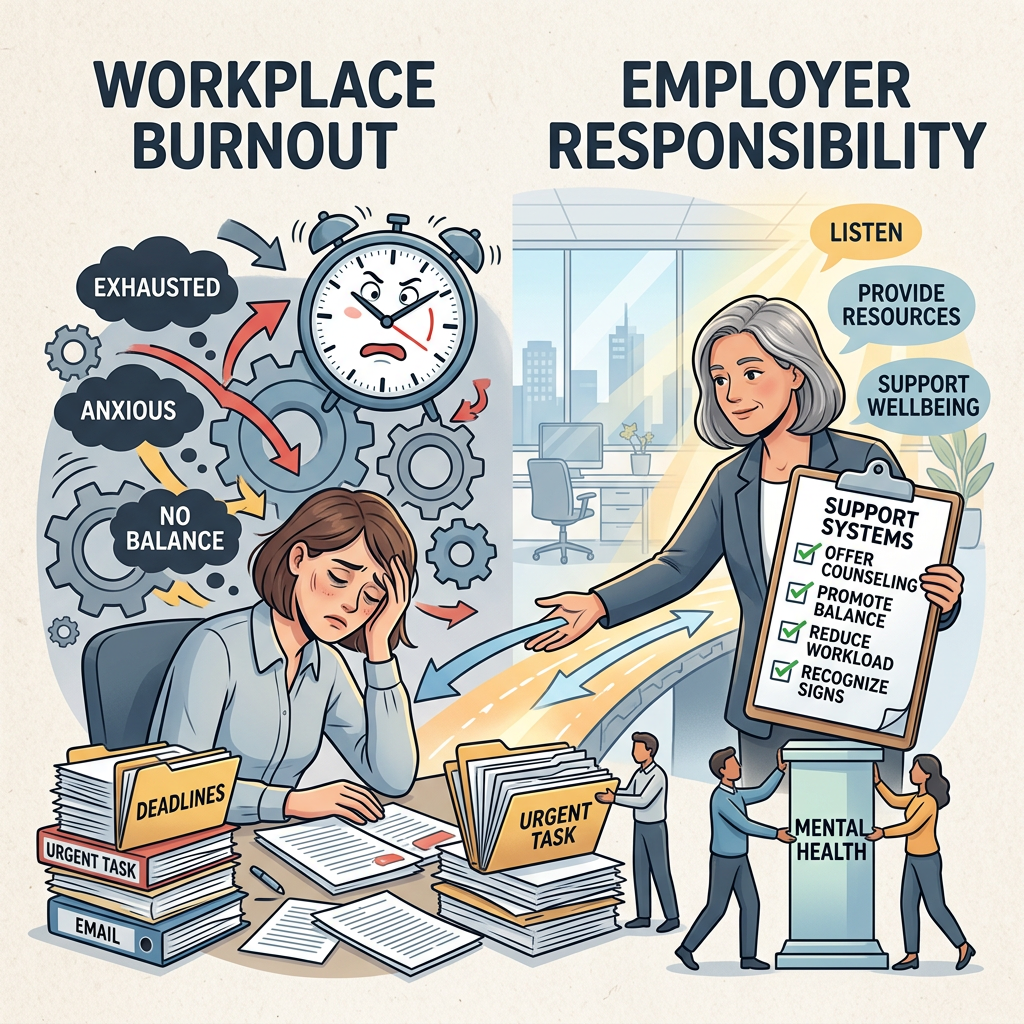

There is a version of burnout talk that puts the whole burden on the person who is already exhausted.
Sleep better. Breathe deeper. Journal more. Regulate your emotions. Take a walk. Drink water. Set boundaries. Practice gratitude. Download the app. Fix yourself.
Some of that advice is useful. Let’s be honest about that. A person under pressure does need tools. They need sleep. They need food. They need recovery. They need a way to stop the internal spiral before it becomes collapse.
But that is not the whole story.
Because sometimes the worker is not burned out because they failed to manage themselves.
Sometimes the worker is burned out because the workplace kept asking them to absorb the impossible.
Reader’s Moment
If you have ever sat in your car before a shift and felt your body resist opening the door, this is for you.
If you have ever stared at your schedule and felt your stomach drop before the week even started, this is for you.
If you have ever been told to “take care of yourself” by the same workplace that kept adding weight to your back, this is definitely for you.
The SOTL Lens
Burnout is often treated like a private weakness.
It is not.
Burnout is what happens when demand keeps exceeding recovery. It is what happens when a person is expected to care, produce, adapt, absorb, smile, cover gaps, manage chaos, and keep showing up without enough support, control, respect, or rest.
Yes, employees have a role in noticing their limits.
But employers have a role in not building workplaces that require people to exceed those limits every week.
The Employee Can Stabilize. The Employer Must Stop the Bleed.
There is nothing wrong with telling a burned-out worker to take care of themselves.
There is something very wrong with stopping there.
Because personal recovery tools do not fix chronic understaffing.
Breathing exercises do not fix impossible workloads.
Journaling does not fix poor management.
Mindfulness does not fix unpredictable scheduling.
A gratitude practice does not fix being underpaid, overextended, ignored, and blamed when the system finally cracks.
At some point, telling the employee to become more resilient becomes a way of protecting the employer from accountability.
That is the part we need to name.
The Employer’s Role in Burnout
Employers do not control every source of stress in a worker’s life. That is true.
But they do control more than they often admit.
They control staffing levels.
They control workload expectations.
They control whether roles are clear or chaotic.
They control whether managers are trained or merely promoted.
They control whether emergencies are rare events or just the normal operating model.
They control whether workers can actually take breaks.
They control whether asking for help is safe or punished.
They control whether the best employees are rewarded with more work until they finally break.
That matters.
Burnout Is Often a Systems Warning
When one employee burns out, maybe that is personal.
When several employees burn out, leave, shut down, detach, go quiet, start calling in sick, or stop caring, that is not a personality problem.
That is a systems warning.
The workplace is telling on itself.
And if leadership responds only by offering wellness language, motivational posters, resilience training, or another reminder to “practice self-care,” then they are missing the point.
You cannot keep lighting the fire and then lecture people on smoke inhalation.
What Employers Need to Ask
Before asking why employees are tired, employers should ask:
- Are we asking too much from too few people?
- Are we confusing loyalty with overextension?
- Are our best workers carrying the failure of poor planning?
- Are breaks real, or only theoretical?
- Do people feel safe saying, “I cannot keep doing this”?
- Are managers solving pressure or passing it downward?
- Are we rewarding the people who quietly absorb dysfunction?
Those are uncomfortable questions.
Good.
They should be.
What Real Burnout Prevention Looks Like
Real burnout prevention is not just telling employees to breathe.
It is designing work that does not depend on constant personal sacrifice.
It means staffing properly.
It means setting realistic expectations.
It means training supervisors to notice strain before collapse.
It means listening when employees say the workload is not sustainable.
It means not treating exhaustion as proof of commitment.
It means not calling people “family” while using them like disposable parts.
It means understanding that a workplace can be productive without being predatory.
From the Ledge
Here is the hard truth:
A burned-out employee may need to recover.
But a workplace that keeps producing burned-out employees needs to change.
Both things can be true.
The worker needs tools.
The employer needs accountability.
One without the other is not a solution. It is just damage control.
The Tool: Burnout Responsibility Check
When burnout shows up, ask two sets of questions.
For the employee:
- What signs is my body giving me?
- What am I carrying that is not actually mine?
- Where do I need recovery, support, or boundaries?
- What one thing can I reduce today?
For the employer:
- What are we asking people to absorb?
- Where are we understaffed, unclear, or unrealistic?
- Who keeps saving the system by sacrificing themselves?
- What needs to change so recovery is not only the employee’s job?
That is the difference between a bandage and a repair.
Closing Thought
Burnout is not always a sign that someone is weak.
Sometimes it is a sign that they were strong for too long in a place that kept taking advantage of that strength.
So yes, ledge walkers, stabilize yourself. Protect your sleep. Eat something real. Drink water. Step back from the edge where you can. Use the tools. Name the damage. Keep your receipts.
But do not let anyone convince you that the fire is your fault just because you are the one covered in smoke.
Sometimes the next step is not becoming more resilient.
Sometimes the next step is asking who keeps setting the fire.
Godspeed.
Discover more from Standing on the Ledge
Subscribe to get the latest posts sent to your email.

