

Shock doesn’t always look dramatic.
Sometimes it looks quiet.
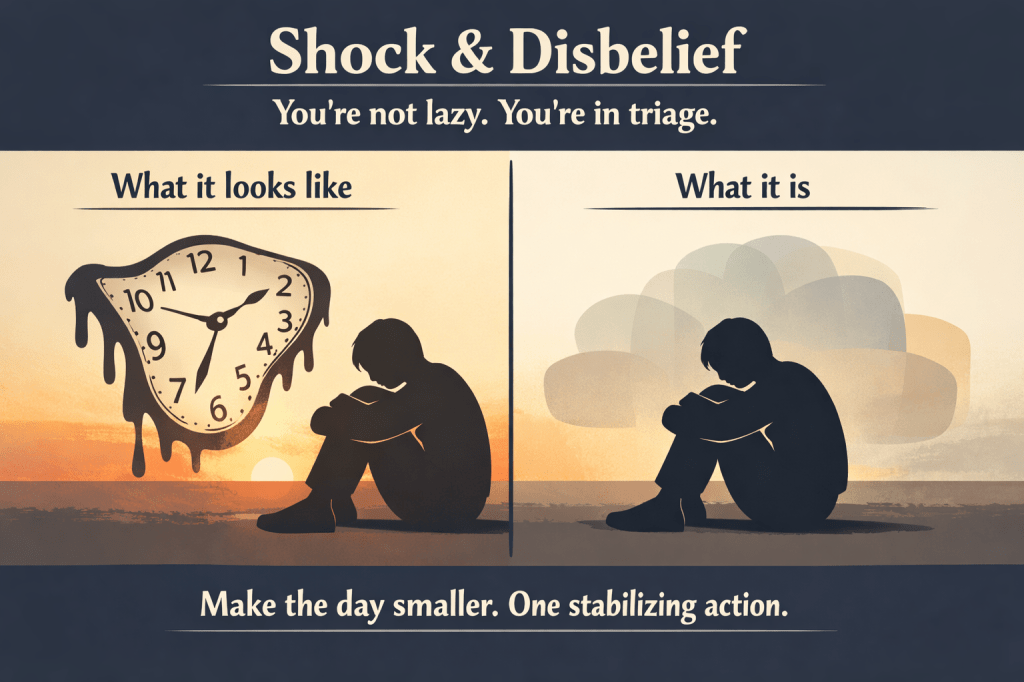
When the nervous system locks up, it can show up as numbness, time distortion, and a strange, surreal feeling of being present—but not fully there. Psychology often frames this as an acute stress response (including “freeze” states) and dissociation. Sociology has its own lens: when life ruptures, you can land in a kind of in-between phase—where the old identity no longer fits and the new one hasn’t formed yet.
You’re not lazy.
You’re not stupid.
You’re in triage.
Common signs
Numbness (not physical):
emotionally flat
surreal, detached
“I’m not okay, but I’m not broken either… I’m just here.”
Time distortion:
losing track of days
forgetting basic routines (food, showers, tasks)
arriving early for appointments that aren’t today
missing things because yesterday and tomorrow feel interchangeable
Shock inertia:
inability to plan
inability to prioritize
The mind stays rooted in “now” with no traction forward
What’s happening (plain language)
Under high stress, the brain reallocates resources from long-range planning toward survival. That’s why calendars, sequencing, and memory can degrade. Add disrupted routines, roles, and social ties—and time can feel unreliable. From a sociological view, you’re not just handling feelings; you’re navigating a collapse in structure: work-role, identity, and the predictable rhythm of daily life.
So the solution isn’t “try harder.”
It creates stability first.
How to get beyond it (without forcing it)
1) Reduce decisions
Decision fatigue is real: the more overwhelmed you are, the more each choice costs.
So shrink your decision load.
Eat the same simple breakfast for a week
Wear the same “default outfit.”
Limit appointments to essentials.
Stop stacking obligations “because I should”
Your goal is to lower cognitive load until your system unfreezes.
2) Stabilize the basics (sleep, food, water)
This isn’t self-care theatre. This is nervous-system mechanics.
Sleep: Protect a consistent bedtime/wake time as best you can
Food: aim for protein + something easy to digest
Water: dehydration amplifies fog and anxiety
When the body stabilizes, the mind regains bandwidth.
3) Externalize time (build a scaffold outside your head)
If your brain can’t track time, don’t argue with it—support it.
Try this:
Write: “Today is __” and place it where you’ll see it
Use two daily alarms: Morning Anchor + Evening Anchor
Keep a tiny log: “ate/showered/left house/appointment.”
You’re rebuilding orientation. Not chasing productivity.
4) Choose “one stabilizing action” per day
Not ten steps. Not a comeback story. One.
Examples:
pay one bill
Confirm one appointment
Submit one form
make one phone call
walk outside for five minutes
This is behavioral science in practice: small wins restore agency. Agency restores momentum.
5) Create a “Minimum Viable Day” checklist
Three items. Maximum.
Minimum Viable Day (example):
Eat something with protein
One admin task (bill/email/form)
Get outside for 5 minutes
If you do those three, the day counts.
6) Don’t isolate in the dark
Humans stabilize through other humans. Even one consistent check-in can reduce spiraling.
Send a message like:
“Hey. I’m in a fog. Can you check on me tomorrow?”
Not a confession.
A tether.
When to get extra support
If you’re not sleeping for days, not eating, feeling persistently detached, or having thoughts about not being here, reach out to a professional, a trusted person, or local crisis support right away. This isn’t moral failure. It’s an overload signal.
Closing
Shock and disbelief can feel as if time has stopped.
You’re still here breathing. That matters.
The path forward isn’t heroic. It’s structural:
Reduce decisions, stabilize the body, externalize time, and take one survivable step at a time.
Tomorrow doesn’t need a grand plan.
It needs a bridge.
Discover more from Standing on the Ledge
Subscribe to get the latest posts sent to your email.
 Standing on the Ledge
One thought on “Coping with Shock: How to Regain Control and Stability”