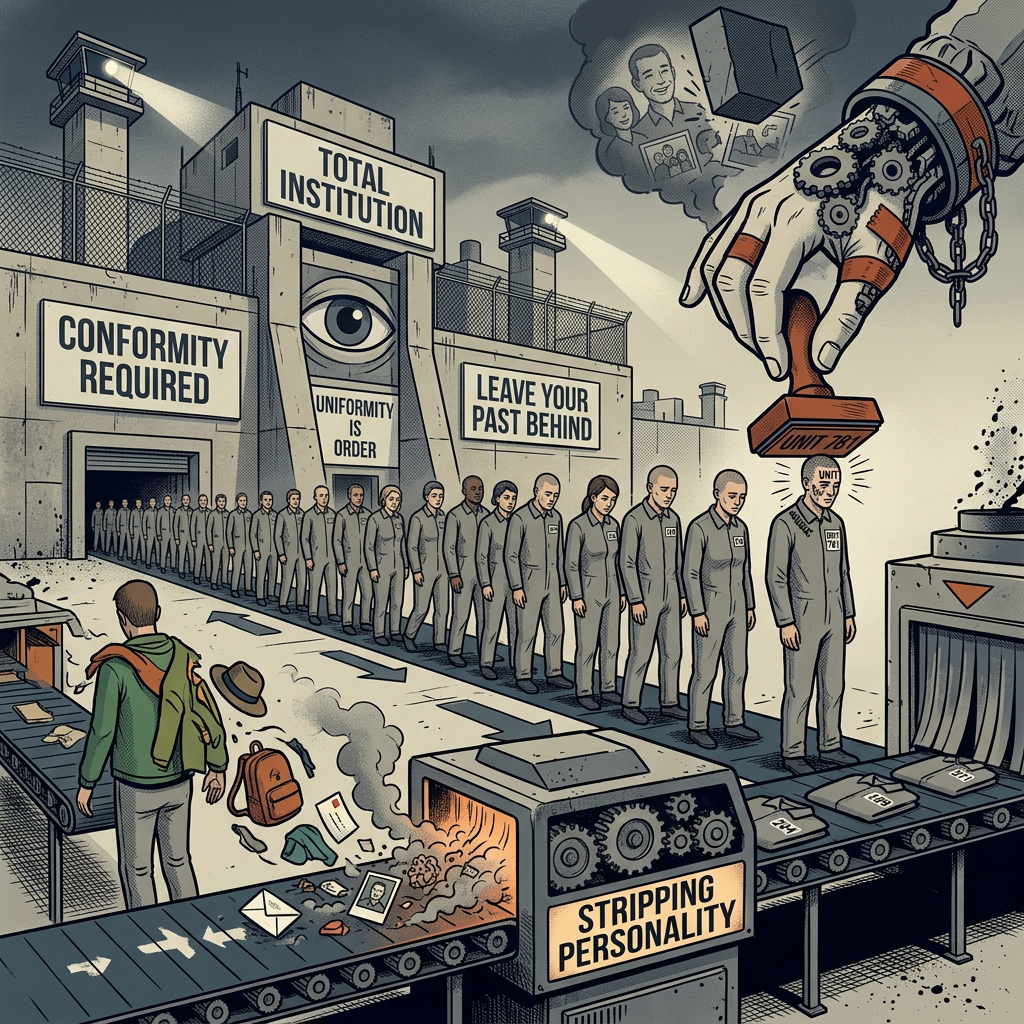

Erving Goffman’s Asylums through an organizational behaviour and Standing on the Ledge perspective
Introduction
Erving Goffman’s Asylums: Essays on the Social Situation of Mental Patients and Other Inmates examines how people experience life inside what he calls total institutions. These are organizations in which a large portion of a person’s daily life occurs under a single authority, according to tightly controlled routines and administrative rules.
Goffman used psychiatric hospitals as his primary subject, but he also identified prisons, military barracks, monasteries, boarding schools, and similar organizations as examples of institutions that can exercise unusually broad control over their members.
I do not interpret Goffman’s work as meaning that an ordinary workplace is equivalent to a psychiatric hospital or prison. However, his ideas provide a valuable organizational behaviour lens for examining what happens when an organization controls information, defines people through narrow roles, suppresses disagreement, and uses communication primarily to enforce compliance.
What happens when the organization has enough power to define both the conflict and the person involved in it?
This question connects directly to the Standing on the Ledge framework. Organizational conflict can do more than end a job or damage a working relationship. It can disrupt identity, confidence, purpose, and a person’s understanding of what happened.
Recovery therefore requires more than finding another position. It requires rebuilding voice, identity, evidence, boundaries, and personal agency.
The Total Institution and Organizational Control
Goffman describes a total institution as a place where people live or work together, separated to some extent from the wider community, under a formally administered routine. The important word is not merely institution, but total. The organization attempts to control multiple areas of life that would ordinarily remain separate.
In everyday society, people move between different roles. A person may be an employee, parent, business owner, friend, student, neighbour, or community member. Each role provides a different source of identity and social recognition.
Inside a total institution, these separate roles are weakened or removed. The institution increasingly defines the person through one administratively convenient identity:
- patient;
- inmate;
- recruit;
- resident;
- subordinate;
- contractor;
- problem employee; or
- former employee.
Goffman calls the erosion of a person’s previous identity the mortification of the self. Personal possessions, routines, relationships, choices, and social roles may be removed or restricted. The individual is then expected to accept an institutional identity created by those in authority.
In organizational behaviour, this can be understood as an extreme form of role control. The organization does not simply tell the person what tasks to perform. It communicates who the person is, what motives they supposedly possess, and how their behaviour should be interpreted.
This distinction matters because communication is never completely separate from power. The person who has the authority to create reports, issue discipline, control meetings, retain records, terminate relationships, or speak officially for the organization possesses a greater ability to establish the accepted version of events.
Communication as a Form of Power
One of my most important lessons from Asylums is that communication does not always function as an open exchange of information. It can also operate as a system of control.
In a healthy organization, communication should allow information to travel in several directions. Management communicates expectations downward, employees communicate concerns upward, and colleagues exchange information horizontally. Feedback should permit the organization to correct mistakes before those mistakes become crises.
In Goffman’s institutional setting, communication is highly unequal. Staff members possess official knowledge, control files, interpret behaviour, and make decisions. Institutional members may speak, but their statements are filtered through the assumptions of those in authority.
The Communication Trap
- The institution defines what normal or cooperative behaviour looks like.
- The individual challenges the institution’s account.
- The challenge is interpreted as further evidence that the individual is difficult, unstable, resistant, or uncooperative.
- The institution uses that interpretation to strengthen its original position.
The individual is technically allowed to speak, but their speech does not carry equal legitimacy. Communication becomes performative rather than participative. The organization can claim that it listened without allowing the person’s information to change the decision.
This resembles the organizational behaviour concept of organizational silence. Morrison and Milliken describe organizational silence as a collective condition in which employees withhold information about problems because they believe speaking is dangerous or pointless.
Such silence prevents organizations from recognizing errors and adapting to change.
Silence should not automatically be interpreted as agreement.
Silence may indicate fear, exhaustion, learned helplessness, lack of psychological safety, or a belief that management has already decided what is true.
Conflict Management or Conflict Suppression?
Goffman’s analysis also changes how I understand conflict management.
Conflict management should involve identifying the issue, hearing the interests of the parties, examining evidence, and developing a fair process for resolution. In an unequal institution, however, management may possess enough power to avoid resolving the conflict. It can instead redefine the conflict as an individual behavioural problem.
For example, an employee may raise concerns about:
- workload;
- resources;
- unclear expectations;
- missing information;
- inconsistent instructions; or
- unfair treatment.
Rather than addressing those concerns, management may describe the employee as negative, confrontational, unreliable, resistant to change, or not a team player.
The subject of the conversation then changes.
The original issue might have been:
Were the expectations realistic, properly communicated, adequately funded, and consistently applied?
The revised issue becomes:
Why is this person causing trouble?
This is not genuine conflict management. It is conflict displacement. Attention moves away from the organizational conditions that produced the dispute and toward the personality of the less powerful participant.
Power asymmetry is therefore central to conflict management. Those with greater authority may influence not only the outcome of a dispute, but also the procedures through which the dispute is understood.
Research on employee voice suggests that giving people meaningful opportunities to raise concerns can support dispute resolution and reduce intentions to leave. Voice is effective, however, only when the organization is prepared to listen and respond rather than merely provide a symbolic opportunity to speak.
Secondary Adjustments and the Institutional Underlife
Goffman also examines what he calls the underlife of an institution. People living under restrictive rules develop informal methods of preserving small areas of independence.
He describes these behaviours as secondary adjustments: practices that allow individuals to obtain unofficial freedoms, protect dignity, maintain relationships, or avoid complete submission to the official role.
From a management perspective, these behaviours may be labelled:
- resistance;
- poor attitude;
- rule-breaking;
- avoidance; or
- noncompliance.
From the individual’s perspective, however, they may represent attempts to retain identity and control.
This does not mean every form of resistance is constructive. Some behaviours can harm coworkers or worsen conflict. However, Goffman demonstrates that management should examine why resistance exists before assuming that stricter control is the solution.
Resistance may communicate information that formal channels have failed to capture.
Employees may use private conversations, informal workarounds, humour, selective compliance, documentation, emotional withdrawal, or peer support because formal communication is no longer trusted.
These informal systems form when official systems do not provide safety, fairness, or practical solutions.
The management lesson is clear: when an organization drives important communication underground, it loses access to accurate information about its own operations.
Application to the Standing on the Ledge Framework
Phase 0: Prevention
The prevention phase involves recognizing harmful organizational patterns before they produce a complete personal or occupational collapse.
Goffman’s work identifies several warning signs:
- One-way communication presented as consultation.
- Important decisions made without the affected person’s participation.
- Rules applied inconsistently but treated as unquestionable.
- Information withheld until it can no longer be acted upon.
- People reduced to labels rather than evaluated through evidence.
- Complaints treated as acts of disloyalty.
- Conflict processes controlled entirely by one party.
- Informal punishment for raising concerns.
- An organizational narrative that cannot be corrected.
The purpose of prevention is not to assume that every management disagreement is abusive. It is to identify situations in which normal conflict-resolution mechanisms have stopped functioning.
Preventive actions include documenting expectations, confirming verbal instructions in writing, identifying decision-makers, asking for measurable standards, preserving relevant records, and separating personal identity from organizational approval.
Phase 1: Impact
The impact phase begins when the organizational event occurs: termination, public blame, betrayal, sudden exclusion, loss of authority, collapse of a business relationship, or another major disruption.
Goffman helps explain why the impact can feel larger than the immediate economic loss. The person may experience a form of identity stripping. Their previous role disappears, access to information ends, relationships change, and the organization may issue a final account that portrays the outcome as inevitable or deserved.
The organization continues operating while the individual is left trying to understand what happened.
During this phase, communication often becomes fragmented. The affected person may repeatedly review conversations, search for missed warnings, attempt to reconstruct timelines, or mentally rehearse arguments that were never properly heard.
The first SOTL responsibility is not to solve the entire conflict. It is to survive the impact without allowing the organization’s description of the event to become the person’s permanent self-description.
A role can be terminated. A contract can end. A business can fail. None of these outcomes provides a complete definition of the individual.
Phase 2: Triage
Triage involves stabilizing the person and separating immediate facts from emotional overload.
Goffman’s analysis suggests that the individual must distinguish between three things:
- What happened
- How the organization describes what happened
- What the event means about the person
These are not necessarily the same.
During triage, communication should become deliberate rather than reactive. Records should be organized. Timelines should be created. Emotional responses should be acknowledged without being inserted into every formal communication.
Advice should be obtained from people who are outside the disputed system and therefore less dependent on the organization’s official narrative.
This phase also involves identifying loaded labels. Words such as difficult, uncooperative, unprofessional, or unreliable may sound factual while concealing subjective judgment.
Triage asks for the behaviours, dates, instructions, standards, and evidence behind those labels.
The objective is not to deny personal mistakes. It is to prevent vague institutional language from replacing careful analysis.
Phase 3: Rebuilding Systems
The rebuilding phase focuses on creating structures that reduce vulnerability to the same type of collapse.
From a communication perspective, rebuilding includes:
- Confirming responsibilities and resources in writing.
- Creating clear escalation procedures.
- Establishing boundaries around availability and workload.
- Distinguishing urgent issues from manufactured emergencies.
- Maintaining independent copies of important records.
- Addressing conflict early rather than allowing resentment to accumulate.
- Requesting specific feedback instead of accepting vague criticism.
- Developing relationships and identities outside a single organization.
- Recognizing when dialogue has become impossible.
Trust should not eliminate documentation. Healthy trust and accurate records can coexist.
Conflict-management systems must also be evaluated by their results. A policy is not effective merely because it exists.
A grievance process, open-door policy, meeting, or mediation procedure has little value when one party controls the information, determines the interpretation, and faces no consequences for refusing to engage honestly.
Phase 4: Gaining Territory
Gaining territory means moving beyond stabilization and rebuilding an active sense of agency.
Through Goffman’s lens, this phase reverses the mortification process. The person reconstructs a broader identity that is not dependent on the role assigned by the former institution.
This does not require pretending that the conflict never happened. It means integrating the experience without remaining trapped inside it.
Gaining territory may involve:
- speaking about the experience;
- creating educational material;
- helping others identify communication failures;
- developing stronger conflict-management practices;
- pursuing legitimate remedies; or
- building new work that reflects lessons learned from the collapse.
The person moves from being the object of an institutional narrative to becoming the author of their own informed account.
This is not simply moving on. It is reclaiming the ability to interpret, communicate, choose, and act.
Personal Reflection
Goffman’s Asylums showed me that identity is not formed entirely within the individual. It is also affected by how organizations classify people, communicate expectations, distribute power, and respond to disagreement.
I previously thought of communication failure mainly as a problem of unclear messages. I now understand that some communication failures are not accidental. An organization may benefit from ambiguity, silence, selective documentation, or one-sided interpretation.
A person cannot resolve such a problem merely by explaining themselves more clearly.
I also learned that conflict-management styles cannot be evaluated without considering power. Collaboration may be the ideal approach, but true collaboration requires both parties to recognize each other as legitimate participants.
When one party controls the process, records, consequences, and official narrative, a request to “work together” may conceal pressure to submit.
The SOTL framework adds an important recovery dimension to Goffman’s theory. Goffman explains how institutional systems can weaken identity and agency. SOTL asks what a person does afterward.
The answer is not to reject every organization or authority structure. Organizations need rules, roles, coordination, accountability, and management.
The answer is to build systems in which authority remains answerable to evidence, communication moves in more than one direction, and conflict is treated as information rather than automatically interpreted as disloyalty.
Conclusion
Asylums is a historical and influential sociological work, but its concepts should be applied carefully. Institutions differ, psychiatric treatment has changed, and not every structured organization should be described as a total institution.
Nevertheless, Goffman provides a powerful warning for organizational behaviour:
An organization becomes dangerous when it gains the power to define a person, control the available information, suppress meaningful disagreement, and then describe the resulting silence as consent.
Effective communication requires more than transmitting instructions. It requires reciprocal voice, access to relevant information, respect for identity, and a genuine possibility that feedback can influence decisions.
Effective conflict management requires more than ending the dispute. It requires a fair process that addresses the underlying issue rather than simply defeating, labelling, or removing the less powerful participant.
Within the SOTL framework, recovery begins when the person separates institutional judgment from personal identity. It continues through evidence, boundaries, rebuilt systems, renewed communication, and the gradual recovery of agency.
The institution may have written the closing account of one role.
It does not get to write the remainder of the person’s life.
References
Goffman, E. (1961). Asylums: Essays on the social situation of mental patients and other inmates. Anchor Books.
Morrison, E. W., & Milliken, F. J. (2000). Organizational silence: A barrier to change and development in a pluralistic world. Academy of Management Review, 25(4), 706–725.
Van Gramberg, B., Teicher, J., Bamber, G. J., & Cooper, B. (2020). Employee voice, intention to quit, and conflict resolution: Evidence from Australia. ILR Review, 73(2), 393–410.
Weinstein, R. M. (1994). Goffman’s Asylums and the total institution model of mental hospitals. Psychiatry, 57(4), 348–367.
Discover more from Standing on the Ledge
Subscribe to get the latest posts sent to your email.

