
Learning Journal — Organizational Behaviour, Work, Life, and Integration
The textbook discussion on work-life integration raises a useful point, but it also raises a red flag.
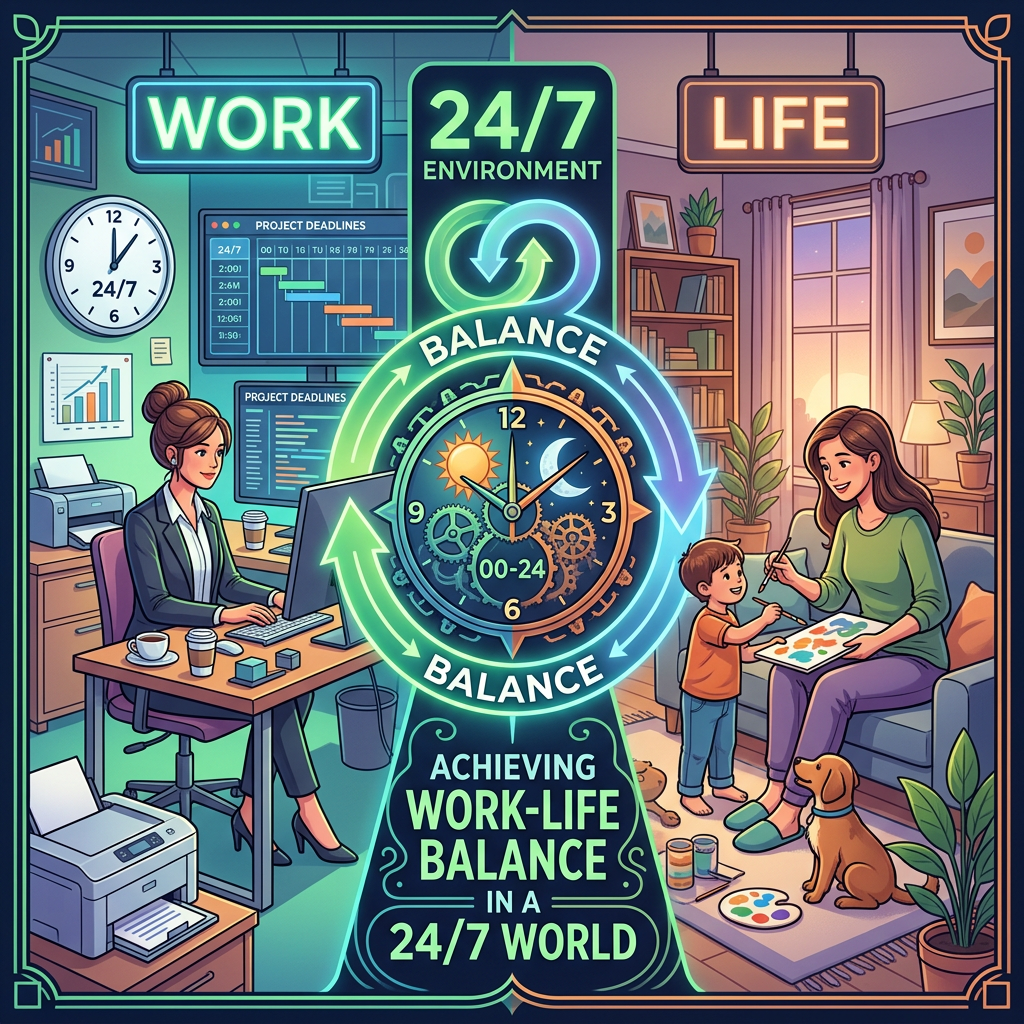
Globalization has changed the rhythm of work. Employees may now deal with coworkers, suppliers, clients, and managers across different time zones. Add a 24/7 operating environment, remote work, rotating shifts, digital platforms, and global supply chains, and the old idea of “leaving work at the office” becomes harder to maintain.
But harder does not mean impossible. And it certainly does not mean employers should treat every employee as permanently available.
The Quote That Started the Question
Our course text, Canadian Organizational Behaviour by McShane and Warner, discusses work-life integration as the extent to which people are effectively engaged in their work and non-work roles while experiencing a low degree of role conflict across life domains.
That distinction matters. Work-life integration should mean that a person can function well across multiple roles. It should not mean that work gets to invade every other role whenever management finds it convenient.
The textbook also refers to Lisa Sterling’s statement that there is “no such thing as work-life balance.” Sterling argues that work and life need to be integrated rather than treated as completely separate compartments.
I understand the argument. Life is not a perfect scale. People are not machines who shut off one identity and activate another. A worker may also be a parent, spouse, caregiver, student, friend, volunteer, homeowner, patient, neighbour, or community member. These roles overlap. They affect one another.
But there is a danger in the language of “integration.” In the wrong hands, integration becomes a polite word for boundary collapse.
Integration Is Not the Same as Availability
From an organizational behaviour perspective, work-life integration can be healthy when it gives employees flexibility, autonomy, and realistic control over their time. For example, an employee may adjust their workday to attend an appointment, care for a child, take a course, or manage personal responsibilities while still meeting work expectations.
That kind of integration can reduce conflict between life domains.
But integration becomes unhealthy when it means the employer expects access to the employee at all hours. If the phone is always on, the email is always expected to be checked, and the employee feels pressure to respond during evenings, weekends, holidays, sick days, or family time, that is not integration. That is work expanding into every available space.
In that case, the organization has not solved work-life conflict. It has transferred the conflict onto the employee.
Where This Fits With Norms and Values
In organizational behaviour, values are the beliefs an organization claims to hold. Norms are the informal rules about how people are actually expected to behave.
An organization may claim to value wellness, family, flexibility, mental health, and respect. Those are stated values.
But the real norm may be something different:
- Answer emails after hours.
- Pick up the phone when the boss calls.
- Be available even when you are not scheduled.
- Treat silence as lack of commitment.
- Prove loyalty by sacrificing personal time.
- Do not complain, because “this is just how the industry works.”
That is where the real culture shows itself.
The important question is not only, “What does the company say it values?”
The better question is, “What behaviour gets rewarded, punished, tolerated, or quietly expected?”
If employees are praised for responding at midnight, if managers send non-urgent messages on weekends, if people who maintain boundaries are seen as less committed, then the organization’s real value is not balance, wellness, or integration. The real value is availability.
The Right to Disconnect
This is where the textbook feels somewhat out of date. The discussion of work-life integration cannot be separated from the right to disconnect, especially in Ontario.
Ontario’s Employment Standards Act requires employers with 25 or more employees in Ontario on January 1 of a given year to have a written policy on disconnecting from work before March 1 of that year.
Ontario defines “disconnecting from work” as not engaging in work-related communications, including emails, phone calls, video calls, or other messages, so that the employee is free from the performance of work.
However, this needs to be stated carefully: Ontario’s legislation requires a written policy, but it does not automatically create a broad new individual right for every employee to refuse all after-hours communication in every circumstance. The policy requirement is useful, but limited.
That makes Ontario’s right-to-disconnect framework important. It forces the issue into writing. It makes the employer define expectations. But it does not automatically solve the deeper cultural problem.
And that brings us back to norms and values.
The Policy Is Formal. The Norm Is Cultural
A company can comply with the law by having a written disconnecting-from-work policy. But the policy alone does not tell us whether employees actually feel free to disconnect.
The real test is cultural:
- Do managers model disconnection themselves?
- Are after-hours messages clearly marked as urgent or non-urgent?
- Are employees punished socially for not replying outside work hours?
- Are schedules designed realistically?
- Are staffing levels adequate?
- Are global time-zone demands shared fairly, or dumped onto the same people repeatedly?
- Does the organization distinguish between emergencies and poor planning?
This is where organizational behaviour becomes practical. A written policy is structure. But norms are lived behaviour. If the written policy says one thing and the manager’s behaviour says another, employees will usually follow the manager’s behaviour. People respond to consequences.
Globalization Is a Real Challenge, But Not a Free Pass
Globalization does create legitimate coordination problems. If a supplier is in Asia, a client is in Europe, a manager is in Ontario, and a support team is in another province, someone may occasionally need to work outside the traditional 9-to-5 window.
But that should be designed into the work. It should not be hidden inside vague expectations.
A healthy organization can deal with global time zones by using:
- rotating on-call schedules;
- clear escalation rules;
- time-zone-aware meeting practices;
- delayed-send email norms;
- compensated standby or overtime where applicable;
- defined emergency channels;
- realistic staffing models;
- manager training on boundaries.
The problem is not that global work exists. The problem is when global work becomes an excuse to erase the boundary between paid labour and personal life.
Role Conflict and Boundary Management
The phrase “work-life integration” only makes sense if it reduces role conflict. If it increases role conflict, then the organization is using the language incorrectly.
Role conflict happens when the demands of one role interfere with the demands of another. For example:
- The employee is expected to answer work messages while caring for a child.
- The employee is contacted during sleep time after a shift.
- The employee is pressured to respond while sick.
- The employee is expected to solve work problems during family time.
- The employee’s personal recovery time is treated as less important than operational convenience.
In those examples, the issue is not poor employee attitude. The issue is competing role demands.
Good organizational behaviour should not simply ask, “How can the employee be more resilient?”
It should also ask, “How is the organization creating the conflict?”
My Position
I do not reject work-life integration entirely. There are cases where integration is realistic and even beneficial. Flexibility can help people manage real lives. Remote work, flexible scheduling, and autonomy can reduce stress when they are handled properly.
But I do reject the idea that work-life integration should replace boundaries.
Separation still matters. People need time when they are not performing, not monitoring, not anticipating, not managing impressions, and not waiting for the next message. Rest is not wasted time. Off time is not a loophole. A person’s non-work life is not spare capacity waiting to be claimed by the employer.
From an organizational behaviour perspective, the right to disconnect belongs directly inside the discussion of norms and values. It asks a simple but uncomfortable question:
Does this organization actually respect employees as whole people, or does it only respect them when they are useful?
Conclusion
Work-life integration can be a useful concept when it means reducing conflict between life roles and giving employees more control. But it becomes dangerous when it is used to normalize permanent availability.
The right to disconnect pushes back against that drift. Even where the law is limited, the concept matters. It forces organizations to confront the difference between formal values and lived norms.
An employer may say it values wellness. But if the real expectation is 24/7 responsiveness, then the real value is not wellness. It is access.
And access is not the same thing as commitment.
Healthy organizations should not need employees to disappear from their own lives in order to prove they care about their work.
Suggested Course Connection
This reflection connects to organizational culture, norms and values, role conflict, psychological contracts, globalization, employee well-being, and boundary management.
References
Ontario Ministry of Labour, Immigration, Training and Skills Development. Your Guide to the Employment Standards Act: Written Policy on Disconnecting from Work.
Ontario Ministry of Labour, Immigration, Training and Skills Development. Employment Standards Act Policy and Interpretation Manual: Written Policy on Disconnecting from Work.
HR Dive. Work-Life Balance? “There’s No Such Thing.”
Discover more from Standing on the Ledge
Subscribe to get the latest posts sent to your email.

