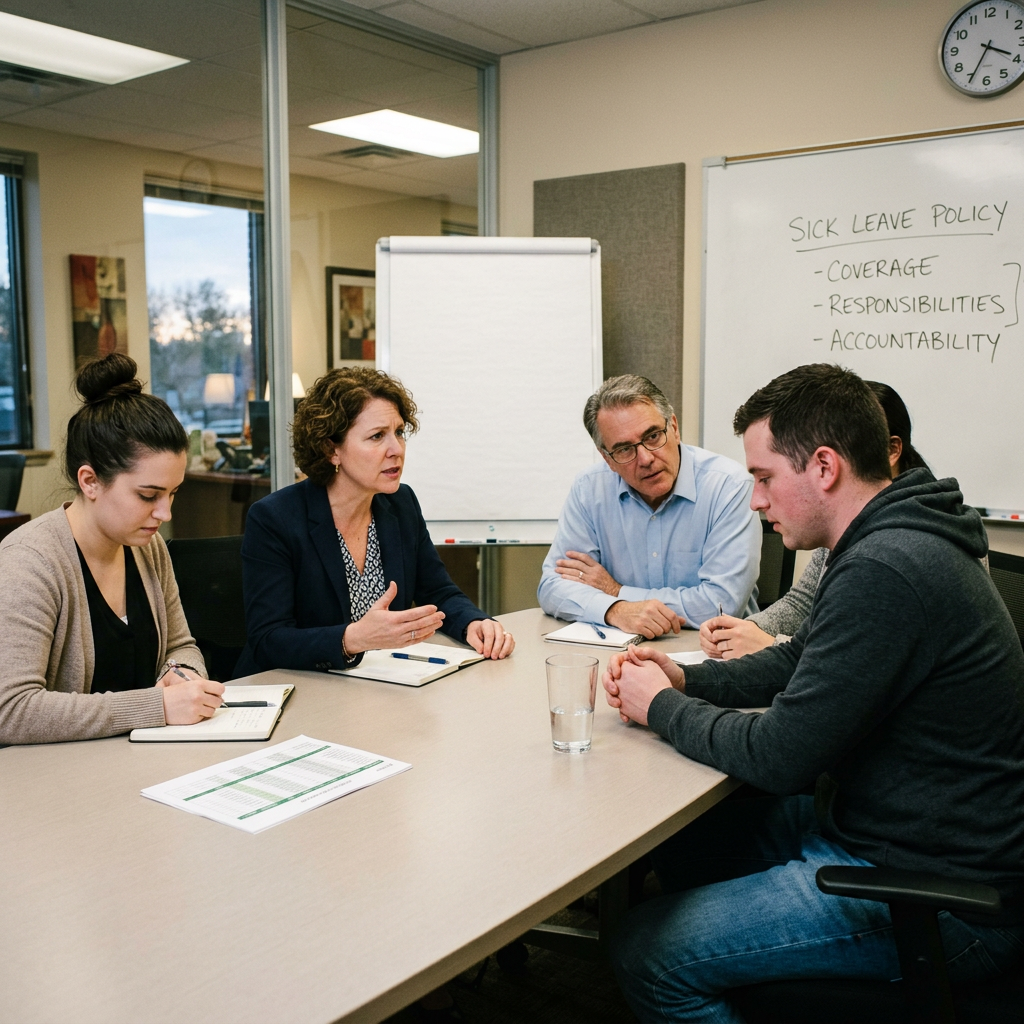

I am not going to reproduce the private conversation here, because the point is not to put another person on trial.
But the pattern matters.
I notified someone that I was sick and would not make it in. I apologized. The response was not just frustration about the impact. The response carried a moral charge: that being sick, being late, or calling off close to the shift was not only inconvenient, but somehow dirty, selfish, or proof of poor character.
That is the part worth examining.
Because there is a difference between saying:
“This created a real problem for me tonight.”
and saying:
“Your illness proves something bad about you.”
The first names impact.
The second turns impact into indictment.
That distinction matters in Organizational Behaviour.
One of the early definitions in the course is that organizational behaviour is the study of what people think, feel, and do in and around organizations. This situation fits that definition almost too neatly. Someone got sick. A shift was disrupted. Another person felt abandoned. Frustration came out sideways. A workplace coverage issue became a moral judgment.
That is not just a personal conflict. That is organizational behaviour happening in real time.
Roles, Norms, and Values Under Pressure
Workplaces run on roles, norms, and values.
The role says: show up for the shift.
The norm says: do not leave your coworker alone with the whole workload.
The value underneath that norm might be loyalty, reliability, fairness, or mutual support.
Those are not bad things. In fact, workplaces need them. People need to know they can count on one another. Coverage matters. Communication matters. When one person is absent, the impact lands on someone else.
But there is another value that has to sit beside reliability:
People are human.
That means people get sick. Bodies fail. Energy runs out. Symptoms get worse. Sometimes a person thinks they can push through and then realizes they cannot.
If the only value in the workplace is “show up no matter what,” then sickness becomes a character flaw.
If the only norm is “never leave anyone short,” then the sick person becomes guilty simply for having a body.
That is where a useful workplace value can become distorted.
Human Capital Still Has Limits
The textbook also talks about human capital: the knowledge, skills, abilities, creative thinking, and other resources employees bring to an organization.
That language is useful, but it can also become dangerously clean.
Human capital still has a body.
Human capital gets sick.
Human capital has headaches, fatigue, stress, immune systems, stomach problems, bad sleep, and breaking points.
When organizations talk about people as resources, they can forget that those resources are living people. They are not machines. They are not endlessly available units of labour. They are human beings trying to function inside systems of expectation, pressure, time, money, and consequence.
A sick worker is not automatically an unreliable worker.
A late call-in is not automatically a betrayal.
A body failing under load is not the same thing as a person choosing to abandon responsibility.
Impact Is Real, But So Is Attribution
This is where the psychological side of Organizational Behaviour comes in.
When something goes wrong, people often look for someone to blame. That is understandable. Pressure wants a target.
If someone is left alone with a muddy building to clean, the impact is real. The frustration is real. The extra work is real.
But impact and intention are not the same thing.
There is a difference between:
“Your absence created a problem for me.”
and:
“You chose to do something dirty to me.”
The first statement describes impact.
The second assigns motive.
That leap matters.
In Organizational Behaviour terms, this is where conflict can escalate. A practical problem becomes personal. A coverage issue becomes a character judgment. Instead of asking, “How do we handle the work?” the conversation becomes, “What kind of person are you?”
That shift does not solve the problem.
It usually makes the system more brittle.
The Multiple Levels Problem
The course also talks about multiple levels of analysis. In plain language, that means you cannot always understand a workplace problem by looking only at one person.
There is the individual level: I was sick. I did not make it in. I apologized.
There is the interpersonal level: another person felt left alone, frustrated, and unsupported.
There is the team level: coverage was thin enough that one absence created a serious burden.
There is the organizational level: the company may not have had enough backup, communication structure, or contingency planning in place.
There is the stakeholder level: the client still expects the building cleaned, the company still has a contract to protect, and the workers are caught in the pressure between service expectations and human limits.
That is why reducing the whole situation to “one person did something dirty” is too simple.
It may feel emotionally satisfying in the moment, but it does not explain the system.
Accountability Without Shame
The useful lesson is not that nobody should be upset when a shift gets disrupted.
Of course disruption matters.
The useful lesson is that frustration still needs a clean channel.
Impact can be named without character assassination.
Accountability can be requested without shame.
Coverage problems can be solved without pretending sickness is a moral defect.
A cleaner response would sound something like this:
“This left me with a lot more work tonight. I understand you are sick, but I need more notice next time if possible so coverage can be arranged.”
That names the impact.
It asks for a better process.
It does not turn the person into the problem.
The Standing on the Ledge Lesson
For me, this comes back to one of the central lines in the work:
Accountability does not require infallibility.
I can own the fact that my absence had an impact.
I can own that earlier communication would have been better.
I can own that another person was left with more work than they expected.
But I do not have to accept the idea that being sick makes me dirty, selfish, or defective.
That is the difference between responsibility and shame.
Responsibility asks, “What happened, what was the impact, and what needs to change?”
Shame says, “This proves something bad about you.”
The first can build a better system.
The second just spreads pressure from one person to another.
And that, right there, is Organizational Behaviour in the wild.
Discover more from Standing on the Ledge
Subscribe to get the latest posts sent to your email.

