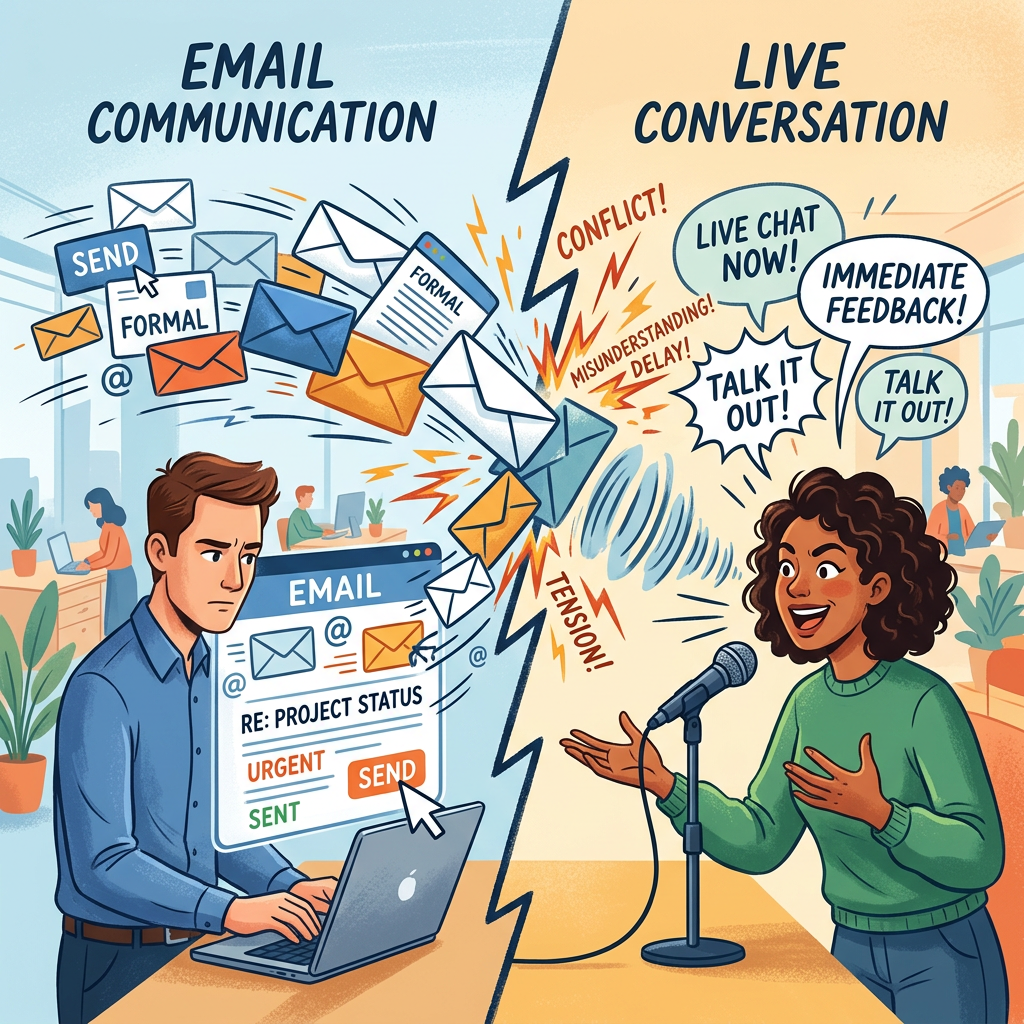

Reader’s Moment: You are angry, activated, or trying to fix something delicate, and the keyboard suddenly feels like a courtroom.
Why this matters: Because the wrong channel can turn a manageable issue into a cascade of projection, defensiveness, and escalation.
From the Ledge: I am not anti-email. I am anti-using email for jobs it is bad at. Some things need a record. Some things need a live conversation. Confusing those two creates a lot of avoidable damage.
Email strips away tone, pace, facial feedback, interruption, repair attempts, and the human signals that help a tense conversation stay human. That means the receiver has to guess more. Under stress, people guess badly.
That is how a short email becomes a referendum on respect. That is how silence becomes insult. That is how a message meant as efficient lands as hostile.
When email is usually the wrong tool
- When the issue is emotionally loaded
- When trust is already thin
- When motives are being assumed
- When identity, status, or fairness is in play
- When you can feel yourself trying to win instead of clarify
A better sequence
- Pause.
- Have the live conversation if it is safe and possible.
- Clarify what changed and what the next step is.
- Then confirm in writing.
The record still matters. But record and repair are not the same job. Use the live channel for repair and the written channel for confirmation. If you have to use writing because live conversation is unsafe, exploitative, or impossible, keep it short, factual, and structured. No speeches. No courtroom exhibits unless you are actually building one for a lawyer.
Tool
Use the channel that reduces volatility, not the channel that flatters the part of you that wants to build a case.
Godspeed
Discover more from Standing on the Ledge
Subscribe to get the latest posts sent to your email.
 Standing on the Ledge