The post reflects on the author's struggles as they navigate the termination of a business contract and their uncertainty about the future. Snowy weather amplifies a somber mood, filled with feelings of betrayal and disillusionment. The author seeks solace and hopes for guidance from a deceased friend while contemplating life's complexities.
Tag: writing
Lessons from a Sleepless Night: Contracts and Life Friction
Personal Log — 3:30 AM (I’ll post this later) It’s 3:30 in the morning as I start dictating this. I’m not posting it now—partly because I don’t want to be spammy, and partly because my brain is still running too hot to trust what comes out in real time. I can’t sleep. I’m yawning as … Continue reading Lessons from a Sleepless Night: Contracts and Life Friction
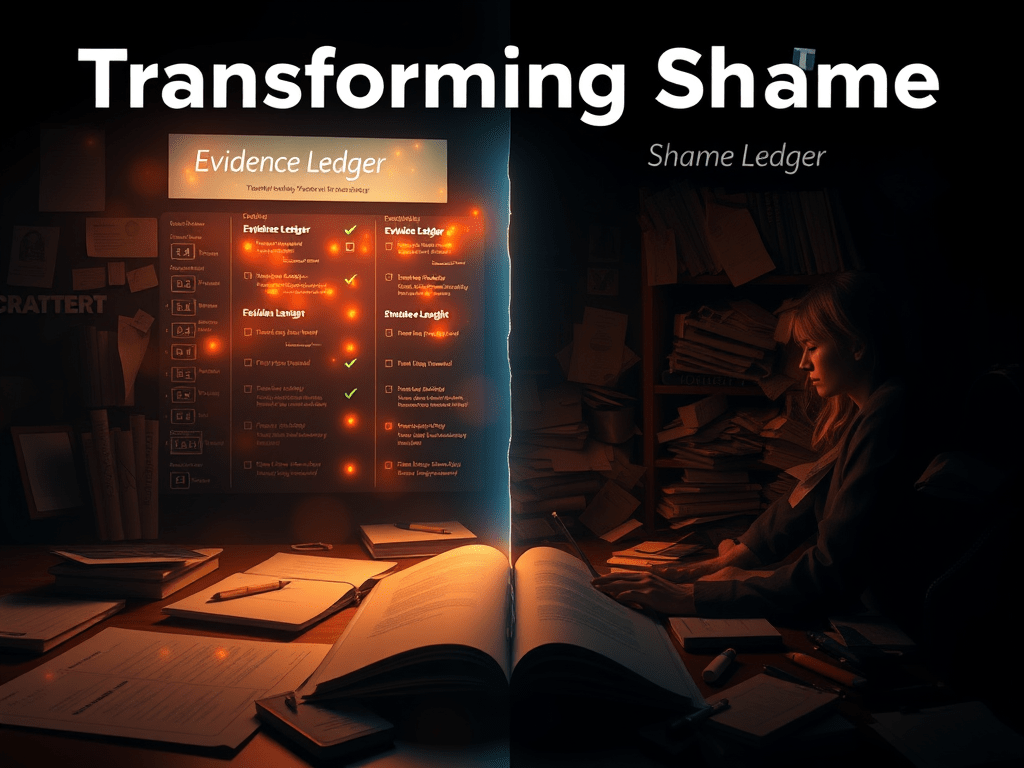
Transforming Shame: The Evidence Ledger Approach
The content explores the dichotomy between the Evidence Ledger, which documents measurable achievements, and the Shame Ledger, which focuses on self-identity and flaws. It emphasizes transforming shame into actionable evidence to foster self-worth, encouraging concrete actions for personal growth and emotional healing while proposing a structured approach to manage these internal narratives.
Navigating Emotional Work Challenges: A Log Entry
Personal Log — “Blech. What a day.” Standing on the Ledge — Rebuilding from the Rubble Today felt like one of those days where everything technically happens, but nothing lands. I’m still stuck in that 3–4 a.m. loop, and it’s starting to cost me. When I’m waking up late, the day doesn’t feel like it … Continue reading Navigating Emotional Work Challenges: A Log Entry
Three Effective Strategies to Manage Life’s Friction
The Friction Audit involves analyzing personal life for inefficiencies and distractions, much like an organizational audit. The author identifies three major friction triggers: morning fog, boundary violations, and communication noise. To combat these, they propose simple strategies like completing small tasks and setting clear boundaries to enhance productivity and reduce decision fatigue.
Navigating Change: A Month of Growth and Learning
One month after a significant work contract ended, the author reflects on personal growth amidst uncertainty. They emphasize learning from experiences, setting clear boundaries, and staying proactive in rebuilding their life. By focusing on writing and pursuing further education, they aim to navigate challenges while balancing progress with self-care.
Inventory Before Identity: A Guide to Rebuilding Confidence
Chapter 3 emphasizes the importance of conducting an inventory of personal assets after a crisis before defining one's identity. It encourages assessing skills, tools, and networks while identifying gaps. This inventory helps rebuild credibility and self-efficacy, transforming experiences into usable resources and guiding future actions effectively.
A Working Name for a Working Moment
The author reflects on their dual identity as Kevin McLaughlin, the legal name, and Lugh Sulian, the working name, which symbolizes a tool for truth. They share their journey from being unnoticed in the background to confronting systemic issues in business, ultimately documenting their experience of rebuilding after a collapse, aiming to support others facing similar struggles.
Job Hunting When Your World Just Collapsed (Notes From Both Sides of the Desk)
The content emphasizes practical job hunting strategies post-collapse, covering essential tips on applications, resumes, cover letters, and interviews. It highlights the importance of discernment during interviews, maintaining professionalism, and the significance of online presence. Ultimately, it underscores the need for honesty and strategic approaches in the job search process.
The Role of AI in Modern Work: A Personal Insight
The author reflects on the evolution of technology, particularly AI, in work and research. Although AI speeds up processes and aids in organizing information, it still requires human input and critical judgment. The author argues against banning AI in academia, emphasizing its utility as a tool rather than a replacement for original thought.